


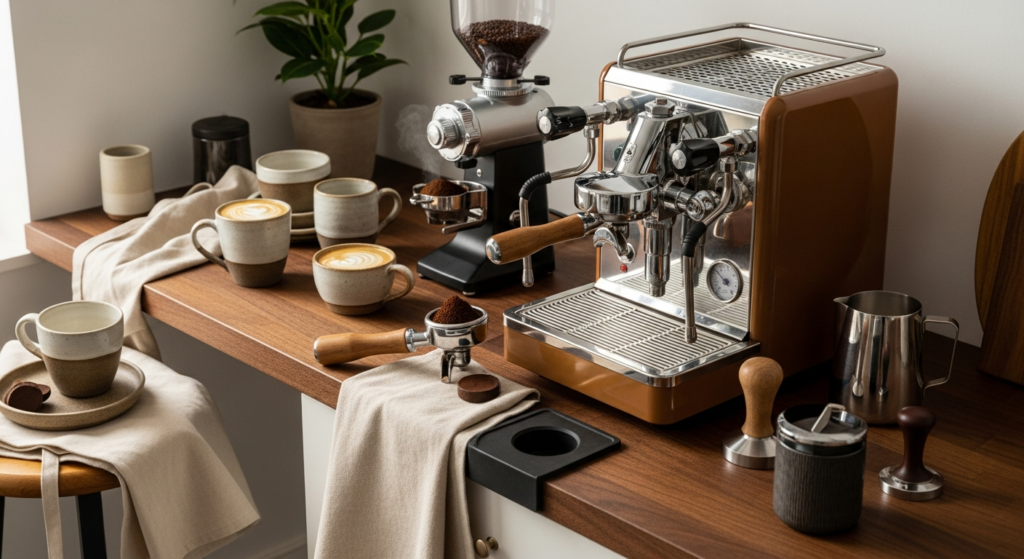
The Ultimate 2026 Guide to Barista Tools: Essential Home Setup Needs
The transition from a casual coffee drinker to a dedicated home barista is a journey of precision, chemistry, and sensory delight. In 2026, the landscape of home brewing has shifted from simple convenience to a pursuit of “god shots”—those perfect extractions that rival the best specialty cafes in Milan or Seattle. Building a home barista station is more than just buying a shiny machine; it is about assembling a toolkit that allows you to control the variables of temperature, pressure, and particle size. Whether you are starting with a modest budget or building a dream “prosumer” station, the tools you choose will define the quality of your morning ritual. This guide explores the essential barista tools for home setup needs, focusing on the equipment that bridges the gap between amateur brewing and professional craftsmanship. By understanding the “why” behind each tool, you can curate a setup that delivers consistent, cafe-quality espresso every single day.
1. The Foundation: Selecting a Grinder That Prioritizes Uniformity
Ask any professional barista what the most important tool in a home setup is, and they won’t say the espresso machine. They will say the grinder. In 2026, the focus has shifted entirely toward grind uniformity and low retention. When you grind coffee, you aren’t just breaking beans; you are creating a surface area for water to extract flavor. If your grind is inconsistent—containing both “fines” (tiny dust-like particles) and “boulders” (large chunks)—your coffee will be simultaneously bitter and sour.
For a serious home setup, a burr grinder is non-negotiable. Blade grinders chop beans unevenly, whereas burr grinders crush them between two abrasive surfaces. Within the world of burr grinders, you have two primary choices: conical and flat burrs. Conical burrs are often favored for their ability to produce a “bimodal” grind distribution, which adds body and texture to traditional espresso. Flat burrs, increasingly popular in 2026 for high-end home setups, offer a more unimodal distribution, highlighting the clarity and acidity of light-roast specialty coffees.
Another trend to consider for your 2026 setup is “single dosing.” Instead of keeping a pound of beans in a hopper where they oxidize and go stale, single-dose grinders allow you to weigh out exactly 18 or 20 grams, grind them, and have near-zero “retention” (coffee stuck inside the machine). This ensures every shot uses the freshest possible grounds.
2. Precision Puck Prep: WDT, Levelers, and Calibrated Tampers
The most common cause of “bad” espresso at home is channeling. Channeling occurs when high-pressure water finds a path of least resistance through the coffee puck, rushing through cracks rather than saturating the grounds evenly. To prevent this, your home barista toolkit must include dedicated “puck prep” tools.
The WDT (Weiss Distribution Technique) tool has become a staple of the modern home setup. This simple tool, consisting of several thin needles, is used to stir the grounds in the portafilter. It breaks up clumps caused by static and ensures the density of the coffee is uniform from top to bottom. Following the WDT, a distributor or leveling tool can be used to create a perfectly flat surface, though many 2026 purists argue that a proper WDT makes a leveler redundant.
Finally, the tamper is where you apply the physical pressure necessary to compress the puck. While the plastic tampers that come with many machines are better than nothing, a precision-fit, calibrated tamper is a game-changer. These tampers are designed to fit the exact diameter of your basket (e.g., 58.5mm instead of a standard 58mm) to eliminate “ring channeling” at the edges. Calibrated tampers also ensure you apply the same amount of pressure every time, removing one more variable from the extraction equation.
3. The Digital Scale: Why 0.1g Precision is Mandatory
In the world of specialty coffee, “eyeballing it” is the enemy of excellence. To achieve consistency, you must measure your inputs and outputs. A high-quality digital coffee scale with 0.1-gram precision is perhaps the most underrated barista tool for home setup needs.
Your scale allows you to follow a specific “recipe” or ratio. A standard starting point is a 1:2 ratio—for example, 18 grams of dry coffee grounds yielding 36 grams of liquid espresso in about 25 to 30 seconds. Without a scale, you cannot know if your shot was sour because the grind was too coarse or simply because you accidentally pulled 45 grams of liquid instead of 36.
Modern scales in 2026 often come with built-in timers and Bluetooth connectivity, allowing you to sync your brewing data to smartphone apps. This “smart brewing” approach helps you track your extractions over time, making it easier to “dial in” a new bag of beans. When choosing a scale, ensure it is water-resistant (accidents happen) and thin enough to fit on the drip tray of your espresso machine under a cup.
4. Milk Texturing Tools: Pitchers, Thermometers, and Microfoam
For many, the goal of a home barista setup is the perfect latte or flat white. This requires more than just hot milk; it requires “microfoam”—a silky, paint-like texture consisting of millions of microscopic bubbles. To achieve this, the ergonomics of your milk steaming pitcher are vital.
A high-quality stainless steel pitcher with a sharp spout is essential for pouring latte art. The shape of the pitcher affects how the milk “rolls” when hit by steam. A narrower bottom helps create the vortex necessary to integrate the air into the milk. In 2026, many home baristas are opting for Teflon-coated or ceramic-lined pitchers, which are easier to clean and provide a different thermal profile during the steaming process.
While experienced baristas can judge milk temperature by the feel of the pitcher against their palm, a clip-on digital thermometer is a great tool for beginners. Steaming milk past 150°F (65°C) begins to break down the natural sugars (lactose), resulting in a scorched, less sweet taste. Mastering the tools of milk texturing is what turns a standard coffee into a luxurious, cafe-style beverage.
5. Maintenance and Hygiene: Keeping the “Craft” in Your Coffee
A dirty espresso machine is the fastest way to ruin expensive coffee beans. Residual coffee oils turn rancid quickly, imparting a bitter, “ashy” flavor to your shots. Therefore, your barista tools home setup needs must include a comprehensive cleaning kit.
This kit should include a group head brush for scrubbing the gasket and shower screen, a blind basket for “backflushing” the machine with specialized detergent, and microfiber cloths for wiping down the steam wand. In 2026, there is a heightened focus on water quality, as mineral buildup (scale) is the leading cause of machine failure. Including a water filtration pitcher or specialized mineral packets (like Third Wave Water) in your setup will not only protect your investment but also significantly improve the flavor of your coffee.
Additionally, don’t overlook the “knock box.” This is a dedicated bin with a reinforced bar used to “knock” the spent coffee puck out of the portafilter. It keeps your workspace clean and prevents you from damaging your portafilter by banging it against a regular trash can.
6. Elevating the Workflow: Organization and Aesthetics
The final stage of building your 2026 home barista station is optimizing the workflow. A cluttered workspace leads to a frustrated barista. This is where accessories like tamping mats, portafilter stands, and tool organizers come into play.
A silicone tamping mat protects your countertops from scratches and provides a stable surface for applying pressure. If you are using a bottomless (naked) portafilter—a fantastic tool for diagnosing your extraction—a tamping stand can help keep it level. Tool organizers or “barista stations” are becoming increasingly popular for keeping WDT tools, brushes, and tampers in one dedicated spot.
Aesthetics also play a role. Whether you prefer a sleek, industrial stainless steel look or a warm, “hygge” vibe with wooden handles and leather accents, your tools should be a reflection of your personal style. When your setup is organized and visually appealing, the process of making coffee becomes a meditative experience rather than a chore.
—
FAQ: Frequently Asked Questions About Home Barista Tools
**Q1: Do I really need a WDT tool if my grinder doesn’t produce clumps?**
Even if your grinder appears to produce fluffy grounds, micro-clumps and uneven density are almost always present. A WDT tool is a low-cost, high-impact accessory that ensures the water travels through the coffee puck evenly. It is one of the most effective ways to improve shot consistency in a 2026 home setup.
**Q2: What is a “Bottomless Portafilter,” and do I need one?**
A bottomless portafilter has the bottom removed, exposing the filter basket. It doesn’t inherently change the flavor, but it is an essential diagnostic tool. It allows you to see if the espresso is flowing evenly or if it is “spraying” due to channeling. It is highly recommended for anyone serious about mastering their technique.
**Q3: Is it worth spending more on a grinder than the espresso machine?**
In many cases, yes. A $1,000 espresso machine with a $100 grinder will produce mediocre coffee. However, a $500 espresso machine paired with a $600 high-quality burr grinder will produce exceptional results. The grinder is the gatekeeper of flavor.
**Q4: How often should I clean my barista tools?**
The steam wand should be wiped and purged after every single use. The group head should be brushed daily. A full chemical backflush with espresso cleaner should typically be done once a week for domestic use, or every 20-30 shots.
**Q5: Can I use a regular kitchen scale for coffee?**
A regular kitchen scale usually measures in 1-gram increments, which is not precise enough for espresso. A 1-gram difference in coffee dose can drastically change the pressure and flow rate of a shot. You need a scale that measures to 0.1 grams.
—
Conclusion: Crafting Your Perfect 2026 Coffee Ritual
Building a home barista station is a rewarding endeavor that combines technical skill with artistic flair. By focusing on the essential barista tools for home setup needs—from the precision of a high-end burr grinder to the tiny needles of a WDT tool—you empower yourself to explore the vast world of specialty coffee from the comfort of your kitchen.
As we move through 2026, the technology available to home enthusiasts continues to blur the lines between professional and domestic brewing. However, the core principles remain the same: consistency, cleanliness, and control. You don’t need to buy every gadget on the market at once. Start with a great grinder and a precise scale, then slowly add tools that solve specific problems in your workflow. Over time, your home setup will become more than just a place to make caffeine; it will become a laboratory of flavor where every cup is a testament to your craft. Happy brewing!