


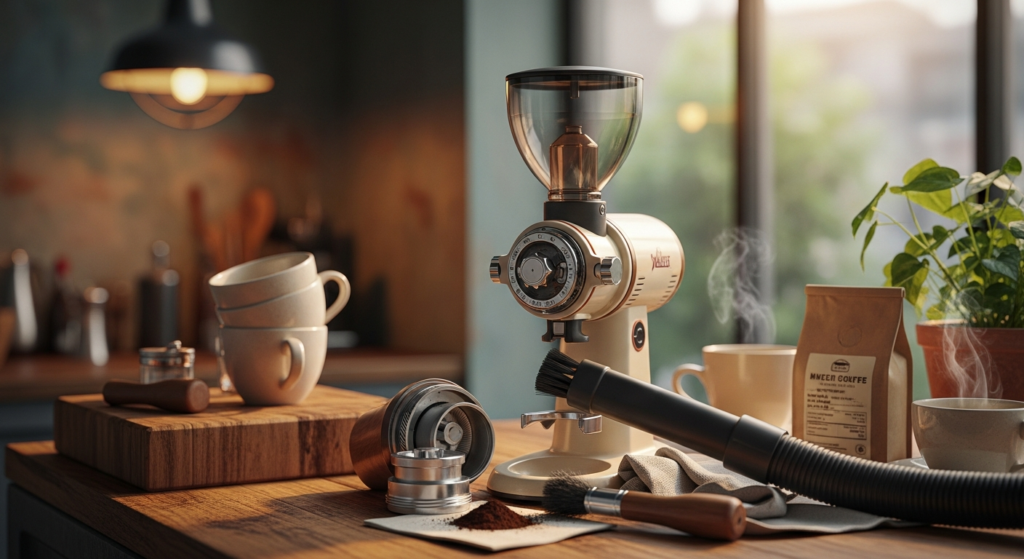
The Ultimate Burr Coffee Grinder Cleaning Guide: Maintenance for Peak Performance in 2026
For the dedicated home barista, the coffee grinder is the most critical piece of equipment in the kitchen. Even the most expensive, pressure-profiled espresso machine or the most delicate hand-poured Chemex cannot compensate for a poor-quality grind. However, there is a silent killer of flavor that many enthusiasts overlook: residual coffee oils and stale “fines” trapped within the burr chamber. As we look toward 2026, the standards for home brewing continue to rise, and maintaining your equipment is no longer optional—it is a foundational skill. A dirty grinder doesn’t just produce a messy workspace; it introduces rancid flavors, causes mechanical strain, and leads to inconsistent particle sizes that ruin your extraction. This comprehensive guide will walk you through everything you need to know about cleaning your burr coffee grinder, ensuring every cup you brew is as vibrant and clean as the roaster intended.
The Science of Stale Coffee: Why Cleaning is Non-Negotiable
To understand why cleaning is vital, we must look at the chemistry of the coffee bean. Coffee beans are packed with volatile oils (lipids). When these beans are crushed by your burrs, those oils are released. Over time, a thin film of oil coats the burrs, the grinding chamber, and the exit chute.
In the high-oxygen environment of your kitchen, these oils undergo oxidation. Within days, they turn rancid, developing a sour, metallic, or “fishy” odor. When you grind fresh, expensive specialty beans, they pass through this layer of rancid residue, picking up off-flavors. Furthermore, “fines”—microscopic coffee dust—get stuck in the crevices of the burrs and the threading of the adjustment collar. These fines eventually compress into a hard, “caked” layer that can cause your grinder to jam or lose its ability to hold a precise calibration. By 2026, as high-uniformity burr sets become the industry standard, even a tiny amount of buildup can throw off the micron-level precision required for a perfect light-roast espresso.
Essential Tools for the Home Barista’s Cleaning Kit
Before you begin, gather the right tools. Using the wrong equipment can actually damage your burrs or void your warranty.
1. **The Specialized Brush:** A dual-ended brush is ideal. One end should have stiff nylon bristles for scrubbing the burrs, while the other should have softer hair (like horsehair) for sweeping away loose dust.
2. **A Handheld Vacuum or Shop Vac:** This is the secret weapon of professional baristas. Brushing only moves dust around; a vacuum actually removes it from the chamber.
3. **Compressed Air or an Air Blower:** A simple rubber “rocket blower” (used for camera lenses) is perfect for clearing out the exit chute without introducing moisture.
4. **Microfiber Cloths:** Use these to wipe down the hopper and the exterior. They grab oils without leaving lint behind.
5. **Grinder Cleaning Pellets:** Products like Urnex Grindz are made from food-safe, grain-based binders that soak up oils as they pass through the burrs. These are excellent for “interim” cleaning between deep sessions.
6. **Isopropyl Alcohol (Optional):** Only for non-metal parts like the bean hopper, to strip away stubborn oily residue. Never use water on steel burrs.
Step-by-Step: Deep Cleaning Your Electric Burr Grinder
Deep cleaning should be performed every 2–4 weeks, depending on your usage and the darkness of your roast (darker roasts are oilier and require more frequent cleaning).
#
Step 1: Empty and Purge
Close the hopper slide (if applicable) and run the grinder until it is empty. This ensures no whole beans are caught in the “teeth” when you try to disassemble it. Unplug the machine—safety is paramount.
#
Step 2: Remove the Hopper
Take off the bean hopper. Wash it with warm, soapy water to remove the oily film. Dry it completely; even a single drop of water in the grinding chamber can cause rust on steel burrs.
#
Step 3: Access the Burrs
Most modern grinders have a removable top burr carrier. This usually involves rotating the adjustment collar to the coarsest setting until it unscrews, or releasing a locking pin. Take note of your current grind setting before doing this so you can return to it later.
#
Step 4: The Dry Scrub
Once the burrs are exposed, use your stiff brush to scrub the “v” shapes (the flutes) of both the stationary and the rotating burr. Use your vacuum simultaneously to suck up the dislodged particles. Pay close attention to the “sweeper arms” (the rotating parts that push coffee into the chute), as these often collect the most buildup.
#
Step 5: Clear the Exit Chute
Insert your brush or a pipe cleaner into the exit chute. Static often causes coffee to “clump” here. Use your air blower to puff air through the chamber and out the chute to clear any hidden blockages.
#
Step 6: Reassemble and Calibrate
Put the burr carrier back in place. Be extremely careful not to cross-thread the adjustment collar. Once assembled, “season” the grinder by grinding a small handful of beans (about 10g) and discarding them. This ensures any remaining cleaning dust is purged before you brew your first real cup.
Manual Grinders: A Specific Approach to Hand-Crank Maintenance
Manual or hand grinders have exploded in popularity heading into 2026 due to their portability and “zero-retention” designs. While they collect less waste than large electric grinders, they still require care.
Because manual grinders often use high-carbon steel burrs, moisture is your greatest enemy. Never soak the internal components of a Comandante, 1Zpresso, or Fellow hand grinder. Instead, disassemble the central shaft according to the manufacturer’s instructions. Manual grinders contain small washers, springs, and bearings—keep these organized in a small bowl.
Use a brush and a dry microfiber cloth to wipe down each component. For the bearings, do not use soap; if they feel “gritty,” they may need a drop of food-grade lubricant, though most modern bearings are sealed and should not be messed with. When reassembling, ensure the “click” mechanism is properly aligned so your grind settings remain accurate.
The 2026 Maintenance Schedule: Daily, Weekly, and Monthly
To maintain peak flavor profile and machine longevity, follow this tiered maintenance schedule:
* **Daily (The Purge):** Before your first brew of the day, “purge” about 1–2 grams of coffee. This clears out the “stale” grounds that sat in the chute overnight. Wipe the inside of the hopper with a dry cloth.
* **Weekly (The Surface Clean):** Use a vacuum to suck out the chute and the top of the burr chamber (without disassembly). If you use a bellows (single-dose style), give it several firm pumps to clear the “dead space.”
* **Monthly (The Deep Dive):** Perform the full disassembly described above. This is also a good time to inspect the burrs for signs of wear or chipping.
* **Quarterly (The Pellet Run):** Use cleaning pellets to strip away microscopic oil buildup that brushes can’t reach. This is especially important if you frequently switch between oily dark roasts and delicate light roasts.
Troubleshooting: When Cleaning Isn’t Enough
Sometimes, a simple cleaning won’t fix your issues. As we move through 2026, home baristas are pushing their equipment harder than ever. If you experience the following, it might be time for more than a brush:
1. **The “Walking” Grind Setting:** If your adjustment dial moves while grinding, it usually means the internal threads are coated in slick oil or the tension springs are worn. A deep clean with isopropyl alcohol on the *threads* (not the burrs) can help.
2. **Heat Buildup:** If your coffee feels hot to the touch after grinding, your burrs are likely dull. Dull burrs “smash” coffee rather than cutting it, creating friction and heat that destroys delicate aromatics.
3. **Inconsistent “Fines”:** If your V60 pour-over is taking 6 minutes to drain regardless of the grind setting, your burrs may be misaligned. After cleaning, check the alignment using the “whiteboard marker test” to ensure the burrs are perfectly parallel.
FAQ: Common Questions About Grinder Maintenance
**Q: Can I use uncooked rice to clean my grinder?**
**A:** No. This is a common “hack” that can destroy your motor. Rice (especially white rice) is significantly harder than coffee beans and can strain the motor or snap the drive shaft. Furthermore, rice contains starches that can gum up the internal components. Always use purpose-made cleaning pellets.
**Q: How often should I replace my burrs?**
**A:** Most high-quality steel burrs are rated for 500kg to 1,000kg of coffee. For the average home user grinding 30g a day, this could mean the burrs last 10–20 years. However, if you accidentally grind a “trampt stone” (a small rock found in low-quality beans), you may need to replace them immediately.
**Q: Why does my grinder have so much static after cleaning?**
**A:** Cleaning removes the thin layer of oil that actually helps dissipate static. This is normal. To fix this, use the RDT (Ross Droplet Technique)—add one tiny drop of water to your beans before grinding to neutralize the static charge.
**Q: Is it okay to use a vacuum on my grinder?**
**A:** Yes, it is highly recommended. A vacuum is the most effective way to remove coffee “fines” from the deep recesses of the motor housing and the adjustment threads without pushing them further in.
**Q: Should I clean my grinder more often if I use flavored coffee?**
**A:** Ideally, you should never put flavored coffee in a high-quality burr grinder. The syrups used are incredibly sticky and will ruin the burrs quickly. If you must use them, you should deep clean the grinder after every single use to prevent the artificial scents from ghosting your next batch of beans.
Conclusion: The Path to Better Brewing
In the world of specialty coffee, the difference between a mediocre cup and a transcendent one often comes down to the smallest details. As we embrace the innovations of 2026—from ultra-aligned flat burrs to high-torque manual grinders—the importance of hygiene remains the one constant.
Cleaning your burr coffee grinder is not just about maintenance; it is about respect for the craft and the product. By removing the ghosts of yesterday’s coffee, you allow the true terroir of your beans to shine. Whether you are chasing the perfect tiger-striped espresso or a crystalline pour-over, a clean grinder is your most important tool. Incorporate these habits into your routine, and your palate—and your equipment—will thank you for years to come.