


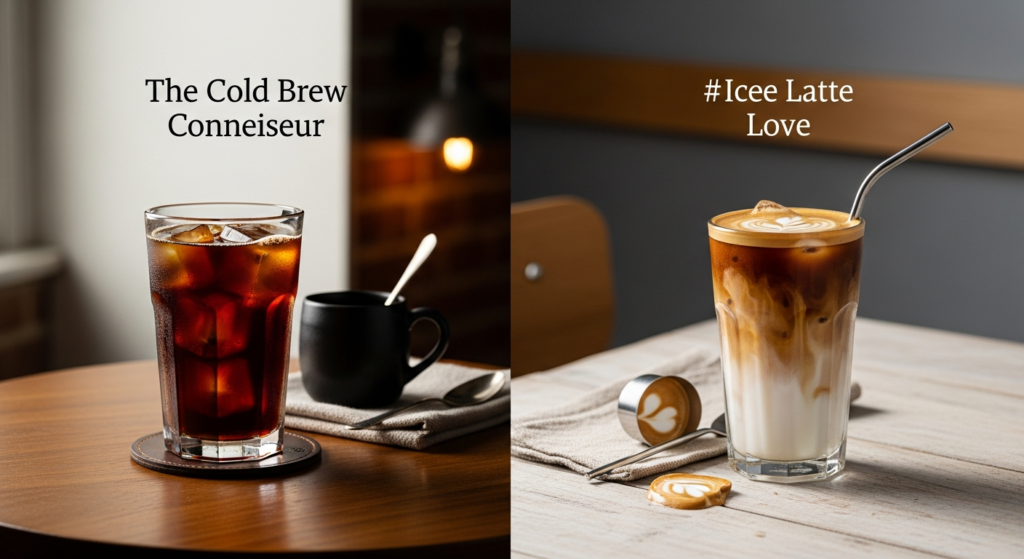
Cold Brew vs. Iced Latte: The Ultimate Guide for Coffee Lovers
As the mercury rises and the sun begins to bake the pavement, the ritual of the morning coffee undergoes a transformation. The steaming ceramic mug is traded for a condensation-speckled glass filled with ice. But as you stand before the menu of your favorite local café or look at the equipment on your home barista station, a fundamental question arises: **Cold Brew or Iced Latte?**
While both are cold, caffeinated, and refreshing, they are fundamentally different beverages. One is a product of time and patience, a slow-motion extraction that yields a syrup-like concentrate. The other is a marriage of high-pressure physics and dairy (or dairy alternatives), creating a creamy, layered indulgence. For the true coffee aficionado, choosing between them isn’t just about temperature—it’s about acidity, mouthfeel, caffeine delivery, and the nuances of the bean. In this definitive 2026 guide, we will break down the chemistry, the flavor profiles, and the brewing techniques behind these two icons to help you decide which deserves a permanent spot in your fridge.
1. The Science of Extraction: Time vs. Pressure
The primary distinction between cold brew and an iced latte lies in how the flavor is pulled from the coffee grounds. To understand the taste, you must understand the physics of the brew.
**Cold Brew: The Marathon**
Cold brew is unique because it never touches hot water. Instead of using heat to speed up the extraction of oils and solubles, it uses time. Coarsely ground beans are submerged in room temperature or chilled water for anywhere from 12 to 24 hours. Because the water is cold, the chemical reactions happen differently. The bitter compounds and acidic oils that are typically released by boiling water remain trapped inside the grounds. The result is a concentrate that is remarkably smooth, low in acidity, and naturally sweet.
**Iced Latte: The Sprint**
An iced latte is built upon a foundation of espresso. Espresso is brewed using high pressure (typically 9 bars) and hot water (around 200°F) to force water through finely-ground coffee in about 25 to 30 seconds. This rapid extraction pulls out the bright acids, the deep aromatic oils, and the intense flavors of the bean quickly. To make it “iced,” this hot shot of espresso is poured over cold milk and ice. The heat of the espresso is immediately tempered by the milk, creating a balanced, refreshing drink that retains the “bite” of traditional coffee.
2. Flavor Profiles: Smooth Complexity vs. Creamy Balance
If you were to taste these two side-by-side without any sugar or milk, the difference would be jarring.
**The Cold Brew Experience**
Cold brew is often described as “chocolatey,” “nutty,” and “mellow.” Because the cold water doesn’t extract the floral or citrusy acids as effectively, the darker, more foundational notes of the coffee bean take center stage. For home baristas, this makes cold brew the perfect candidate for medium-to-dark roast beans from South America or South Asia. It has a heavy, almost syrupy mouthfeel that coats the palate. Many drinkers find they don’t need to add sugar to cold brew because the lack of bitterness allows the natural sweetness of the bean to shine through.
**The Iced Latte Experience**
The flavor of an iced latte is defined by the interaction between the espresso and the milk. In a latte, the milk is the primary ingredient by volume. The espresso provides a “kick” of roasted flavor that cuts through the creaminess. Depending on the beans used, an iced latte can have notes of caramel, toasted malt, or even bright berries. However, because espresso is naturally more acidic than cold brew, the latte has a sharper profile. The milk acts as a buffer, mellowing the intensity of the espresso and providing a velvety, refreshing texture that cold brew lacks.
3. Caffeine Content: Which Packs More Punch?
There is a common misconception that cold brew is always the most caffeinated option on the menu. While often true, the reality depends entirely on the “brew ratio.”
Cold brew is typically made with a much higher coffee-to-water ratio than standard drip coffee—often 1:4 or 1:8. This creates a potent concentrate. If you drink that concentrate straight, you are consuming a massive amount of caffeine (sometimes upwards of 200-300mg per cup). However, most people dilute cold brew with water or milk. Even when diluted, cold brew generally remains higher in caffeine than an iced latte because the long steeping time maximizes caffeine extraction.
An iced latte, conversely, has a very predictable caffeine count. Most “medium” or “large” iced lattes contain two shots of espresso. Depending on the blend, two shots of espresso typically contain between 120mg and 150mg of caffeine. If you are looking for a steady, controlled energy boost, the iced latte is the way to go. If you need a high-octane “jolt” to power through a 2026 workday, a glass of cold brew is your best bet.
4. The Home Barista’s Guide: Equipment and Effort
One of the reasons cold brew has exploded in popularity among home baristas is its accessibility. You don’t need an expensive machine to make a world-class cold brew.
**Making Cold Brew at Home**
All you need is a large jar (or a French Press), a way to filter the grounds (like a cheesecloth or a paper filter), and coffee. You simply mix the grounds and water, let it sit on your counter or in your fridge for 18 hours, and filter. It is “set and forget” coffee. In 2026, many enthusiasts are using dedicated cold brew systems that allow for “nitro” infusion at home, adding a creamy, Guinness-like head to the coffee without any dairy.
**Making an Iced Latte at Home**
The iced latte requires more specialized equipment. To get a true latte, you need an espresso machine capable of generating enough pressure to create *crema*. While you can use a Moka pot or an Aeropress to create a “concentrated coffee” that mimics espresso, purists will argue it isn’t a true latte. You also need to consider the ice—since you are pouring hot liquid over it, you need high-quality, dense ice cubes that won’t melt instantly and water down your drink. The iced latte is for the barista who enjoys the craft of the pull and the immediate gratification of a freshly made beverage.
5. Health, Nutrition, and Digestion
For those with sensitive stomachs or specific dietary goals, the choice between these two drinks is often decided by biology rather than taste.
**Acidity and the Gut**
Cold brew is the undisputed king for coffee lovers with acid reflux or sensitive stomachs. Studies have shown that cold brew is roughly 60-70% less acidic than hot-brewed coffee (including the espresso used in lattes). By avoiding the high-temperature extraction that releases volatile acids, cold brew is much gentler on the digestive system.
**Caloric Density**
If you are watching your caloric intake, cold brew is the winner. A black cold brew contains roughly 5 calories. Because it is naturally sweet and smooth, many drinkers find they don’t need to add cream or sugar.
An iced latte, however, is a milk-based drink. A standard 16oz iced latte made with whole milk can range from 120 to 200 calories before any syrups are added. While the rise of oat, almond, and soy milks has provided lower-calorie alternatives, the latte will always be the heavier, more caloric option. However, for those looking for a “snack” in their coffee—providing protein and fats to keep them full—the iced latte serves that purpose beautifully.
6. Customization Trends in 2026
As we look toward the coffee trends of 2026, both drinks are seeing incredible innovations. The line between them is beginning to blur with the advent of “Cold Foam.”
**Cold Brew Trends:** We are seeing an increase in “Botanical Cold Brews,” where herbs like rosemary, lavender, or even hibiscus are steeped alongside the coffee grounds. Additionally, “Flash Chilled” coffee (brewing hot directly onto ice to lock in aromatics) is competing with traditional cold brew for those who want the acidity of a hot cup but the temperature of a cold one.
**Iced Latte Trends:** The “Deconstructed Latte” and “Plant-Base Layering” are taking over. Baristas are using high-fat cashew or macadamia milks to create a dessert-like experience. We are also seeing the “Saline Trend,” where a tiny pinch of sea salt is added to the espresso shot to cut bitterness and enhance the perception of sweetness in the milk, creating a salted-caramel effect without the sugar.
—
FAQ: Common Questions for the Cold Coffee Enthusiast
**Q1: Can I use regular pre-ground coffee for cold brew?**
While you *can*, it is not recommended. Pre-ground coffee is usually a “medium” grind meant for drip machines. For cold brew, you need a “coarse” grind (resembling sea salt). Using fine grounds will make the coffee over-extracted, bitter, and very difficult to filter, resulting in a muddy texture.
**Q2: Which one is better if I like to add syrups?**
The iced latte is generally the better canvas for syrups. The fats in the milk help to carry the flavors of vanilla, caramel, or mocha and distribute them evenly. Cold brew’s flavor is so distinct and “earthy” that some syrups can clash with it, though simple syrup or maple syrup work quite well.
**Q3: How long does cold brew stay fresh in the fridge?**
One of the best perks of cold brew is its shelf life. A cold brew concentrate can stay fresh in an airtight container for 7 to 10 days. An iced latte, however, must be consumed within 20-30 minutes, as the ice melts and the espresso “dies,” losing its aromatic complexity.
**Q4: Is an Iced Americano the same as Cold Brew?**
No. An Iced Americano is espresso diluted with cold water and ice. It has the high acidity and crispness of espresso. Cold brew is never heated and has a much smoother, heavier profile.
**Q5: Why is cold brew usually more expensive at coffee shops?**
Cold brew requires a much higher volume of coffee beans per ounce of water compared to espresso or drip coffee. Additionally, the 18-hour brewing process takes up physical space in the café and requires more labor for filtration, justifying the higher price tag.
—
Conclusion: Finding Your Cold Coffee Soulmate
In the battle of **Cold Brew vs. Iced Latte**, there is no objective winner—only the winner for your specific palate and lifestyle.
If you value **convenience, high caffeine, and a smooth, stomach-friendly profile**, cold brew is your champion. It is the ultimate “utility” coffee—batch-brewed on a Sunday and ready to pour throughout a busy week. It is a drink of depth, darkness, and effortless sweetness.
If you value **texture, the art of espresso, and a creamy, indulgent experience**, the iced latte is your go-to. It is a sophisticated beverage that balances the intensity of a hot-extracted shot with the cooling comfort of milk. It is a drink of layers, aesthetics, and immediate refreshment.
As we move through 2026, the world of cold coffee continues to expand. Whether you are a home barista experimenting with coarse grinds in a mason jar or a connoisseur seeking out the perfect oat milk latte at a high-end espresso bar, the choice between these two reflects the beautiful diversity of the coffee bean. Next time you’re faced with the choice, ask yourself: do I want the smooth strength of time, or the creamy intensity of pressure? Either way, as long as it’s cold and the beans are fresh, you can’t go wrong.