


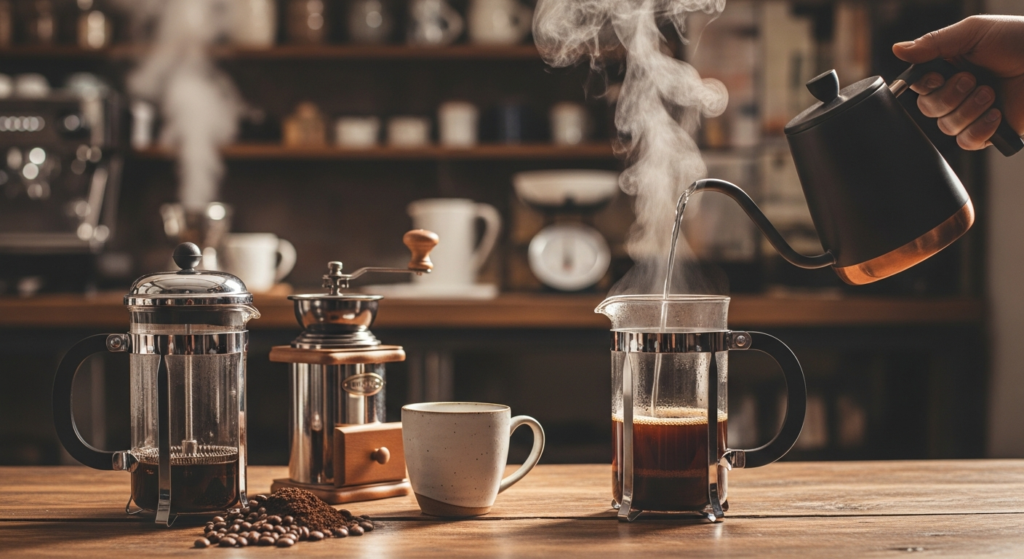
The Ultimate French Press Brewing Guide for Beginners: Master the Art of Immersion Coffee
There is something undeniably romantic and tactile about the French press. While modern coffee culture often chases the latest high-tech gadgets, the French press remains a steadfast icon of intentional brewing. In 2026, as home baristas lean further into the “slow coffee” movement, this classic immersion brewer is reclaiming its throne as the preferred method for those who value body, texture, and depth. Unlike paper-filtered methods that strip away essential oils, the French press—also known as a cafetière or plunger pot—allows the coffee’s natural character to shine through in every heavy, velvety sip.
Whether you are a newcomer looking to upgrade your morning caffeine routine or a seasoned coffee lover refining your technique, this guide is designed to demystify the process. Mastering the French press isn’t just about pushing a plunger; it’s about understanding the delicate dance between time, temperature, and grind size. Let’s dive into everything you need to know to brew a café-quality cup in the comfort of your own kitchen.
1. Why the French Press? Understanding the Immersion Advantage
To truly appreciate the French press, one must understand the difference between infusion (pour-over) and immersion (French press) brewing. In a pour-over, water passes through a bed of coffee grounds and a paper filter. This results in a bright, clean cup but often sacrifices the heavier mouthfeel.
The French press utilizes full immersion. This means the coffee grounds sit in the water for the entire brewing duration. Because the filter is a stainless-steel mesh rather than paper, the aromatic oils and fine sediment (the “fines”) are not filtered out. This results in a cup with a rich, robust body and a complex flavor profile that other methods simply cannot replicate.
Furthermore, the French press is remarkably forgiving. While a pour-over requires a steady hand and a gooseneck kettle for precise pouring, the French press is largely a “set it and forget it” method. This makes it the ideal starting point for beginners who want professional results without an intimidating learning curve. It is a reliable, durable, and sustainable way to enjoy specialty coffee.
2. Essential Equipment: Building Your Home Brew Station
To achieve consistency—the hallmark of a great home barista—you need more than just the press itself. While you can “eyeball” the measurements, a few key tools will elevate your coffee from mediocre to exceptional.
* **The French Press:** Most are made of borosilicate glass, though stainless steel vacuum-insulated models are popular for those who want to keep their coffee hot for longer.
* **A Burr Grinder:** This is the most important investment you can make. Blade grinders produce inconsistent shards; a burr grinder ensures a uniform coarse grind, which is vital for even extraction.
* **Digital Scale:** Coffee is a recipe. Measuring by weight (grams) rather than volume (spoons) ensures that your coffee-to-water ratio is perfect every single time.
* **Kettle:** While a gooseneck isn’t strictly necessary for French press, a kettle with a thermometer or a variable temperature setting is a game-changer.
* **High-Quality Beans:** Look for beans roasted within the last two to four weeks. For the French press, medium to dark roasts often perform best, as the immersion method highlights their chocolatey, nutty, and caramelized notes.
In 2026, the trend in home brewing is “precision simplicity.” You don’t need a lab full of equipment, but the right tools make the ritual more enjoyable and the results far more predictable.
3. The Golden Ratio and the Perfect Grind
The two biggest variables in French press brewing are the ratio of coffee to water and the size of the coffee particles.
#
The Ratio
For a standard, well-balanced cup, the “Golden Ratio” is generally **1:15**. This means for every 1 gram of coffee, you use 15 grams of water.
* **Example:** For a standard 500ml (approx. 17oz) brew, you would use roughly 33 grams of coffee.
* If you prefer a bolder, more intense cup, you can try a **1:14** ratio.
* For a lighter, more tea-like body, a **1:16** or **1:17** ratio works well.
#
The Grind
The French press requires a **coarse grind**. It should resemble sea salt or cracked black pepper.
* **Why coarse?** Because the coffee sits in the water for a long time (4–8 minutes), a fine grind would over-extract, leading to a bitter, astringent taste.
* Additionally, the mesh filter of a French press is designed to stop coarse grounds. If the grind is too fine, it will clog the filter, making it difficult to press and resulting in a “muddy” cup full of grit.
4. Step-by-Step Brewing Guide: The “2026 Technique”
While the traditional method involves a 4-minute steep and an immediate plunge, many modern enthusiasts prefer a modified technique that yields a much cleaner cup. Here is the definitive step-by-step guide.
#
Step 1: Preheat Your Press
Rinse your French press with hot water. This warms the vessel so the brewing temperature doesn’t drop the moment you start. Discard the rinse water before adding your coffee.
#
Step 2: Measure and Grind
Weigh out 30–35 grams of fresh coffee beans and grind them to a coarse consistency. Add them to the bottom of the press.
#
Step 3: The Bloom
Start your timer and pour about twice the weight of the coffee in hot water (around 200°F or 93°C). For 30g of coffee, pour 60g of water. Gently stir to ensure all grounds are saturated. Let this sit for 30 seconds. This allows CO2 to escape (the “bloom”), ensuring better water penetration later.
#
Step 4: The Main Pour
Pour the remaining water until you reach your target weight (e.g., 450g or 500g). Place the lid on top to retain heat, but **do not press yet**.
#
Step 5: The Steep and the “Break”
At the 4-minute mark, remove the lid. You will see a “crust” of coffee grounds floating at the top. Use a spoon to gently stir the surface; the grounds will sink to the bottom. For a cleaner cup, use two spoons to scoop out any remaining foam or floating bits.
#
Step 6: The Final Wait
This is the secret to a great French press. Instead of plunging immediately, wait another 3 to 5 minutes. This allows the fine sediment to settle at the bottom, resulting in a much smoother mouthfeel.
#
Step 7: The Plunge and Serve
Slowly lower the plunger until it sits just above the coffee bed. Do not apply force. Pour the coffee immediately into your mug or a separate carafe. If you leave the coffee in the press, it will continue to extract and become bitter.
5. Troubleshooting Common Mistakes
Even the simplest methods can go wrong. If your coffee doesn’t taste quite right, consider these common culprits:
* **The Coffee is Bitter:** This usually means you have over-extracted. Try a slightly coarser grind or reduce the water temperature. Using boiling water (212°F) can sometimes “scorch” the delicate compounds in the beans.
* **The Coffee is Sour or Thin:** This is a sign of under-extraction. Ensure your water is hot enough (at least 195°F) or let the coffee steep for an extra minute. Check that your grind isn’t *too* coarse.
* **The Plunger is Hard to Push:** Stop! If you feel significant resistance, the grind is likely too fine. Forcing the plunger can lead to a “coffee explosion” or a broken carafe.
* **The Coffee is Gritty:** While some sediment is normal, excessive grit usually comes from a poor-quality blade grinder or plunging too fast. Let the coffee settle longer before pouring.
6. Maintenance: Keeping Your Press in Peak Condition
A French press can last a lifetime if cared for properly. The most common mistake beginners make is a quick rinse with water. Over time, coffee oils build up in the mesh filter and the crevices of the plunger, turning rancid and ruining future brews.
After every use, disassemble the plunger assembly. Most French presses allow you to unscrew the mesh screen, the spring disk, and the top plate. Wash these with warm, soapy water. If you notice a “ghost” of old coffee smell, soak the metal parts in a mixture of water and vinegar or a dedicated coffee equipment cleaner.
For the glass carafe, be mindful of “thermal shock.” Never pour ice-cold water into a hot carafe, as it can cause the glass to crack. In 2026, many manufacturers are using reinforced borosilicate, but it’s still best to handle your equipment with care.
FAQ: Frequently Asked Questions
#
1. What is the best coffee roast for a French press?
While you can use any roast, medium to dark roasts are traditionally favored. The immersion process brings out the oils and sugars that characterize these roasts. However, if you enjoy a “funky” or fruity coffee, a light-roasted Ethiopian bean can be fascinating in a French press, though it may require a slightly finer grind than usual.
#
2. Can I use pre-ground coffee in a French press?
You can, but it is not recommended. Most pre-ground coffee found in grocery stores is “drip grind,” which is too fine for a French press. This leads to over-extraction and a muddy cup. If you must use pre-ground, look for bags specifically labeled “coarse grind” or “French press grind.”
#
3. How long should I actually let the coffee steep?
The total time—from the first pour to the final pour—should be between 6 and 9 minutes for the best results. While the initial “extraction” happens in the first 4 minutes, the additional 4-5 minutes of resting allows the sediment to settle, which is the key to a professional-grade cup.
#
4. Is French press coffee higher in caffeine?
Generally, yes. Because the French press uses a longer steep time and a high coffee-to-water ratio, it often contains more caffeine per ounce than a standard drip coffee. However, the exact amount depends on the beans and the specific ratio you use.
#
5. Why shouldn’t I press all the way to the bottom?
Pressing the plunger into the bed of coffee grounds can squeeze out bitter tannins and “fines” that make the coffee taste harsh. By stopping the plunger just above the grounds, you keep the sediment undisturbed and the flavor profile clean.
Conclusion: Embracing the Ritual
The French press is more than just a coffee maker; it is a gateway to a deeper appreciation of the bean. In an era where convenience often trumps quality, taking ten minutes to weigh, grind, bloom, and steep your coffee is an act of mindfulness. By following this guide, you have moved beyond the “scoop and pour” mentality and entered the world of the home barista.
As you continue your journey through 2026 and beyond, remember that these “rules” are merely a foundation. The beauty of the French press lies in its versatility. Don’t be afraid to experiment with different ratios, steep times, and bean origins. Each adjustment offers a new perspective on your favorite morning beverage. So, grab your carafe, wait for the bloom, and enjoy the rich, full-bodied reward of a perfectly executed French press brew. Happy brewing!