


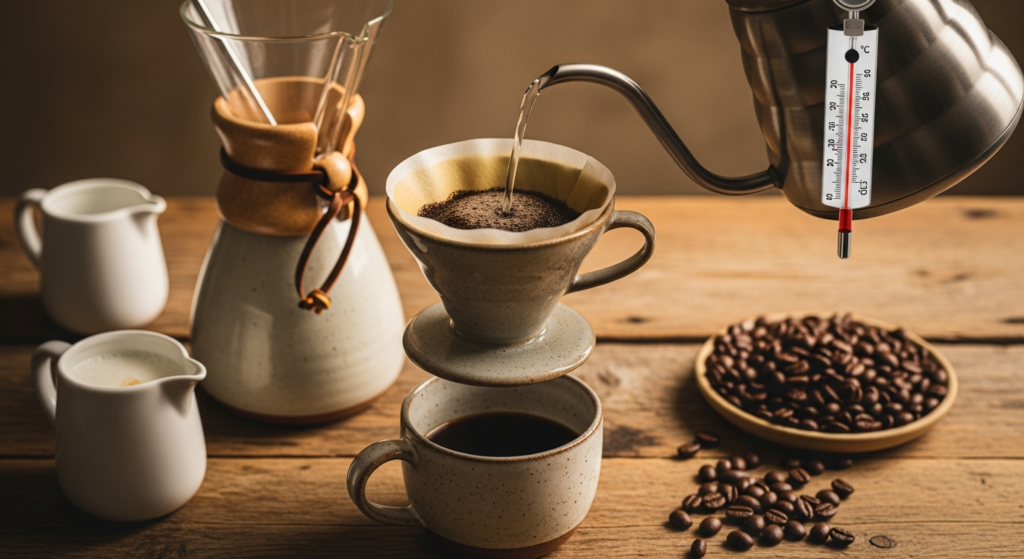
The Ultimate Pour Over Water Temperature Guide: Mastering Extraction for the Perfect Cup
Brewing the perfect pour-over coffee is often described as a marriage between art and science. While we often obsess over the origin of the beans, the precision of the grind, or the aesthetics of a copper gooseneck kettle, one variable stands as the silent conductor of the entire flavor symphony: water temperature. In 2026, as home brewing technology reaches new heights of precision, understanding the thermal dynamics of your brew is no longer just for professional baristas—it is the key to unlocking the full potential of your morning ritual.
Water temperature is the primary engine of extraction. It dictates how quickly flavor compounds—acids, sugars, and oils—dissolve from the coffee grounds into your carafe. Too hot, and you risk scorching the delicate nuances, leaving you with a bitter, ashy cup. Too cold, and the water lacks the kinetic energy to pull out the sweetness, resulting in a sour, thin, and underwhelming brew. This guide will walk you through everything you need to know to master your pour-over water temperature, ensuring every cup you brew is balanced, vibrant, and professional-grade.
1. The Science of Solubility: Why Temperature Matters
To understand why temperature is so critical, we must look at coffee brewing as a chemical extraction process. Roasted coffee beans are composed of organic acids, aromatic oils, sugars, and bitter alkaloids. These compounds have varying levels of solubility, and heat is the catalyst that coaxes them out.
When hot water hits coffee grounds, it acts as a solvent. At higher temperatures, water molecules move faster, possessing more kinetic energy to break down the cellular structure of the coffee bean. Generally, the “pleasant” compounds—the fruity acids and caramel-like sugars—extract first. The heavier, more bitter compounds, such as caffeine and certain polyphenols, extract later and require more energy (heat) to dissolve.
In 2026, specialty coffee enthusiasts recognize that temperature control isn’t just about avoiding “burnt” coffee; it’s about “selective extraction.” By manipulating the heat, you are essentially deciding which flavors to invite into your cup and which to leave behind in the filter. If your coffee tastes sharp or salty, it is likely under-extracted, meaning your water wasn’t hot enough to pull out the sugars. If it tastes dry and astringent, you’ve likely over-extracted, often due to excessive heat.
2. The Golden Range: Finding the Sweet Spot (90°C–96°C)
For decades, the Specialty Coffee Association (SCA) has recommended a standard brewing range of **195°F to 205°F (90.5°C to 96°C)**. This range remains the gold standard for most pour-over methods, whether you are using a Hario V60, a Kalita Wave, or a Chemex.
Within this 10-degree window lies the “sweet spot” for the majority of specialty beans.
* **The High End (204°F–206°F):** This is ideal for maximizing clarity and acidity. It is often used for high-altitude beans that are incredibly dense and require more energy to yield their complex floral notes.
* **The Middle Ground (200°F–202°F):** This is the safest starting point for most home baristas. It provides a balanced extraction that captures both the bright top notes and the foundational sweetness of the coffee.
* **The Lower End (195°F–198°F):** This range is excellent for beans that tend toward chocolatey or nutty profiles, where you want to emphasize body and sweetness without over-extracting any underlying bitterness.
However, as we move further into 2026, the “rules” have become more flexible. The rise of ultra-light “Nordic” roasts has led some professionals to brew with water right off the boil (212°F/100°C), while certain competition recipes for dark roasts suggest dropping as low as 185°F (85°C). The golden range is your foundation, but your beans will tell you when it’s time to deviate.
3. Adjusting Temperature for Roast Profiles
The most important factor in deciding your water temperature is the roast level of your coffee. Roasting changes the physical structure of the bean, making it more or less “porous,” which directly impacts how easily water can penetrate and extract flavor.
#
Light Roasts (The Heat-Seekers)
Lightly roasted beans are dense and less porous. Because they haven’t been subjected to the high heat of a roaster for long, their cellular structure remains tightly packed. To get the best out of a light roast—especially those prized for citrus, jasmine, or berry notes—you need high heat.
* **Recommended Temp:** 203°F to 208°F (95°C to 98°C).
* **Pro Tip:** For exceptionally light roasts, don’t be afraid to use boiling water. The density of the bean acts as a buffer against over-extraction.
#
Medium Roasts (The Balanced Approach)
Medium roasts have a more developed sweetness and a slightly more porous structure than light roasts. They are the most forgiving but can easily turn bitter if pushed too hard.
* **Recommended Temp:** 198°F to 202°F (92°C to 94°C).
* **Pro Tip:** If your medium roast tastes a bit “flat,” try bumping the temperature up by 2 degrees to see if it unlocks more vibrance.
#
Dark Roasts (The Delicate Treatment)
Dark roasted beans are highly porous and fragile. The roasting process has already broken down most of the bean’s organic structures, making the flavors (often smoky, bold, or chocolatey) very easy to extract. Using high heat on dark roasts will almost certainly result in a bitter, “burnt” taste.
* **Recommended Temp:** 185°F to 195°F (85°C to 90°C).
* **Pro Tip:** Lowering the temperature for dark roasts allows the rich, cocoa-like sweetness to shine through without the harsh carbon-like finish.
4. The Slurry Temperature vs. Kettle Temperature
One of the most common mistakes home baristas make is assuming that the temperature in their kettle is the same as the temperature during brewing. This is rarely the case. As soon as water leaves the kettle and hits the air and the coffee grounds, it begins to lose heat.
The **slurry temperature**—the actual temperature of the water and coffee mixture inside the dripper—is what actually determines extraction. Factors that cause temperature drop include:
* **The Material of the Brewer:** Ceramic and glass drippers act as “heat sinks,” sucking warmth away from the water if they aren’t properly preheated. Plastic drippers, interestingly, are often better at maintaining thermal stability because plastic is a poor conductor of heat.
* **Ambient Temperature:** Brewing in a cold kitchen in the middle of winter will result in a faster temperature drop than brewing on a warm summer day.
* **The Bloom:** When you first pour a small amount of water over the grounds to “bloom” the coffee, that small volume of water loses heat almost instantly.
To combat this in 2026, “thermal management” is the buzzword. Always preheat your dripper and your carafe with hot water before you start the brewing process. This ensures that the energy from your kettle water goes into extracting flavor from the beans rather than heating up your equipment.
5. Essential Tools for Temperature Precision
In the modern era of specialty coffee, “guesstimating” your water temperature by waiting two minutes after the boil is no longer sufficient for those seeking a world-class cup. Precision tools have become more accessible and intuitive.
#
Digital Temperature-Controlled Kettles
The gooseneck kettle remains the gold standard for pour-over coffee due to its flow control, but a digital interface is now a must-have. Models in 2026 feature PID (Proportional-Integral-Derivative) controllers, which hold water at a specific degree for up to an hour. This allows for total consistency from your first pour to your last.
#
Instant-Read Thermometers
If you aren’t ready to invest in a high-end electric kettle, a digital instant-read thermometer is your best friend. They are fast, accurate, and can be used with a standard stovetop kettle. Look for one with a thin probe that can easily fit into the spout or top of your kettle.
#
Insulated Brewers
We are seeing a surge in insulated or double-walled pour-over drippers designed to maintain a constant slurry temperature. These tools minimize the variables, allowing you to focus entirely on your pour technique and grind size.
6. Troubleshooting Your Brew with Temperature
If your coffee doesn’t taste quite right, temperature is often the easiest variable to tweak. Before you go changing your grind size or buying a different brand of bottled water, try these temperature-based fixes:
* **Problem: The coffee is too sour, acidic, or “salty.”**
* *Diagnosis:* Under-extraction. The water didn’t have enough energy to pull out the sugars.
* *Solution:* Increase your water temperature by 2–4°F (1–2°C) for your next brew.
* **Problem: The coffee is bitter, dry, or has an ashy aftertaste.**
* *Diagnosis:* Over-extraction. You’ve pulled out the heavy, unpleasant compounds.
* *Solution:* Decrease your water temperature by 2–4°F (1–2°C).
* **Problem: The coffee tastes “hollow” or lacks body.**
* *Diagnosis:* Likely a combination of low temperature and too coarse a grind.
* *Solution:* Try increasing the temperature and ensuring your dripper is thoroughly preheated to maintain a higher slurry temperature.
* **Problem: The coffee is great when hot but turns sour as it cools.**
* *Diagnosis:* This is actually a sign of a good brew! As coffee cools, our tongues perceive acidity more intensely. However, if it becomes *unpleasantly* sour, you might need a slightly higher initial brewing temperature to ensure better sugar extraction.
FAQ: Frequently Asked Questions
**Q: Is it okay to use boiling water for pour-over coffee?**
**A:** Yes, especially for very light roasts and high-altitude beans. While the old myth says boiling water “burns” coffee, the reality is that the beans were roasted at temperatures much higher than 212°F. However, for medium and dark roasts, boiling water will likely lead to over-extraction and bitterness.
**Q: Does altitude affect brewing temperature?**
**A:** Absolutely. At higher altitudes, water boils at a lower temperature (e.g., in Denver, water boils at approximately 202°F). If you live in a high-altitude area, you may find it difficult to over-extract using heat, and you will almost always want to use water as close to the boil as possible.
**Q: Should I use a different temperature for the bloom?**
**A:** Most baristas use the same temperature for the entire process for the sake of consistency. However, some advanced recipes suggest a hotter bloom to degas the coffee more effectively, followed by slightly cooler water for the main pours to prevent bitterness.
**Q: Why does my coffee taste different every time even though I set my kettle to the same temp?**
**A:** Check your thermal management. If you aren’t preheating your dripper the same way every time, or if the room temperature has changed significantly, your slurry temperature will fluctuate. Consistency in equipment prep is just as important as kettle settings.
**Q: Does the type of water affect the temperature I should use?**
**A:** Indirectly, yes. Hard water (high in minerals) extracts coffee more aggressively than soft water. If you have very hard water, you might find that you need to lower your temperature slightly to avoid over-extraction, though using filtered or “third-wave” water is always recommended for the best flavor.
Conclusion
Mastering pour-over water temperature is one of the most rewarding skills a home barista can develop. By moving beyond a “one-size-fits-all” approach and learning to adjust your heat based on roast profile, bean density, and equipment, you transform your coffee from a simple caffeine delivery system into a culinary experience.
As we look toward the future of coffee in 2026, the tools for precision are at our fingertips, but the ultimate guide will always be your own palate. Don’t be afraid to experiment—try that light roast at a scorching 208°F or that dark roast at a mellow 188°F. Record your results, note the flavor shifts, and soon you’ll find that “perfect” temperature is a destination you can reach every single morning. Happy brewing!