


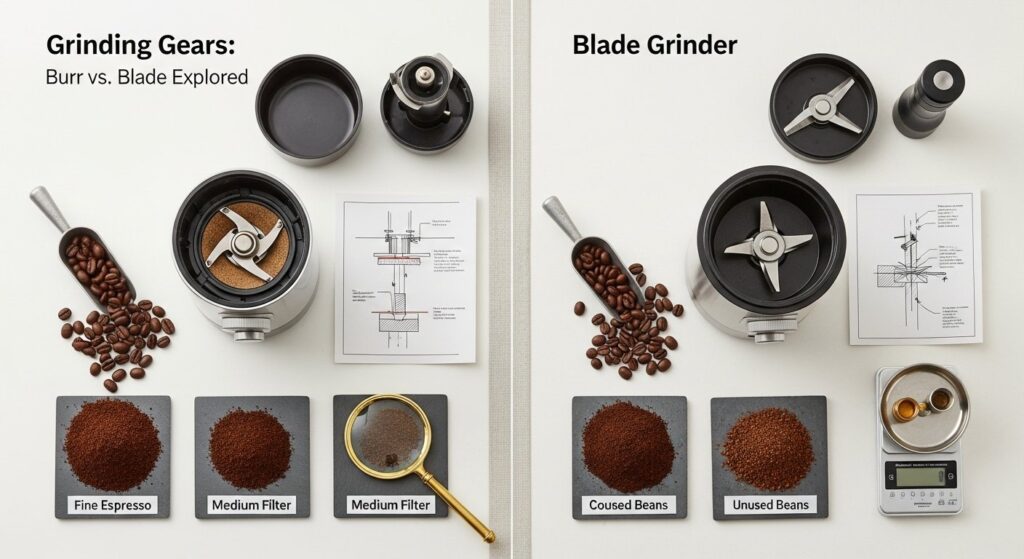
Burr vs Blade Grinder: The Ultimate Guide to Unlocking Superior Coffee Flavor
Affiliate disclosure: This article may contain affiliate links. Recommendations are independent and editorially driven.
For any true coffee aficionado, the journey to a perfect cup begins long before the hot water meets the grounds. It starts with the bean, yes, but its potential is truly unlocked at the moment of grinding. The act of transforming whole, roasted coffee beans into fine, consistent particles is perhaps the single most critical step in brewing, dictating everything from extraction efficiency to the nuanced flavors that dance on your palate. Yet, amidst the myriad choices available to coffee lovers, one fundamental question often sparks intense debate: burr vs blade grinder. Is there a definitive champion? What are the true implications of choosing one over the other for your daily brew?
At cafeserre, we believe that understanding your tools is paramount to elevating your coffee experience. This comprehensive guide will delve deep into the mechanics, science, and practical outcomes of both burr and blade grinders. We’ll explore why grind consistency isn’t just a buzzword, how each grinder type impacts flavor, and ultimately, help you make an informed decision that aligns with your brewing methods, budget, and pursuit of coffee perfection. Prepare to transform your morning ritual from a mere routine into an art form.
The Undeniable Importance of Grind Consistency: Why It All Matters
Before we dissect the differences between grinder types, it’s crucial to grasp the foundational principle that underpins all high-quality coffee preparation: grind consistency. Imagine baking a cake where some flour particles are as fine as dust and others are coarse as sand. The result would be an uneven texture, unpredictable cooking, and a compromised flavor. The same principle applies, with even greater urgency, to coffee.
Understanding Coffee Extraction and Particle Size
Coffee extraction is the process by which water dissolves soluble compounds from roasted coffee grounds. These compounds include acids, sugars, lipids, and various aromatic molecules that collectively create coffee’s complex flavor profile. The rate and extent of this dissolution are directly proportional to the surface area of the coffee particles and the time they are in contact with water. If your coffee grounds are inconsistent in size, you encounter a phenomenon known as uneven extraction.
- Finer Particles: These have a greater surface area relative to their volume and will extract more quickly. If over-extracted, they can release bitter, astringent compounds.
- Coarser Particles: These have less surface area and extract more slowly. If under-extracted, they lead to sour, thin, and underdeveloped flavors.
In a batch of inconsistently ground coffee, you’ll inevitably have a mix of over-extracted fine particles and under-extracted coarse particles. This leads to a muddied, unbalanced cup where the true potential of the bean is lost. The goal is uniform particle size, allowing for an even extraction across all grounds, resulting in a balanced, nuanced, and delicious cup every single time.
Impact on Flavor Profile and Aroma
Grind consistency is not just about avoiding bitterness or sourness; it’s about unlocking the full spectrum of flavors and aromas inherent in your chosen coffee bean. When extraction is even, you can taste the distinct notes—be it floral, fruity, chocolatey, nutty, or spicy—that the roaster intended. Uneven extraction masks these delicate nuances, leaving you with a generic “coffee” taste that lacks depth and character. The consistent release of aromatic compounds during brewing is also critical for the coffee’s fragrant bouquet, a significant part of the overall sensory experience.
Ensuring Optimal Flow Rate and Brew Time
Beyond flavor, grind consistency also plays a vital role in the mechanics of brewing. For methods like espresso, pour-over, or even drip coffee, the flow rate of water through the coffee bed is crucial. A consistent grind creates a uniform bed resistance, allowing water to pass through evenly. If your grind is inconsistent, finer particles can clump together, creating channels (preferential pathways for water) or clogging the filter entirely. This leads to:
- Channelling: Water bypasses much of the coffee bed, resulting in under-extracted areas.
- Clogging: Water can’t pass through, leading to vastly extended brew times or even overflow.
Both scenarios compromise extraction and can ruin your brew. A consistent grind ensures predictable flow rates and repeatable brew times, which are essential for dialing in any brewing method successfully.
[INLINE IMAGE 1: place after second H2 | alt=”burr vs blade grinder concept illustration”]
Blade Grinders: The Swift, Budget-Friendly Option

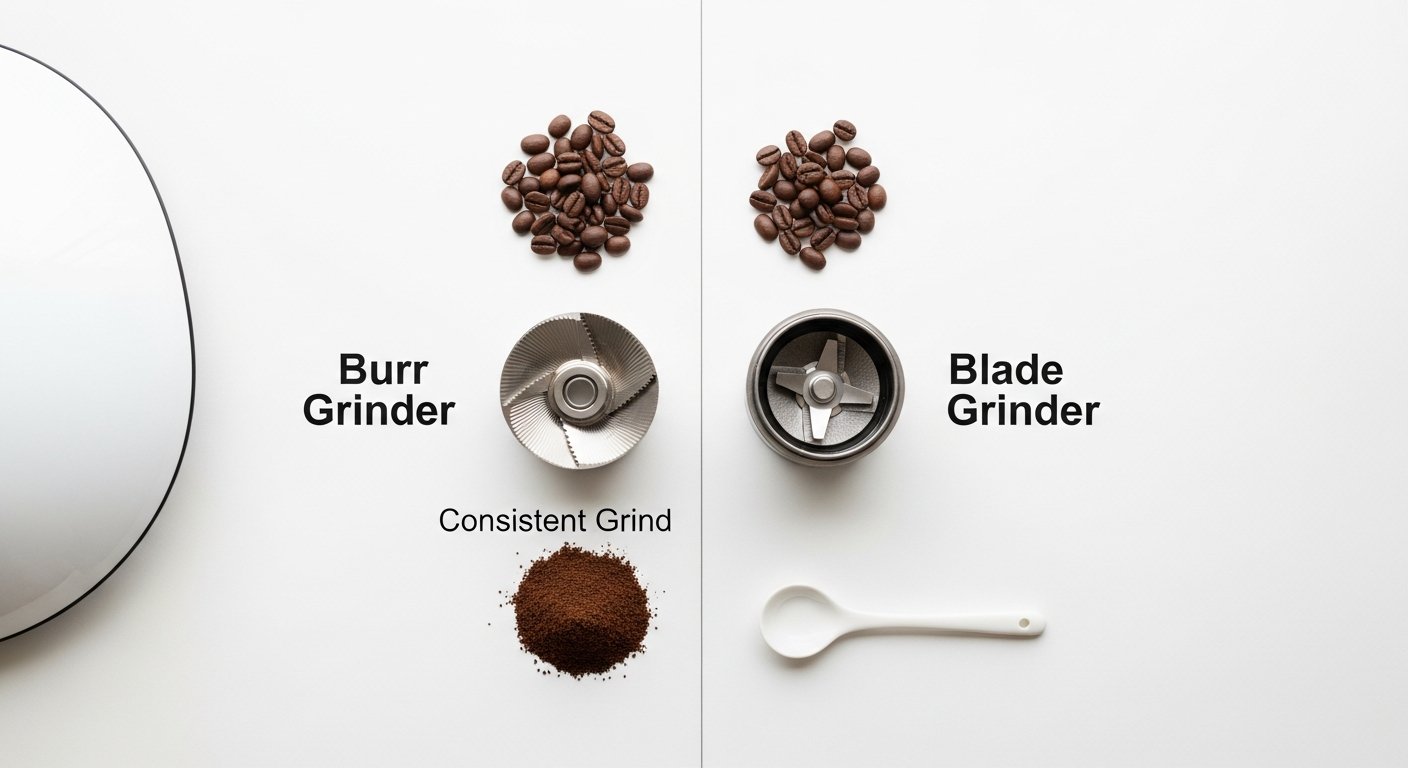
Often the entry point for many home coffee enthusiasts, blade grinders are ubiquitous and widely accessible. They are frequently found in kitchen appliance sections and marketed as “coffee grinders” without much distinction from spice grinders. While they serve a basic function, understanding their mechanics reveals why they fall short for serious coffee preparation.
How Blade Grinders Work: A “Chopping” Action
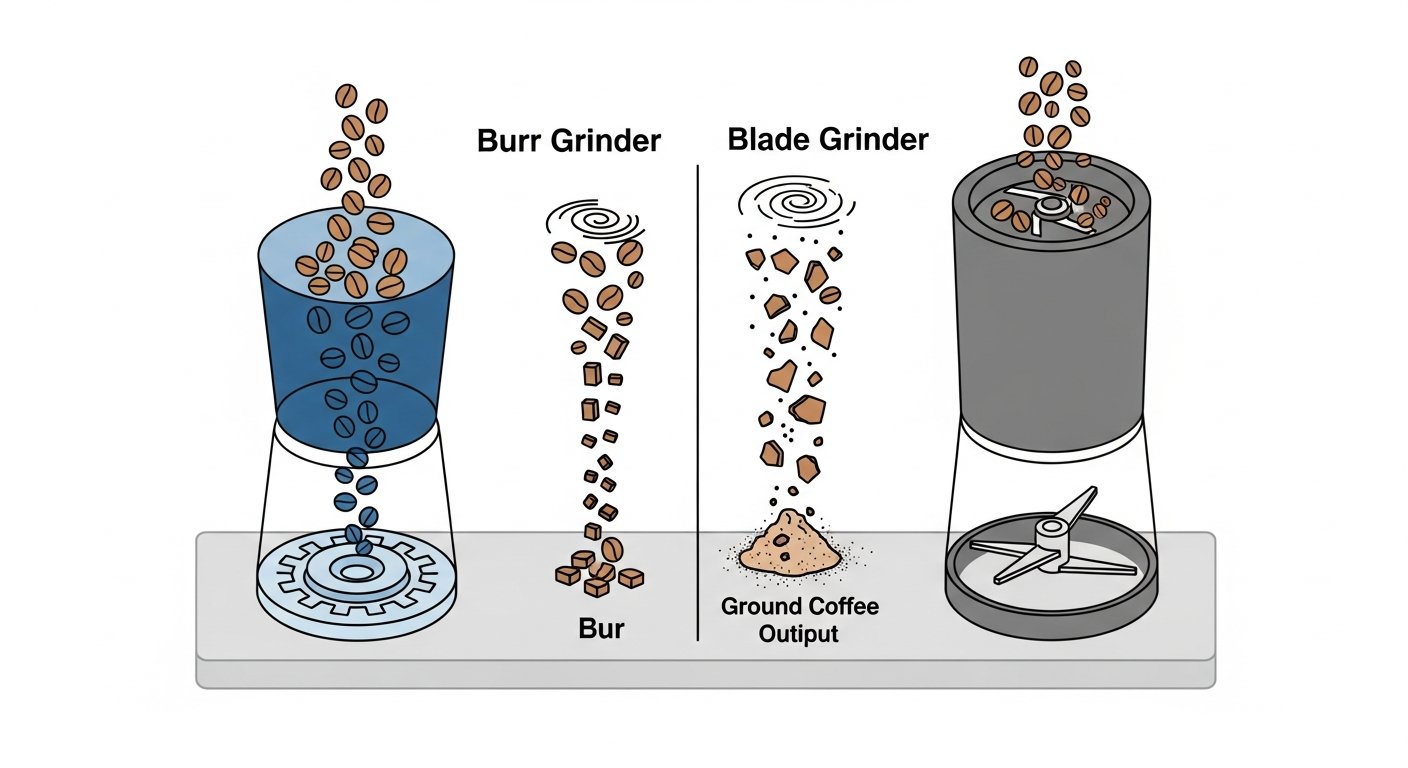
Blade grinders, at their core, are glorified blenders. They feature a central spinning blade (similar to a propeller) that rotates at high speeds. When whole coffee beans are introduced, the blade chops and shatters them into smaller pieces. The longer you run the grinder, the finer the “grind” becomes, as the blades continue to pulverize the particles. There are no adjustable burrs or specific settings; fineness is controlled solely by duration.
Advantages of Blade Grinders: Speed and Accessibility
- Cost-Effective: Without a doubt, the most significant advantage of blade grinders is their price point. They are considerably cheaper than even entry-level burr grinders, making them an attractive option for those on a tight budget or just starting their coffee journey.
- Speed: They can reduce whole beans to a fine powder relatively quickly.
- Multi-Purpose: Many blade grinders can also be used for grinding spices, nuts, or even creating coarse flours, offering versatility in the kitchen beyond just coffee.
- Compact Size: Generally smaller and lighter than burr grinders, making them easy to store.
Disadvantages of Blade Grinders: The Compromise on Quality
Here’s where the limitations become apparent, directly impacting the quality of your coffee.
Inconsistent Particle Size
The primary drawback of blade grinders is their inability to produce a consistent grind. Because they chop rather than mill, you end up with a heterogeneous mixture of:
- “Boulders”: Large, unground or coarsely chopped pieces.
- “Fines”: Very tiny, dust-like particles.
- “Pebbles”: Everything in between.
This inconsistency, as discussed earlier, leads to highly uneven extraction, resulting in a cup that is simultaneously bitter (from over-extracted fines) and sour/weak (from under-extracted boulders). There’s no way to achieve a truly uniform grind with a blade grinder, no matter how skilled you are with pulsing techniques.
Heat Generation
The high-speed rotation of the blades generates significant friction and heat. Coffee beans are delicate and contain volatile oils and aromatics. Exposing them to excessive heat during grinding can “cook” these oils, causing them to degrade or dissipate even before brewing. This results in a muted flavor, a loss of desirable aromas, and a duller cup.
Static Electricity and Mess
The friction also creates static electricity. This causes coffee grounds to stick to the inside of the grinder, to the collection cup, and often to your counter. Not only does this make for a messy cleanup, but it also means you lose some of your precious grounds, affecting your dose accuracy.
Flavor Contamination
If you use your blade grinder for spices in addition to coffee, lingering spice residues can easily transfer flavors to your coffee, leading to an unwanted and unpleasant taste profile.
Noise Level
Blade grinders are typically quite loud due to their high-speed motor and the violent chopping action.
In essence, while a blade grinder technically turns whole beans into smaller pieces, it does so in a way that actively hinders optimal extraction and compromises the delicate flavors of your coffee. For cafeserre, while we understand their initial appeal, we strongly advocate for investing in a better grinding solution for anyone serious about the quality of their brew.
Explore our guide to choosing the best coffee beans for every brewing method.
Burr Grinders: The Connoisseur’s Choice for Precision
Stepping into the world of burr grinders is where the true potential of your coffee beans begins to unfold. Favored by professional baristas, specialty coffee shops, and discerning home brewers alike, burr grinders are designed for precision and consistency. They are the cornerstone of any serious coffee setup, directly impacting the quality of every single cup.
How Burr Grinders Work: A “Milling” Action
Unlike blade grinders that chop, burr grinders mill coffee beans. They utilize two abrasive surfaces, known as burrs, which rotate against each other. Coffee beans are fed between these burrs, and as they pass through, they are progressively crushed and ground to a uniform size. The distance between the burrs determines the fineness of the grind. This milling action is far superior because it breaks the beans apart rather than shattering them, resulting in a much more consistent particle size distribution.
Types of Burr Grinders: Conical vs. Flat
Within the burr grinder category, there are two primary designs, each with its own characteristics:
Conical Burr Grinders
- Design: Feature two cone-shaped burrs – an inner cone that rotates within an outer stationary burr. The beans are drawn down between the two burrs, gradually being ground finer.
- Advantages: Generally produce less heat and noise than flat burrs. They tend to be more efficient, requiring less motor power. Conical burrs are also known for their durability and longevity. They often produce a slightly wider particle distribution than flat burrs, which some argue can create a more complex flavor profile, particularly for espresso.
- Common Use: Very popular in both home and commercial settings, suitable for a wide range of brewing methods.
Flat Burr Grinders
- Design: Consist of two flat, ring-shaped burrs. One burr is stationary, and the other rotates parallel to it. Coffee beans are fed into the center and propelled outwards by centrifugal force as they are ground between the two surfaces.
- Advantages: Renowned for their exceptional grind consistency, often producing a very tight particle distribution. This can lead to a very clear, clean cup profile, especially for pour-over and espresso.
- Disadvantages: Can generate more heat and noise due to the higher RPMs and grinding action. They may also retain more ground coffee within the burr set (“retention”).
- Common Use: Often found in high-end commercial grinders and increasingly in enthusiast-level home grinders, particularly for espresso.
While differences exist between conical and flat burrs, both are vastly superior to blade grinders in terms of grind quality.
[INLINE IMAGE 2: place after fourth H2 | alt=”burr vs blade grinder comparison illustration”]
Advantages of Burr Grinders: Precision and Flavor Excellence
- Superior Grind Consistency: This is the paramount advantage. Burr grinders produce a remarkably uniform particle size, which is critical for even extraction and a balanced, flavorful cup.
- Adjustable Grind Settings: Burr grinders offer a wide range of grind settings, from extra-fine (for espresso) to very coarse (for French press). This adjustability allows you to fine-tune your grind for any brewing method, optimizing extraction and taste.
- Minimal Heat Generation: Because they mill rather than chop, burr grinders produce significantly less heat, preserving the delicate volatile oils and aromatics in the coffee beans. This means a more vibrant and authentic flavor profile in your cup.
- Enhanced Flavor Extraction: With consistent particle size and minimal heat, you achieve a more predictable and optimal extraction, leading to a richer, cleaner, and more nuanced flavor profile. The true character of your specialty coffee can shine through.
- Durability and Longevity: High-quality burr grinders are built to last, often featuring robust motors and durable burr materials (stainless steel or ceramic).
- Less Static and Mess: While not entirely static-free, the milling action generally produces less static cling compared to blade grinders, resulting in a cleaner operation.
Considerations for Burr Grinders: Investment and Maintenance
- Higher Initial Cost: Burr grinders are a more significant upfront investment than blade grinders. However, this cost is quickly justified by the dramatic improvement in coffee quality.
- Noise Level: While generally quieter than blade grinders, burr grinders still produce noise, especially during the grinding process.
- Maintenance: To maintain optimal performance, burr grinders require periodic cleaning to remove accumulated coffee oils and fines. Burrs also wear down over time and may need replacement after several years of heavy use.
For anyone serious about experiencing coffee at its best, a burr grinder is not just an upgrade; it’s an essential tool. It provides the control and consistency necessary to truly appreciate the complex world of coffee flavors and aromas.
The Direct Showdown: Burr vs. Blade Grinder Head-to-Head
To truly highlight the differences, let’s put these two grinding technologies side-by-side across key performance indicators. This comparative analysis will solidify why burr grinders are the superior choice for quality-driven coffee preparation, while also acknowledging the niche where blade grinders might still find a use.
Comparison Table: Burr vs. Blade Grinder
| Feature | Burr Grinder | Blade Grinder |
|---|---|---|
| Grinding Mechanism | Milling (crushing beans between abrasive burrs) | Chopping/Shattering (high-speed rotating blades) |
| Grind Consistency | Excellent (uniform particle size) | Poor (mix of boulders, pebbles, and fines) |
| Flavor Impact | Optimizes flavor extraction, preserves aromatics, balanced cup | Compromised flavor, uneven extraction, bitter/sour notes, muted aromatics |
| Heat Generation | Minimal (preserves coffee integrity) | Significant (degrades coffee oils and flavors) |
| Grind Settings | Wide range (fine to coarse), adjustable for specific brew methods | None (fineness controlled by duration of grinding) |
| Noise Level | Moderate to Loud (varies by model) | Loud (high-speed motor and chopping) |
| Cost Range | Moderate to High ($50 – $1000+) | Low ($15 – $40) |
| Durability/Lifespan | High (quality burrs and motors), burrs may need replacement | Moderate (blades can dull, motor life varies) |
| Maintenance | Regular cleaning required, burr replacement eventually | Minimal cleaning, but can harbor residues |
| Best For | Espresso, pour-over, French press, drip, all specialty brewing methods | Extremely casual coffee drinkers, occasional use, general spice grinding |
Detailed Performance Metrics
Grind Consistency and Extraction
As repeatedly emphasized, this is the cornerstone. A burr grinder delivers the consistent particle size needed for even extraction, allowing you to “dial in” your brew. Whether it’s the precise uniformity for a perfect espresso shot or the clean separation needed for a pour-over, burr grinders empower you with control. Blade grinders, by their very nature, make consistent extraction an impossibility, leading to an inherently flawed cup.
Flavor Preservation and Development
The heat generated by blade grinders is a silent killer of flavor. It volatilizes delicate aromatics and can pre-cook coffee oils, robbing your brew of vibrancy and complexity. Burr grinders, with their slower, milling action, minimize heat transfer, preserving the full spectrum of flavors and ensuring that the nuances of your chosen beans are translated directly into your cup. This is particularly noticeable with single-origin coffees and light roasts, where subtle flavors are easily masked.
Versatility Across Brewing Methods
Different brewing methods demand different grind sizes. Espresso requires an extremely fine, flour-like consistency, while French press needs a coarse, breadcrumb-like grind. A quality burr grinder offers the versatility to precisely achieve these varying requirements. With distinct, repeatable settings, you can seamlessly switch from preparing an espresso to a batch of cold brew. Blade grinders, lacking these precise adjustments, force a compromise on every brew, making it impossible to truly optimize for any specific method.
Longevity and Investment Value
While the initial cost of a burr grinder is higher, it represents a long-term investment in your coffee quality. High-quality burr grinders are built with robust materials and motors, designed for years of consistent performance. The burrs themselves, typically made from ceramic or hardened steel, are durable and can be replaced when they eventually wear out. Blade grinders, while cheap, often have a shorter lifespan when used regularly for coffee, and their inability to produce a good grind means they offer poor value in terms of coffee quality.
Discover the best brewing methods for every coffee lover.
Choosing the Right Grinder for Your Lifestyle and Coffee Journey
The choice between a burr and blade grinder, at this point, should be relatively clear for anyone prioritizing coffee quality. However, practical considerations like budget, space, and intended use also play a significant role. Let’s break down how to make the best decision for your unique situation.
Assessing Your Coffee Priorities
- Are you an occasional coffee drinker or a daily ritualist? If coffee is an infrequent indulgence or simply a means to an end for caffeine, a blade grinder might suffice initially, though we’d still recommend an upgrade for a better experience. For daily drinkers, especially those who appreciate good coffee, a burr grinder is non-negotiable.
- What are your preferred brewing methods?
- Espresso: Absolutely requires a high-quality burr grinder with micro-adjustments. Blade grinders are completely unsuitable.
- Pour-Over/Drip: Benefits immensely from a consistent, medium grind. Burr grinders shine here.
- French Press/Cold Brew: Needs a coarse, uniform grind to prevent sludge and over-extraction. Burr grinders excel at producing this.
- Aeropress: Versatile with grind sizes, but consistency from a burr grinder will always yield better results.
- How much do you value nuanced flavor? If you invest in specialty beans and enjoy exploring different origins and roast profiles, a burr grinder is essential to unlock their full potential. If “coffee taste” is enough, a blade grinder might seem acceptable, but you’re missing out on a world of flavor.
Budget Considerations: An Investment in Flavor
While blade grinders start under $20, entry-level electric burr grinders typically range from $50-$150. High-quality home burr grinders can go from $200-$500, and professional-grade models can exceed $1000. Manual burr grinders offer an excellent balance of consistency and affordability, often starting around $30-$80.
- Under $40: You’re primarily looking at blade grinders or very basic manual burr grinders. For the best coffee quality in this range, a manual burr grinder is your only viable option.
- $50 – $150: This range opens up to decent electric burr grinders. Look for models from reputable brands known for their burr quality. This is a solid starting point for most home brewers.
- $150 – $300: Here you find excellent all-around home burr grinders, often with more robust build quality, better burrs (flat or conical), and finer grind adjustment, suitable for espresso if paired with a capable espresso machine.
- $300+: This category includes advanced home grinders and entry-level prosumer models, often with features like digital timers, stepped/stepless adjustments, and larger, more powerful motors. Essential for serious espresso enthusiasts.
Consider your coffee budget holistically. If you’re spending $15-$25 on a bag of quality beans, putting them through a blade grinder is akin to buying gourmet ingredients and then microwaving them. A good grinder will pay for itself in the enjoyment and quality it adds to every single cup.
Space and Aesthetics
Burr grinders vary in size. Electric models can take up considerable counter space, especially larger conical burr grinders. If space is a premium, look for more compact electric models or consider a manual hand grinder, which is very space-efficient.
Manual Burr Grinders: A Worthwhile Alternative
For those on a tighter budget who still demand quality, or for travelers, manual burr grinders are an excellent choice.
- Advantages:
- Excellent Grind Quality: Produce consistent grinds comparable to electric burr grinders, often using ceramic or steel conical burrs.
- Portable: Compact and require no electricity, ideal for travel or camping.
- Affordable: Generally much cheaper than electric burr grinders, offering incredible value for quality.
- Quiet: Operate silently, a boon for early morning coffee rituals.
- Disadvantages:
- Effort: Requires manual effort to grind, which can be tiring for large batches or very fine grinds (like espresso).
- Speed: Slower than electric grinders.
If you’re only making one or two cups at a time, a manual burr grinder offers a superior coffee experience without breaking the bank.
Read our expert reviews of the top manual coffee grinders for travel and home use.
Beyond the Basics: Advanced Grinding Concepts and Maintenance
Once you’ve made the switch to a burr grinder, there are further considerations that can fine-tune your grinding process and extend the life of your equipment. Understanding these nuances can further elevate your coffee game.
Stepped vs. Stepless Adjustment
Burr grinders come with different mechanisms for adjusting grind size:
- Stepped Grinders: These have pre-defined settings or “steps” that click into place. Each step represents a specific grind size.
- Pros: Easy to replicate settings, intuitive to use, good for varied brewing methods.
- Cons: Less fine-tuned control, as you’re limited to the existing steps. Might be harder to dial in espresso precisely.
- Stepless Grinders: These allow for infinite adjustment between the coarsest and finest settings, often by rotating a collar or ring that continuously moves the burrs closer or further apart.
- Pros: Unparalleled precision for dialing in the perfect grind, especially crucial for espresso where small changes make a big difference.
- Cons: Can be harder to return to a previous setting without experimentation; less intuitive for beginners.
For most home brewers using drip, pour-over, or French press, a stepped grinder is perfectly adequate. Espresso enthusiasts, however, will often benefit from the micro-adjustments offered by stepless grinders.
Dosing and Retention
- On-Demand Grinding: Many electric burr grinders dispense grounds directly into a portafilter (for espresso) or a container. Some offer timed dosing, where you set a timer for a specific duration of grinding, aiming for a consistent dose by weight.
- Single Dosing: This technique involves weighing out the exact amount of whole beans you need for your brew and grinding only that amount. It’s popular for minimizing stale grounds and maximizing freshness. It requires a grinder with low “retention” (the amount of ground coffee left trapped in the grinder after grinding), though some grinders can be modified or “modded” to reduce retention.
Maintenance: Keeping Your Burr Grinder in Top Shape
Even the best burr grinder needs regular care to perform optimally. Coffee oils are sticky and can build up on the burrs and in the grinding chamber, leading to:
- Stale Coffee Residue: Old oil residues can turn rancid and impart off-flavors to fresh coffee.
- Reduced Performance: Clogged burrs become less efficient, leading to inconsistent grinds and slower grinding times.
- Increased Wear: Dirt and grit can accelerate burr wear.
Cleaning Schedule and Process
- Every 1-2 Weeks (Light Cleaning):
- Unplug the grinder.
- Remove the bean hopper and top burr (consult your grinder’s manual).
- Use a stiff brush (often included with the grinder) or a vacuum cleaner to remove loose grounds and fines from the burrs and grinding chamber.
- Wipe down accessible surfaces with a damp cloth.
- Every 1-3 Months (Deep Cleaning / Grinder Cleaner):
- In addition to brushing, use specialized grinder cleaning tablets (e.g., Grindz). These tablets are food-safe and designed to absorb coffee oils and dislodge fine particles.
- Run a small amount of cleaning tablets through the grinder as if they were coffee beans, then run a small amount of actual coffee beans through to purge any residue from the tablets. Discard these purge grounds.
- Burr Replacement:
- Burrs, whether ceramic or steel, will eventually dull and wear out. This typically occurs after several years of heavy use (e.g., 500-1000 lbs of coffee, depending on burr material and design).
- Signs of dull burrs include slower grinding, inconsistent particle size despite proper settings, increased fines, and a higher-pitched grinding sound.
- Consult your grinder’s manufacturer for replacement burrs and instructions.
Proper maintenance ensures your burr grinder continues to deliver consistent, high-quality grinds, prolonging its life and ensuring every cup of coffee is as delicious as possible.
The Future of Coffee Grinding: Innovation and Automation
The world of coffee equipment is constantly evolving, and grinders are no exception. While the fundamental principles of burr grinding remain, innovations are continually being introduced to enhance user experience, precision, and consistency.
Smart Grinders and Connectivity
The rise of smart home technology has naturally extended to coffee equipment. We’re seeing more grinders with:
- Integrated Scales: Some high-end grinders now feature built-in precision scales, allowing for grinding by weight (rather than time) for incredibly accurate dosing. This reduces waste and ensures precise ratios.
- App Control: Connectivity via Bluetooth or Wi-Fi allows users to control grind settings, timer functions, and even receive maintenance alerts from their smartphones.
- Recipe Storage: Apps can store preferred grind settings for various brewing methods or specific coffee beans, making it easier to switch between recipes.
These features promise a more consistent and user-friendly experience, making the art of coffee preparation more accessible to a wider audience.
New Burr Geometries and Materials
Manufacturers are continually experimenting with new burr designs and materials to optimize particle distribution and reduce retention. Advances in metallurgy and manufacturing precision are leading to burrs that are sharper, more durable, and capable of producing even more uniform grinds. We’re also seeing unique geometries designed to enhance specific flavor attributes or reduce specific types of fines.
Noise Reduction Technologies
Noise is a common complaint with many electric grinders. Future innovations are likely to focus on further dampening motor noise and vibrations, making the grinding process quieter and less disruptive, especially in home environments.
Sustainability and Repairability
As consumers become more environmentally conscious, there’s a growing demand for products that are built to last and easily repairable. The coffee grinder industry is responding with more modular designs, readily available spare parts (including burrs), and longer product warranties, moving away from a disposable culture.
These innovations highlight a continuous pursuit of perfection in coffee preparation, driven by both technological advancement and a deep understanding of coffee science. While the core “burr vs blade grinder” debate remains foundational, the future promises even more sophisticated tools to help us achieve the ultimate cup.
Conclusion: The Clear Choice for Coffee Excellence
In the perennial debate of burr vs blade grinder, the verdict from cafeserre is unequivocal for anyone who genuinely cares about the quality of their coffee: the burr grinder reigns supreme. While blade grinders offer a low-cost, convenient entry point, their fundamental design flaws — inconsistent particle size, excessive heat generation, and lack of adjustability — inherently compromise the potential of even the finest coffee beans.
A burr grinder, whether electric or manual, represents an investment in flavor, consistency, and a profoundly more satisfying coffee experience. It is the essential tool that unlocks the complex aromatics and nuanced flavors hidden within your beans, allowing you to consistently brew a balanced, delicious cup tailored precisely to your chosen method. From the demanding precision of espresso to the clean clarity of a pour-over, the burr grinder provides the control necessary to transform good coffee into exceptional coffee.
Our recommendation is clear: if you are serious about your coffee, make the upgrade. Start with a quality manual burr grinder if budget is a concern, or invest in an entry-level electric burr grinder as soon as you can. The difference in your daily brew will be immediate, undeniable, and utterly transformative. Embrace the consistency, savor the enhanced flavors, and elevate your coffee journey to new heights with the right grinding tool.
Frequently Asked Questions
Q1: Is a blade grinder really that bad for coffee?
A1: While a blade grinder will technically turn whole beans into smaller pieces, it does so inconsistently by chopping and shattering. This leads to a mix of fine dust and large chunks, resulting in uneven extraction during brewing. This unevenness causes your coffee to taste simultaneously bitter (from over-extracted fines) and sour/weak (from under-extracted coarse particles), significantly compromising the flavor and aroma. So, yes, for quality coffee, a blade grinder is considered quite detrimental.
Q2: How much should I expect to spend on a good burr grinder?
A2: The price range for burr grinders varies significantly. For a good quality manual burr grinder, you can expect to spend between $30 and $80. For entry-level electric burr grinders suitable for most home brewing methods (excluding high-end espresso), prices typically range from $100 to $250. More advanced electric grinders, especially those designed for espresso, can range from $300 to $800+, with professional models exceeding $1000. It’s an investment that directly correlates with the quality of your daily coffee.
Q3: What’s the difference between conical and flat burrs?
A3: Both conical and flat burrs are types of burr grinders, vastly superior to blade grinders. Conical burrs consist of an inner cone rotating within a stationary outer ring, drawing beans downwards. They are often quieter, produce less heat, and are durable. Flat burrs consist of two parallel, flat rings (one stationary, one rotating), grinding beans as they are pushed outwards. Flat burrs are often lauded for creating a very uniform particle size, leading to a “cleaner” cup, but can sometimes be noisier and generate more heat. The choice often comes down to personal preference for flavor profile and specific brewing needs.
Q4: Can I use a burr grinder for different brewing methods?
A4: Absolutely! This is one of the primary advantages of a burr grinder. Quality burr grinders offer a wide range of adjustable settings, allowing you to select the precise grind size required for various brewing methods—from extra-fine for espresso, medium for drip and pour-over, to coarse for French press and cold brew. This versatility ensures optimal extraction and flavor for every type of coffee preparation.
Q5: How often should I clean my burr grinder?
A5: For optimal performance and taste, it’s recommended to perform a light cleaning of your burr grinder every 1-2 weeks, which involves brushing away loose grounds and fines. A deeper cleaning, using specialized grinder cleaning tablets, should be done every 1-3 months, depending on usage. Regular cleaning prevents the buildup of rancid coffee oils and ensures your burrs operate efficiently, preserving the quality of your coffee and extending the life of your grinder.
Burr vs Blade Grinder: The Ultimate Guide to Unlocking Superior Coffee Flavor
Affiliate disclosure: This article may contain affiliate links. Recommendations are independent and editorially driven.
For any true coffee aficionado, the journey to a perfect cup begins long before the hot water meets the grounds. It starts with the bean, yes, but its potential is truly unlocked at the moment of grinding. The act of transforming whole, roasted coffee beans into fine, consistent particles is perhaps the single most critical step in brewing, dictating everything from extraction efficiency to the nuanced flavors that dance on your palate. Yet, amidst the myriad choices available to coffee lovers, one fundamental question often sparks intense debate: burr vs blade grinder. Is there a definitive champion? What are the true implications of choosing one over the other for your daily brew?
At cafeserre, we believe that understanding your tools is paramount to elevating your coffee experience. This comprehensive guide will delve deep into the mechanics, science, and practical outcomes of both burr and blade grinders. We’ll explore why grind consistency isn’t just a buzzword, how each grinder type impacts flavor, and ultimately, help you make an informed decision that aligns with your brewing methods, budget, and pursuit of coffee perfection. Prepare to transform your morning ritual from a mere routine into an art form.
The Undeniable Importance of Grind Consistency: Why It All Matters
Before we dissect the differences between grinder types, it’s crucial to grasp the foundational principle that underpins all high-quality coffee preparation: grind consistency. Imagine baking a cake where some flour particles are as fine as dust and others are coarse as sand. The result would be an uneven texture, unpredictable cooking, and a compromised flavor. The same principle applies, with even greater urgency, to coffee.
Understanding Coffee Extraction and Particle Size
Coffee extraction is the process by which water dissolves soluble compounds from roasted coffee grounds. These compounds include acids, sugars, lipids, and various aromatic molecules that collectively create coffee’s complex flavor profile. The rate and extent of this dissolution are directly proportional to the surface area of the coffee particles and the time they are in contact with water. If your coffee grounds are inconsistent in size, you encounter a phenomenon known as uneven extraction.
- Finer Particles: These have a greater surface area relative to their volume and will extract more quickly. If over-extracted, they can release bitter, astringent compounds.
- Coarser Particles: These have less surface area and extract more slowly. If under-extracted, they lead to sour, thin, and underdeveloped flavors.
In a batch of inconsistently ground coffee, you’ll inevitably have a mix of over-extracted fine particles and under-extracted coarse particles. This leads to a muddied, unbalanced cup where the true potential of the bean is lost. The goal is uniform particle size, allowing for an even extraction across all grounds, resulting in a balanced, nuanced, and delicious cup every single time.
Impact on Flavor Profile and Aroma
Grind consistency is not just about avoiding bitterness or sourness; it’s about unlocking the full spectrum of flavors and aromas inherent in your chosen coffee bean. When extraction is even, you can taste the distinct notes—be it floral, fruity, chocolatey, nutty, or spicy—that the roaster intended. Uneven extraction masks these delicate nuances, leaving you with a generic “coffee” taste that lacks depth and character. The consistent release of aromatic compounds during brewing is also critical for the coffee’s fragrant bouquet, a significant part of the overall sensory experience.
Ensuring Optimal Flow Rate and Brew Time
Beyond flavor, grind consistency also plays a vital role in the mechanics of brewing. For methods like espresso, pour-over, or even drip coffee, the flow rate of water through the coffee bed is crucial. A consistent grind creates a uniform bed resistance, allowing water to pass through evenly. If your grind is inconsistent, finer particles can clump together, creating channels (preferential pathways for water) or clogging the filter entirely. This leads to:
- Channelling: Water bypasses much of the coffee bed, resulting in under-extracted areas.
- Clogging: Water can’t pass through, leading to vastly extended brew times or even overflow.
Both scenarios compromise extraction and can ruin your brew. A consistent grind ensures predictable flow rates and repeatable brew times, which are essential for dialing in any brewing method successfully.
[INLINE IMAGE 1: place after second H2 | alt=”burr vs blade grinder concept illustration”]
Blade Grinders: The Swift, Budget-Friendly Option
Often the entry point for many home coffee enthusiasts, blade grinders are ubiquitous and widely accessible. They are frequently found in kitchen appliance sections and marketed as “coffee grinders” without much distinction from spice grinders. While they serve a basic function, understanding their mechanics reveals why they fall short for serious coffee preparation.
How Blade Grinders Work: A “Chopping” Action
Blade grinders, at their core, are glorified blenders. They feature a central spinning blade (similar to a propeller) that rotates at high speeds. When whole coffee beans are introduced, the blade chops and shatters them into smaller pieces. The longer you run the grinder, the finer the “grind” becomes, as the blades continue to pulverize the particles. There are no adjustable burrs or specific settings; fineness is controlled solely by duration.
Advantages of Blade Grinders: Speed and Accessibility
- Cost-Effective: Without a doubt, the most significant advantage of blade grinders is their price point. They are considerably cheaper than even entry-level burr grinders, making them an attractive option for those on a tight budget or just starting their coffee journey.
- Speed: They can reduce whole beans to a fine powder relatively quickly.
- Multi-Purpose: Many blade grinders can also be used for grinding spices, nuts, or even creating coarse flours, offering versatility in the kitchen beyond just coffee.
- Compact Size: Generally smaller and lighter than burr grinders, making them easy to store.
Disadvantages of Blade Grinders: The Compromise on Quality
Here’s where the limitations become apparent, directly impacting the quality of your coffee.
Inconsistent Particle Size
The primary drawback of blade grinders is their inability to produce a consistent grind. Because they chop rather than mill, you end up with a heterogeneous mixture of:
- “Boulders”: Large, unground or coarsely chopped pieces.
- “Fines”: Very tiny, dust-like particles.
- “Pebbles”: Everything in between.
This inconsistency, as discussed earlier, leads to highly uneven extraction, resulting in a cup that is simultaneously bitter (from over-extracted fines) and sour/weak (from under-extracted boulders). There’s no way to achieve a truly uniform grind with a blade grinder, no matter how skilled you are with pulsing techniques.
Heat Generation
The high-speed rotation of the blades generates significant friction and heat. Coffee beans are delicate and contain volatile oils and aromatics. Exposing them to excessive heat during grinding can “cook” these oils, causing them to degrade or dissipate even before brewing. This results in a muted flavor, a loss of desirable aromas, and a duller cup.
Static Electricity and Mess
The friction also creates static electricity. This causes coffee grounds to stick to the inside of the grinder, to the collection cup, and often to your counter. Not only does this make for a messy cleanup, but it also means you lose some of your precious grounds, affecting your dose accuracy.
Flavor Contamination
If you use your blade grinder for spices in addition to coffee, lingering spice residues can easily transfer flavors to your coffee, leading to an unwanted and unpleasant taste profile.
Noise Level
Blade grinders are typically quite loud due to their high-speed motor and the violent chopping action.
In essence, while a blade grinder technically turns whole beans into smaller pieces, it does so in a way that actively hinders optimal extraction and compromises the delicate flavors of your coffee. For cafeserre, while we understand their initial appeal, we strongly advocate for investing in a better grinding solution for anyone serious about the quality of their brew.
Explore our guide to choosing the best coffee beans for every brewing method.
Burr Grinders: The Connoisseur’s Choice for Precision
Stepping into the world of burr grinders is where the true potential of your coffee beans begins to unfold. Favored by professional baristas, specialty coffee shops, and discerning home brewers alike, burr grinders are designed for precision and consistency. They are the cornerstone of any serious coffee setup, directly impacting the quality of every single cup.
How Burr Grinders Work: A “Milling” Action
Unlike blade grinders that chop, burr grinders mill coffee beans. They utilize two abrasive surfaces, known as burrs, which rotate against each other. Coffee beans are fed between these burrs, and as they pass through, they are progressively crushed and ground to a uniform size. The distance between the burrs determines the fineness of the grind. This milling action is far superior because it breaks the beans apart rather than shattering them, resulting in a much more consistent particle size distribution.
Types of Burr Grinders: Conical vs. Flat
Within the burr grinder category, there are two primary designs, each with its own characteristics:
Conical Burr Grinders
- Design: Feature two cone-shaped burrs – an inner cone that rotates within an outer stationary burr. The beans are drawn down between the two burrs, gradually being ground finer.
- Advantages: Generally produce less heat and noise than flat burrs. They tend to be more efficient, requiring less motor power. Conical burrs are also known for their durability and longevity. They often produce a slightly wider particle distribution than flat burrs, which some argue can create a more complex flavor profile, particularly for espresso.
- Common Use: Very popular in both home and commercial settings, suitable for a wide range of brewing methods.
Flat Burr Grinders
- Design: Consist of two flat, ring-shaped burrs. One burr is stationary, and the other rotates parallel to it. Coffee beans are fed into the center and propelled outwards by centrifugal force as they are ground between the two surfaces.
- Advantages: Renowned for their exceptional grind consistency, often producing a very tight particle distribution. This can lead to a very clear, clean cup profile, especially for pour-over and espresso.
- Disadvantages: Can generate more heat and noise due to the higher RPMs and grinding action. They may also retain more ground coffee within the burr set (“retention”).
- Common Use: Often found in high-end commercial grinders and increasingly in enthusiast-level home grinders, particularly for espresso.
While differences exist between conical and flat burrs, both are vastly superior to blade grinders in terms of grind quality.
[INLINE IMAGE 2: place after fourth H2 | alt=”burr vs blade grinder comparison illustration”]
Advantages of Burr Grinders: Precision and Flavor Excellence
- Superior Grind Consistency: This is the paramount advantage. Burr grinders produce a remarkably uniform particle size, which is critical for even extraction and a balanced, flavorful cup.
- Adjustable Grind Settings: Burr grinders offer a wide range of grind settings, from extra-fine (for espresso) to very coarse (for French press). This adjustability allows you to fine-tune your grind for any brewing method, optimizing extraction and taste.
- Minimal Heat Generation: Because they mill rather than chop, burr grinders produce significantly less heat, preserving the delicate volatile oils and aromatics in the coffee beans. This means a more vibrant and authentic flavor profile in your cup.
- Enhanced Flavor Extraction: With consistent particle size and minimal heat, you achieve a more predictable and optimal extraction, leading to a richer, cleaner, and more nuanced flavor profile. The true character of your specialty coffee can shine through.
- Durability and Longevity: High-quality burr grinders are built to last, often featuring robust motors and durable burr materials (stainless steel or ceramic).
- Less Static and Mess: While not entirely static-free, the milling action generally produces less static cling compared to blade grinders, resulting in a cleaner operation.
Considerations for Burr Grinders: Investment and Maintenance
- Higher Initial Cost: Burr grinders are a more significant upfront investment than blade grinders. However, this cost is quickly justified by the dramatic improvement in coffee quality.
- Noise Level: While generally quieter than blade grinders, burr grinders still produce noise, especially during the grinding process.
- Maintenance: To maintain optimal performance, burr grinders require periodic cleaning to remove accumulated coffee oils and fines. Burrs also wear down over time and may need replacement after several years of heavy use.
For anyone serious about experiencing coffee at its best, a burr grinder is not just an upgrade; it’s an essential tool. It provides the control and consistency necessary to truly appreciate the complex world of coffee flavors and aromas.
The Direct Showdown: Burr vs. Blade Grinder Head-to-Head
To truly highlight the differences, let’s put these two grinding technologies side-by-side across key performance indicators. This comparative analysis will solidify why burr grinders are the superior choice for quality-driven coffee preparation, while also acknowledging the niche where blade grinders might still find a use.
Comparison Table: Burr vs. Blade Grinder
| Feature | Burr Grinder | Blade Grinder |
|---|---|---|
| Grinding Mechanism | Milling (crushing beans between abrasive burrs) | Chopping/Shattering (high-speed rotating blades) |
| Grind Consistency | Excellent (uniform particle size) | Poor (mix of boulders, pebbles, and fines) |
| Flavor Impact | Optimizes flavor extraction, preserves aromatics, balanced cup | Compromised flavor, uneven extraction, bitter/sour notes, muted aromatics |
| Heat Generation | Minimal (preserves coffee integrity) | Significant (degrades coffee oils and flavors) |
| Grind Settings | Wide range (fine to coarse), adjustable for specific brew methods | None (fineness controlled by duration of grinding) |
| Noise Level | Moderate to Loud (varies by model) | Loud (high-speed motor and chopping) |
| Cost Range | Moderate to High ($50 – $1000+) | Low ($15 – $40) |
| Durability/Lifespan | High (quality burrs and motors), burrs may need replacement | Moderate (blades can dull, motor life varies) |
| Maintenance | Regular cleaning required, burr replacement eventually | Minimal cleaning, but can harbor residues |
| Best For | Espresso, pour-over, French press, drip, all specialty brewing methods | Extremely casual coffee drinkers, occasional use, general spice grinding |
Detailed Performance Metrics
Grind Consistency and Extraction
As repeatedly emphasized, this is the cornerstone. A burr grinder delivers the consistent particle size needed for even extraction, allowing you to “dial in” your brew. Whether it’s the precise uniformity for a perfect espresso shot or the clean separation needed for a pour-over, burr grinders empower you with control. Blade grinders, by their very nature, make consistent extraction an impossibility, leading to an inherently flawed cup.
Flavor Preservation and Development
The heat generated by blade grinders is a silent killer of flavor. It volatilizes delicate aromatics and can pre-cook coffee oils, robbing your brew of vibrancy and complexity. Burr grinders, with their slower, milling action, minimize heat transfer, preserving the full spectrum of flavors and ensuring that the nuances of your chosen beans are translated directly into your cup. This is particularly noticeable with single-origin coffees and light roasts, where subtle flavors are easily masked.
Versatility Across Brewing Methods
Different brewing methods demand different grind sizes. Espresso requires an extremely fine, flour-like consistency, while French press needs a coarse, breadcrumb-like grind. A quality burr grinder offers the versatility to precisely achieve these varying requirements. With distinct, repeatable settings, you can seamlessly switch from preparing an espresso to a batch of cold brew. Blade grinders, lacking these precise adjustments, force a compromise on every brew, making it impossible to truly optimize for any specific method.
Longevity and Investment Value
While the initial cost of a burr grinder is higher, it represents a long-term investment in your coffee quality. High-quality burr grinders are built with robust materials and motors, designed for years of consistent performance. The burrs themselves, typically made from ceramic or hardened steel, are durable and can be replaced when they eventually wear out. Blade grinders, while cheap, often have a shorter lifespan when used regularly for coffee, and their inability to produce a good grind means they offer poor value in terms of coffee quality.
Discover the best brewing methods for every coffee lover.
Choosing the Right Grinder for Your Lifestyle and Coffee Journey
The choice between a burr and blade grinder, at this point, should be relatively clear for anyone prioritizing coffee quality. However, practical considerations like budget, space, and intended use also play a significant role. Let’s break down how to make the best decision for your unique situation.
Assessing Your Coffee Priorities
- Are you an occasional coffee drinker or a daily ritualist? If coffee is an infrequent indulgence or simply a means to an end for caffeine, a blade grinder might suffice initially, though we’d still recommend an upgrade for a better experience. For daily drinkers, especially those who appreciate good coffee, a burr grinder is non-negotiable.
- What are your preferred brewing methods?
- Espresso: Absolutely requires a high-quality burr grinder with micro-adjustments. Blade grinders are completely unsuitable.
- Pour-Over/Drip: Benefits immensely from a consistent, medium grind. Burr grinders shine here.
- French Press/Cold Brew: Needs a coarse, uniform grind to prevent sludge and over-extraction. Burr grinders excel at producing this.
- Aeropress: Versatile with grind sizes, but consistency from a burr grinder will always yield better results.
- How much do you value nuanced flavor? If you invest in specialty beans and enjoy exploring different origins and roast profiles, a burr grinder is essential to unlock their full potential. If “coffee taste” is enough, a blade grinder might seem acceptable, but you’re missing out on a world of flavor.
Budget Considerations: An Investment in Flavor
While blade grinders start under $20, entry-level electric burr grinders typically range from $50-$150. High-quality home burr grinders can go from $200-$500, and professional-grade models can exceed $1000. Manual burr grinders offer an excellent balance of consistency and affordability, often starting around $30-$80.
- Under $40: You’re primarily looking at blade grinders or very basic manual burr grinders. For the best coffee quality in this range, a manual burr grinder is your only viable option.
- $50 – $150: This range opens up to decent electric burr grinders. Look for models from reputable brands known for their burr quality. This is a solid starting point for most home brewers.
- $150 – $300: Here you find excellent all-around home burr grinders, often with more robust build quality, better burrs (flat or conical), and finer grind adjustment, suitable for espresso if paired with a capable espresso machine.
- $300+: This category includes advanced home grinders and entry-level prosumer models, often with features like digital timers, stepped/stepless adjustments, and larger, more powerful motors. Essential for serious espresso enthusiasts.
Consider your coffee budget holistically. If you’re spending $15-$25 on a bag of quality beans, putting them through a blade grinder is akin to buying gourmet ingredients and then microwaving them. A good grinder will pay for itself in the enjoyment and quality it adds to every single cup.
Space and Aesthetics
Burr grinders vary in size. Electric models can take up considerable counter space, especially larger conical burr grinders. If space is a premium, look for more compact electric models or consider a manual hand grinder, which is very space-efficient.
Manual Burr Grinders: A Worthwhile Alternative
For those on a tighter budget who still demand quality, or for travelers, manual burr grinders are an excellent choice.
- Advantages:
- Excellent Grind Quality: Produce consistent grinds comparable to electric burr grinders, often using ceramic or steel conical burrs.
- Portable: Compact and require no electricity, ideal for travel or camping.
- Affordable: Generally much cheaper than electric burr grinders, offering incredible value for quality.
- Quiet: Operate silently, a boon for early morning coffee rituals.
- Disadvantages:
- Effort: Requires manual effort to grind, which can be tiring for large batches or very fine grinds (like espresso).
- Speed: Slower than electric grinders.
If you’re only making one or two cups at a time, a manual burr grinder offers a superior coffee experience without breaking the bank.
Read our expert reviews of the top manual coffee grinders for travel and home use.
Beyond the Basics: Advanced Grinding Concepts and Maintenance
Once you’ve made the switch to a burr grinder, there are further considerations that can fine-tune your grinding process and extend the life of your equipment. Understanding these nuances can further elevate your coffee game.
Stepped vs. Stepless Adjustment
Burr grinders come with different mechanisms for adjusting grind size:
- Stepped Grinders: These have pre-defined settings or “steps” that click into place. Each step represents a specific grind size.
- Pros: Easy to replicate settings, intuitive to use, good for varied brewing methods.
- Cons: Less fine-tuned control, as you’re limited to the existing steps. Might be harder to dial in espresso precisely.
- Stepless Grinders: These allow for infinite adjustment between the coarsest and finest settings, often by rotating a collar or ring that continuously moves the burrs closer or further apart.
- Pros: Unparalleled precision for dialing in the perfect grind, especially crucial for espresso where small changes make a big difference.
- Cons: Can be harder to return to a previous setting without experimentation; less intuitive for beginners.
For most home brewers using drip, pour-over, or French press, a stepped grinder is perfectly adequate. Espresso enthusiasts, however, will often benefit from the micro-adjustments offered by stepless grinders.
Dosing and Retention
- On-Demand Grinding: Many electric burr grinders dispense grounds directly into a portafilter (for espresso) or a container. Some offer timed dosing, where you set a timer for a specific duration of grinding, aiming for a consistent dose by weight.
- Single Dosing: This technique involves weighing out the exact amount of whole beans you need for your brew and grinding only that amount. It’s popular for minimizing stale grounds and maximizing freshness. It requires a grinder with low “retention” (the amount of ground coffee left trapped in the grinder after grinding), though some grinders can be modified or “modded” to reduce retention.
Maintenance: Keeping Your Burr Grinder in Top Shape
Even the best burr grinder needs regular care to perform optimally. Coffee oils are sticky and can build up on the burrs and in the grinding chamber, leading to:
- Stale Coffee Residue: Old oil residues can turn rancid and impart off-flavors to fresh coffee.
- Reduced Performance: Clogged burrs become less efficient, leading to inconsistent grinds and slower grinding times.
- Increased Wear: Dirt and grit can accelerate burr wear.
Cleaning Schedule and Process
- Every 1-2 Weeks (Light Cleaning):
- Unplug the grinder.
- Remove the bean hopper and top burr (consult your grinder’s manual).
- Use a stiff brush (often included with the grinder) or a vacuum cleaner to remove loose grounds and fines from the burrs and grinding chamber.
- Wipe down accessible surfaces with a damp cloth.
- Every 1-3 Months (Deep Cleaning / Grinder Cleaner):
- In addition to brushing, use specialized grinder cleaning tablets (e.g., Grindz). These tablets are food-safe and designed to absorb coffee oils and dislodge fine particles.
- Run a small amount of cleaning tablets through the grinder as if they were coffee beans, then run a small amount of actual coffee beans through to purge any residue from the tablets. Discard these purge grounds.
- Burr Replacement:
- Burrs, whether ceramic or steel, will eventually dull and wear out. This typically occurs after several years of heavy use (e.g., 500-1000 lbs of coffee, depending on burr material and design).
- Signs of dull burrs include slower grinding, inconsistent particle size despite proper settings, increased fines, and a higher-pitched grinding sound.
- Consult your grinder’s manufacturer for replacement burrs and instructions.
Proper maintenance ensures your burr grinder continues to deliver consistent, high-quality grinds, prolonging its life and ensuring every cup of coffee is as delicious as possible.
The Future of Coffee Grinding: Innovation and Automation
The world of coffee equipment is constantly evolving, and grinders are no exception. While the fundamental principles of burr grinding remain, innovations are continually being introduced to enhance user experience, precision, and consistency.
Smart Grinders and Connectivity
The rise of smart home technology has naturally extended to coffee equipment. We’re seeing more grinders with:
- Integrated Scales: Some high-end grinders now feature built-in precision scales, allowing for grinding by weight (rather than time) for incredibly accurate dosing. This reduces waste and ensures precise ratios.
- App Control: Connectivity via Bluetooth or Wi-Fi allows users to control grind settings, timer functions, and even receive maintenance alerts from their smartphones.
- Recipe Storage: Apps can store preferred grind settings for various brewing methods or specific coffee beans, making it easier to switch between recipes.
These features promise a more consistent and user-friendly experience, making the art of coffee preparation more accessible to a wider audience.
New Burr Geometries and Materials
Manufacturers are continually experimenting with new burr designs and materials to optimize particle distribution and reduce retention. Advances in metallurgy and manufacturing precision are leading to burrs that are sharper, more durable, and capable of producing even more uniform grinds. We’re also seeing unique geometries designed to enhance specific flavor attributes or reduce specific types of fines.
Noise Reduction Technologies
Noise is a common complaint with many electric grinders. Future innovations are likely to focus on further dampening motor noise and vibrations, making the grinding process quieter and less disruptive, especially in home environments.
Sustainability and Repairability
As consumers become more environmentally conscious, there’s a growing demand for products that are built to last and easily repairable. The coffee grinder industry is responding with more modular designs, readily available spare parts (including burrs), and longer product warranties, moving away from a disposable culture.
These innovations highlight a continuous pursuit of perfection in coffee preparation, driven by both technological advancement and a deep understanding of coffee science. While the core “burr vs blade grinder” debate remains foundational, the future promises even more sophisticated tools to help us achieve the ultimate cup.
Conclusion: The Clear Choice for Coffee Excellence
In the perennial debate of burr vs blade grinder, the verdict from cafeserre is unequivocal for anyone who genuinely cares about the quality of their coffee: the burr grinder reigns supreme. While blade grinders offer a low-cost, convenient entry point, their fundamental design flaws — inconsistent particle size, excessive heat generation, and lack of adjustability — inherently compromise the potential of even the finest coffee beans.
A burr grinder, whether electric or manual, represents an investment in flavor, consistency, and a profoundly more satisfying coffee experience. It is the essential tool that unlocks the complex aromatics and nuanced flavors hidden within your beans, allowing you to consistently brew a balanced, delicious cup tailored precisely to your chosen method. From the demanding precision of espresso to the clean clarity of a pour-over, the burr grinder provides the control necessary to transform good coffee into exceptional coffee.
Our recommendation is clear: if you are serious about your coffee, make the upgrade. Start with a quality manual burr grinder if budget is a concern, or invest in an entry-level electric burr grinder as soon as you can. The difference in your daily brew will be immediate, undeniable, and utterly transformative. Embrace the consistency, savor the enhanced flavors, and elevate your coffee journey to new heights with the right grinding tool.
Frequently Asked Questions
Q1: Is a blade grinder really that bad for coffee?
A1: While a blade grinder will technically turn whole beans into smaller pieces, it does so inconsistently by chopping and shattering. This leads to a mix of fine dust and large chunks, resulting in uneven extraction during brewing. This unevenness causes your coffee to taste simultaneously bitter (from over-extracted fines) and sour/weak (from under-extracted coarse particles), significantly compromising the flavor and aroma. So, yes, for quality coffee, a blade grinder is considered quite detrimental.
Q2: How much should I expect to spend on a good burr grinder?
A2: The price range for burr grinders varies significantly. For a good quality manual burr grinder, you can expect to spend between $30 and $80. For entry-level electric burr grinders suitable for most home brewing methods (excluding high-end espresso), prices typically range from $100 to $250. More advanced electric grinders, especially those designed for espresso, can range from $300 to $800+, with professional models exceeding $1000. It’s an investment that directly correlates with the quality of your daily coffee.
Q3: What’s the difference between conical and flat burrs?
A3: Both conical and flat burrs are types of burr grinders, vastly superior to blade grinders. Conical burrs consist of an inner cone rotating within a stationary outer ring, drawing beans downwards. They are often quieter, produce less heat, and are durable. Flat burrs consist of two parallel, flat rings (one stationary, one rotating), grinding beans as they are pushed outwards. Flat burrs are often lauded for creating a very uniform particle size, leading to a “cleaner” cup, but can sometimes be noisier and generate more heat. The choice often comes down to personal preference for flavor profile and specific brewing needs.
Q4: Can I use a burr grinder for different brewing methods?
A4: Absolutely! This is one of the primary advantages of a burr grinder. Quality burr grinders offer a wide range of adjustable settings, allowing you to select the precise grind size required for various brewing methods—from extra-fine for espresso, medium for drip and pour-over, to coarse for French press and cold brew. This versatility ensures optimal extraction and flavor for every type of coffee preparation.
Q5: How often should I clean my burr grinder?
A5: For optimal performance and taste, it’s recommended to perform a light cleaning of your burr grinder every 1-2 weeks, which involves brushing away loose grounds and fines. A deeper cleaning, using specialized grinder cleaning tablets, should be done every 1-3 months, depending on usage. Regular cleaning prevents the buildup of rancid coffee oils and ensures your burrs operate efficiently, preserving the quality of your coffee and extending the life of your grinder.