bottomless spouted portafilter comparison
Bottomless vs. Spouted Portafilter: The Ultimate Guide for Home Baristas in 2026
For the dedicated home barista, the quest for the perfect shot of espresso is an endless journey of micro-adjustments, sensory analysis, and technical refinement. At the heart of this ritual lies the portafilter—the bridge between your espresso machine and your cup. While most espresso machines come standard with a traditional spouted portafilter, the “bottomless” or “naked” portafilter has become a symbol of expertise in the specialty coffee world. Choosing between the two isn’t just a matter of aesthetics; it affects your workflow, your ability to diagnose extraction issues, and the literal texture of your crema. As we look at the state of home brewing in 2026, the technology behind baskets and precision machining has made this choice more nuanced than ever. This guide provides a deep-dive comparison to help you decide which tool deserves a permanent spot on your group head, weighing the benefits of classic reliability against the transparency of modern extraction.
Spouted Portafilters: The Reliable Industry Standard
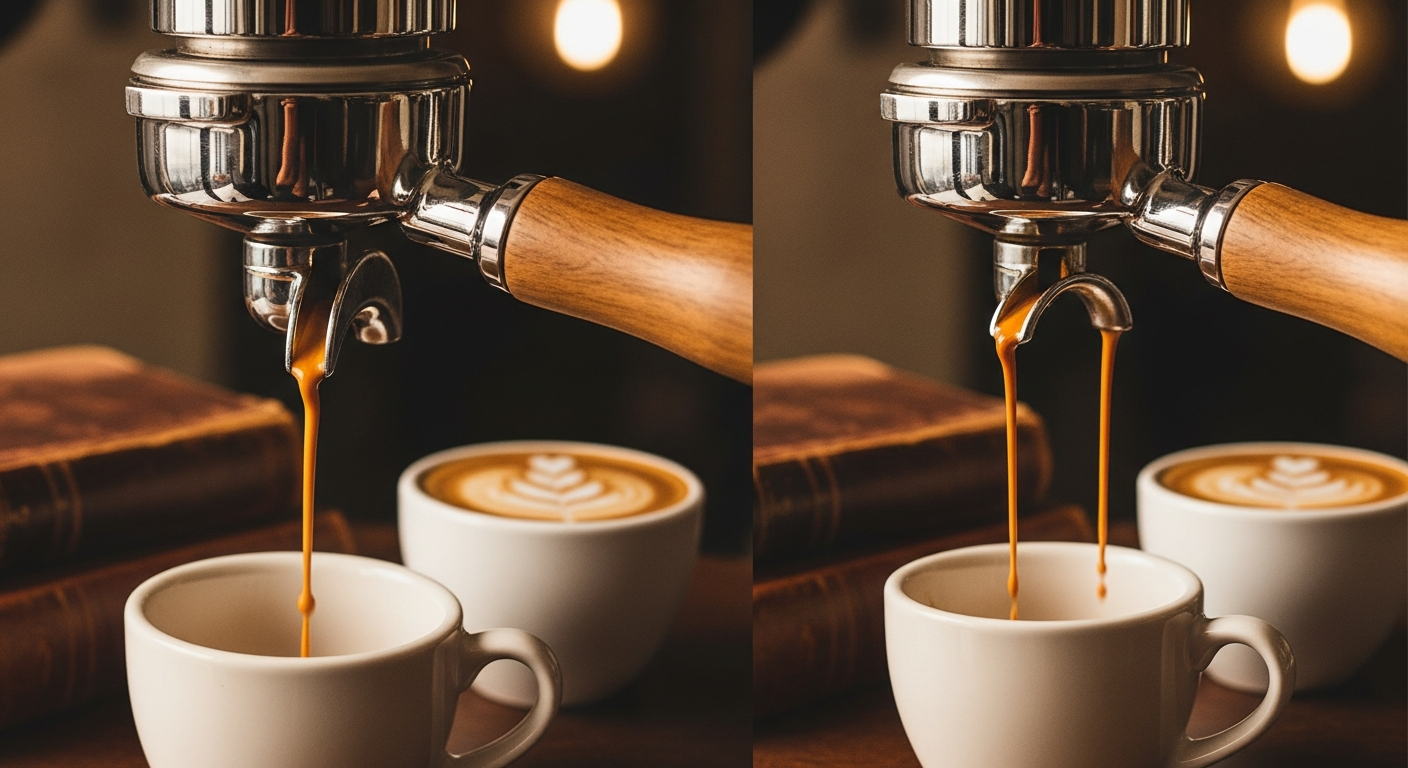
The spouted portafilter is the traditional design that has defined espresso service for decades. Characterized by one or two metal spouts at the bottom, these portafilters are designed to channel the flowing espresso into one or two cups simultaneously. For many, the spouted portafilter represents the “set it and forget it” reliability required for a busy morning routine.
One of the primary advantages of the spouted version is its ability to split shots. If you are frequently making two single lattes or sharing a double shot with a partner, the dual-spout design is indispensable. It provides a level of workflow efficiency that the bottomless version simply cannot match. Furthermore, spouted portafilters are generally more “forgiving.” Because the liquid is gathered in the bowl of the portafilter before exiting through the spouts, minor channeling or unevenness in your puck prep is hidden from view. While this doesn’t improve the *taste* of the shot, it certainly prevents the messy “spritzers” that can occur with a bottomless portafilter when your technique isn’t perfect.
From a thermal perspective, spouted portafilters offer a significant amount of thermal mass. Once fully heated by the group head, the heavy brass or stainless steel body helps maintain a consistent temperature as the water passes through the coffee puck. However, this is a double-edged sword: if the portafilter is cold, it will rapidly sap heat from your espresso, leading to sour, under-extracted shots. In 2026, we see more manufacturers moving toward high-grade stainless steel to minimize this thermal lag, but the fundamental design remains a pillar of consistency for those who prioritize a clean kitchen and a steady workflow.
Bottomless Portafilters: The Ultimate Diagnostic Tool
Often referred to as a “naked” portafilter, the bottomless version is exactly what it sounds like: a portafilter with the bottom floor removed, leaving the filter basket completely exposed. While it has become a staple of “coffee-gram” aesthetics due to the mesmerizing way the espresso beads and converges into a single golden stream, its true value is functional.
The bottomless portafilter is the ultimate diagnostic tool for any home barista looking to level up their skills. Because the bottom of the basket is visible, you can see exactly how the water is moving through the coffee puck in real-time. If you see “blonde” spots, multiple streams that won’t converge, or high-pressure jets of coffee shooting sideways (channeling), you know immediately that your puck prep—whether it be the grind, the distribution, or the tamp—needs adjustment. This instant feedback loop is the fastest way to master the art of the even extraction.
Beyond diagnostics, the bottomless portafilter offers a unique advantage in terms of cup clearance. By removing the spouts and the bottom of the handle, you gain an extra inch or two of vertical space. This allows you to fit larger latte mugs or even a scale and a tall glass directly under the group head, which is a common pain point for owners of smaller domestic espresso machines. Additionally, since the espresso goes directly from the basket into the cup without touching any extra metal, there is a school of thought that the crema remains more intact and the flavor profile more vibrant, as there is less surface area for the coffee to lose heat or oxidize.
The Great Debate: Crema, Flavor, and Temperature Stability
When comparing the output of these two tools, the differences often come down to the physics of the pour. Many enthusiasts argue that bottomless portafilters produce a superior crema. In a spouted portafilter, the espresso must travel across the metal floor and through the spouts before reaching the cup. This contact can cause some of the delicate CO2 bubbles that make up the crema to collapse. In a bottomless setup, the crema is preserved in its most “raw” state. In 2026, as we use more light-roast specialty beans that naturally produce less crema, preserving every bit of texture becomes a high priority.
Temperature stability is another point of contention. As mentioned, the spouted portafilter has more mass, which can be beneficial if pre-heated correctly. However, the bottomless portafilter is often preferred by those who find it difficult to keep their spouts hot. Because the coffee travels directly from the basket to the cup, it spends less time in contact with the portafilter body, potentially resulting in a hotter shot in the cup if the machine’s thermal management is slightly lacking.
However, there is a flavor caveat. Because the bottomless portafilter is so revealing, it can lead to “over-analysis.” A shot might look slightly messy but taste incredible. Conversely, a spouted portafilter might hide a minor channel that creates a tiny bit of bitterness, but the mixing that occurs inside the spouts can actually homogenize the flavor profile, resulting in a more balanced-tasting cup for the casual drinker.
Puck Prep and the Learning Curve
If you decide to make the switch to a bottomless portafilter, be prepared for a steeper learning curve. The naked portafilter is a cruel mistress; it will highlight every flaw in your technique. If your coffee is ground too coarsely or if your distribution is uneven, the resulting “spritzers” can spray espresso all over your machine, your counter, and your shirt.
This has led to the rise of advanced puck prep tools that are now considered essential in 2026. To get the most out of a bottomless portafilter, you will likely need:
* **A high-quality WDT (Weiss Distribution Technique) tool:** To break up clumps and ensure even density.
* **A calibrated or leveling tamper:** To ensure a perfectly flat and consistent puck.
* **Precision Filter Baskets:** Baskets from brands like IMS or VST are designed with more consistent hole patterns, which are almost a requirement for a clean bottomless pour.
With a spouted portafilter, you can get away with a less-than-perfect routine. The spouts catch the mess and the “bowl” of the portafilter acts as a buffer. For many home baristas, especially those just starting their journey, the spouted portafilter provides a “safe space” to enjoy coffee while they slowly refine their technique. The choice between the two often reflects where you are in your barista journey: are you looking to be challenged and improve, or do you just want a reliable caffeine fix?
Workflow Efficiency: Maintenance and Cleanliness
Maintenance is an often-overlooked aspect of the portafilter comparison. Spouted portafilters are notoriously difficult to keep perfectly clean. Over time, coffee oils and fine particles accumulate inside the spouts and the hollow area beneath the basket. If not scrubbed daily and backflushed regularly with detergent, these oils go rancid and will negatively affect the flavor of your espresso. Deep-cleaning a spouted portafilter often requires soaking it in a solution like Cafiza or even removing the spouts entirely to scrub the interior.
Bottomless portafilters are a dream to clean. Since there is no bottom and no spouts, there is nowhere for old coffee oils to hide. A quick rinse under the group head and a wipe with a microfiber cloth are usually all it takes to keep it in pristine condition. For the hygiene-conscious barista, the bottomless option is the clear winner.
However, “cleanliness” during the brewing process is a different story. As mentioned, the potential for splashing with a bottomless portafilter means your espresso machine’s drip tray and faceplate will likely need more frequent wiping. If you value a pristine, dry coffee station, the spouted portafilter—which keeps the liquid contained and directed—is much more practical for everyday use.
The Verdict: Which Tool Belongs in Your Coffee Bar?
The decision between a bottomless and spouted portafilter ultimately depends on your goals as a home barista.
**Choose a Spouted Portafilter if:**
* You frequently make drinks for two people and need to split shots.
* You are new to espresso and want to avoid the mess of “spritzing” while you learn.
* You prefer a traditional workflow and value the thermal stability of a heavy metal handle.
* You use a smaller machine where “hiding” minor extraction flaws leads to a more consistent morning experience.
**Choose a Bottomless Portafilter if:**
* You are a hobbyist who wants to diagnose and perfect your puck prep.
* You enjoy the visual aspect of espresso brewing and want to capture that perfect “honey-like” flow.
* You use tall cups or a scale and need the extra vertical clearance.
* You prioritize ease of cleaning and want to ensure no old oils are tainting your flavor.
* You have invested in precision baskets and WDT tools and want to see the results of your labor.
In 2026, many enthusiasts find that the best setup is actually having both. Use the bottomless portafilter on the weekends when you have time to dial in a new bag of beans and experiment with your technique. Switch back to the spouted portafilter during the busy work week when you need a fast, reliable, and mess-free double shot before heading out the door.
***
#
FAQ: Common Questions About Portafilter Types
**1. Does a bottomless portafilter make better-tasting espresso?**
Not inherently. It allows for a better-tasting shot by helping you *identify* and *fix* extraction errors. However, if your technique is already perfect, the difference in taste is minimal, though some baristas note a slight improvement in crema texture.
**2. Why is my bottomless portafilter spraying everywhere?**
This is usually caused by “channeling.” This happens when water finds a path of least resistance through the coffee puck. Common causes include an uneven tamp, clumps in the coffee grounds, or using coffee that is too old. Improving your puck prep with a WDT tool usually solves this.
**3. Can I use any basket in a bottomless portafilter?**
Yes! One of the best perks of a bottomless portafilter is that it can accommodate baskets of any height. If you want to use a massive 22g triple basket that wouldn’t fit in a standard spouted handle, a bottomless portafilter is the only way to do it.
**4. Is it harder to keep the temperature stable with a bottomless portafilter?**
Because there is less metal, it doesn’t “hold” heat as long as a spouted portafilter. However, because the coffee spends less time in contact with the metal, many find it actually delivers a more consistent temperature from the basket to the cup.
**5. Can I turn my spouted portafilter into a bottomless one?**
Yes, if you have access to a hole saw and a drill press, you can cut the bottom out of a standard portafilter. However, given the precision required and the availability of high-quality aftermarket bottomless portafilters in 2026, most people find it easier to simply purchase one designed for their specific machine’s group head size (e.g., 58mm or 54mm).
***
#
Conclusion
The debate between bottomless and spouted portafilters isn’t about which one is “better,” but rather which one serves your current needs. The spouted portafilter is the reliable workhorse of the coffee world—elegant, clean, and efficient. The bottomless portafilter is the teacher—demanding, revealing, and ultimately rewarding.
As the home espresso scene continues to evolve in 2026, the barriers to professional-level coffee at home are lower than ever. Whether you choose the traditional path or the “naked” one, the most important factor remains the quality of your beans and the precision of your grind. A portafilter is simply a window into your process; whether you choose to look through that window or keep it shuttered is up to you. For those committed to the craft, the bottomless portafilter remains an essential rite of passage, while the spouted handle remains the comforting standard of a well-earned cup.