espresso puck prep tools baristas
Mastering the Shot: The Ultimate Guide to Espresso Puck Prep Tools for Baristas in 2026
The journey from a bag of specialty beans to a syrupy, balanced shot of espresso is paved with precision. For years, the “holy trinity” of espresso consisted simply of a good grinder, a solid machine, and a heavy tamper. However, as we move into 2026, the landscape of home espresso has undergone a radical transformation. Baristas and home enthusiasts alike have realized that what happens inside the portafilter—the “puck prep”—is often more important than the price tag on the machine itself.
Puck prep is the art and science of ensuring that pressurized water moves through the coffee bed with absolute uniformity. Without proper preparation, water finds the path of least resistance, leading to “channeling,” where some grounds are over-extracted and bitter while others remain dry and sour. This guide explores the essential espresso puck prep tools that have become the gold standard for baristas, helping you unlock the full potential of your beans and achieve professional-grade results in your own kitchen.
The Science of Surface Area: Why Puck Prep Matters
To understand why we need a specialized toolkit, we must first understand the physics of extraction. When your espresso machine engages its pump, it forces water through the coffee bed at approximately 9 bars of pressure. In a perfectly prepared puck, this water moves evenly across the entire diameter of the basket. However, coffee grounds are naturally prone to “clumping” due to static electricity and the oils present in the beans.
These microscopic clumps create density variations. If one area of the puck is denser than another, the water will bypass the dense spots and rush through the looser areas. This is the definition of channeling. By 2026, the industry consensus has shifted: we are no longer just “squashing coffee”; we are performing micro-level architecture within the portafilter. Proper puck prep ensures that every single grain of coffee contributes equally to the flavor profile, resulting in the clarity, sweetness, and body that define a world-class shot. For the modern barista, these tools aren’t just gadgets; they are the gatekeepers of consistency.
Distribution Reimagined: From WDT to Blind Shakers
The most significant shift in puck prep over the last few years has been the refinement of distribution techniques. For a long time, baristas relied on the “stockfleth” method or simple finger leveling. Today, the Weiss Distribution Technique (WDT) is the undisputed king of the workflow.
#
The Evolution of WDT Tools
WDT involves using ultra-thin needles (typically 0.2mm to 0.35mm in diameter) to stir the grounds within the portafilter. This action breaks up clumps and redistributes the grounds to ensure a uniform density from top to bottom. In 2026, we’ve moved past the DIY cork-and-needle setups. Professional WDT tools now feature stand-integrated designs, replaceable needles, and ergonomic grips that allow for a systematic stirring pattern.
#
The Rise of the Blind Shaker
While WDT remains popular, 2026 has seen the “Blind Shaker” become a staple for high-end home setups. Originally popularized by world-class baristas, the shaker involves grinding coffee into a specialized vessel, shaking it to homogenize the particles and eliminate static, and then releasing the grounds directly into the center of the basket. This method provides a level of “randomized uniformity” that some argue outperforms manual stirring. Whether you prefer the meditative ritual of WDT or the efficiency of a shaker, the goal remains the same: a perfectly fluffy, clump-free bed of coffee.
Precision Tamping: Leveling Up Consistency
Once the coffee is distributed, it must be compressed into a puck. While tamping seems simple, it is the most common source of human error in the espresso workflow. An unlevel tamp—where one side of the puck is slightly deeper than the other—is a guaranteed recipe for lopsided extraction.
#
Calibrated and Leveling Tampers
The “standard” tamper is rapidly being replaced by leveling tampers. These tools feature a built-in flange that sits on the rim of the portafilter basket, ensuring that the tamping face is perfectly horizontal every single time.
Furthermore, calibrated tampers have become the norm for those seeking 100% repeatability. These tools use an internal spring mechanism to provide a consistent amount of pressure (usually around 25-30 lbs). In 2026, the focus has shifted away from “how hard” you tamp—since coffee is relatively incompressible after a certain point—and toward “how level” you tamp. Tools like the palm tamper, which combines distribution and tamping into one height-adjustable device, offer a streamlined workflow for baristas who value speed without sacrificing quality.
The Rise of Specialized Screens: Puck Screens and Paper Filters
One of the most interesting trends in 2026 espresso culture is the widespread adoption of secondary filtration—specifically puck screens and bottom paper filters.
#
Sintered Metal Puck Screens
A puck screen is a thin, stainless steel mesh disk that sits on top of the coffee grounds after tamping. It serves two primary purposes. First, it acts as a secondary dispersion screen, ensuring that the water from the group head is distributed even more softly and uniformly across the coffee. Second, it keeps your group head incredibly clean by preventing coffee oils and grounds from being sucked back into the machine’s internal valves. This leads to better thermal stability and less maintenance.
#
The Paper Filter Revolution
For the “high-clarity” obsessed barista, placing a small paper filter at the bottom of the basket (before the coffee) has become a game-changer. This prevents “fines”—the smallest particles of coffee—from clogging the holes of the portafilter basket. By reducing this resistance, baristas can grind even finer than usual without the shot stalling. The result is an espresso with higher extraction yields and a tea-like clarity that highlights the nuanced notes of light-roast specialty coffees.
Workflow Optimization: RDT, Mats, and Portafilter Stands
Precision puck prep can be messy, which is why workflow optimization tools are essential for the organized barista. A cluttered station leads to inconsistent shots.
#
RDT (Ross Droplet Technique)
Static is the enemy of grind quality. The RDT involves using a small spray bottle to mist your coffee beans with a tiny amount of water before grinding. This simple step virtually eliminates “chaff” and prevents grounds from sticking to the internal components of the grinder. In 2026, dedicated RDT atomizers with fine-mist nozzles are standard kit for any serious home barista.
#
The Foundation: Mats and Stands
A high-quality tamping mat protects your countertops and provides a stable surface for prep. However, the 2026 trend is moving toward dedicated portafilter stands. These stands hold the portafilter perfectly level while you perform WDT and tamping, eliminating the awkward balancing act on the edge of a counter. When your equipment has a dedicated home, your muscle memory develops faster, leading to a more fluid and enjoyable brewing process.
Essential 2026 Toolkit Checklist: Building Your Station
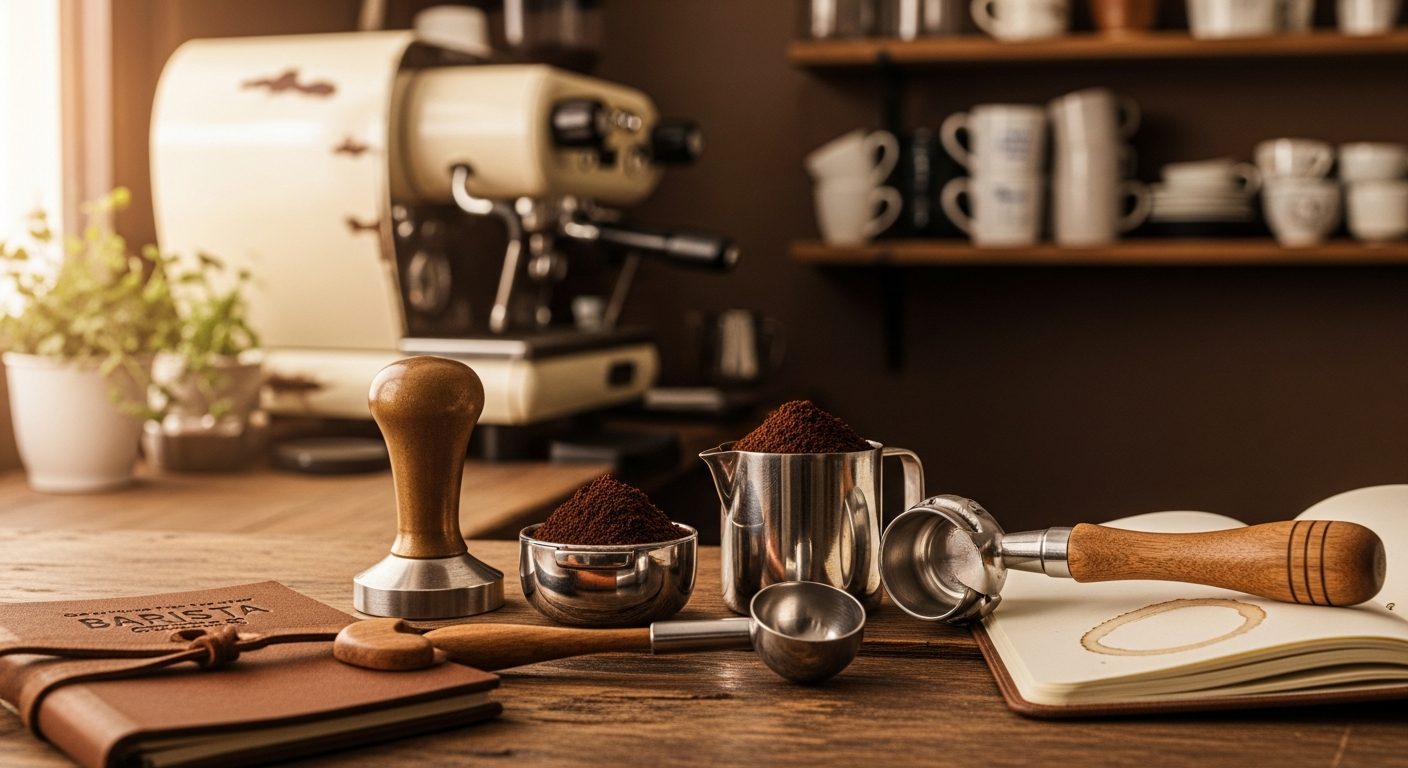
If you are looking to build the ultimate espresso station this year, here is a breakdown of the must-have puck prep tools. While you don’t need every single item to make good coffee, each piece adds a layer of insurance against a bad shot.
1. **High-Precision Basket:** Start with a precision basket (like those from VST or IMS). These have laser-drilled holes that ensure uniform flow across the entire bottom.
2. **Thin-Needle WDT Tool:** Look for needles between 0.25mm and 0.3mm for the best “fluffing” effect without moving the coffee around too much.
3. **Self-Leveling Tamper:** Eliminate the “leaning tower of coffee” forever with a tamper that rests on the basket rim.
4. **Dosing Funnel:** This is a simple ring that sits on your portafilter to prevent grounds from spilling during the WDT process. It is the best way to keep your station clean.
5. **Puck Screen:** A 1.7mm or 1.0mm sintered screen to protect your machine and improve water dispersion.
6. **Digital Scale (0.1g resolution):** You cannot manage puck prep if you don’t know exactly how much coffee is in the basket. Consistency starts with the weight.
By integrating these tools into a cohesive workflow, the modern barista moves away from guesswork and toward a repeatable, scientific process.
FAQ: Espresso Puck Prep for Baristas
#
1. Is WDT really necessary, or is it just a fad?
While it may seem like an extra step, WDT is one of the few tools that provides a measurable improvement in extraction yield. By breaking up clumps created by the grinder, you ensure that the water doesn’t find “soft spots” in the puck. In 2026, it is considered the most cost-effective way to improve the taste of your espresso.
#
2. Should I tamp as hard as I can?
No. Once the air is removed from the coffee bed and the grounds are fully compressed, additional pressure does not change the density of the puck. The goal of tamping is to create a level, air-free surface. Usually, about 15-25 lbs of pressure is more than enough. Focusing on a level tamp is far more important than the amount of force used.
#
3. Do puck screens affect the temperature of the brew?
Puck screens have a small amount of thermal mass. Most baristas in 2026 recommend pre-heating the screen by placing it on top of the portafilter while the machine warms up or running a “blank shot” with the screen in place. This ensures it doesn’t “steal” heat from the water during extraction.
#
4. What is the difference between a dosing cup and a blind shaker?
A dosing cup is simply a vessel to catch grounds and transfer them to the portafilter. A blind shaker is designed with a center plug that, when lifted, drops the grounds into the basket in a specific way that promotes even distribution. Shakers are generally more effective at reducing static and clumps but require a bit more technique.
#
5. Can I use paper filters with any portafilter?
Yes, as long as the paper filter is the correct diameter for your basket (usually 58mm, 54mm, or 51mm). You can place them at the bottom to improve clarity or on the top as a budget-friendly alternative to a metal puck screen.
Conclusion: The Path to the Perfect Shot
The world of espresso in 2026 is one of incredible detail and intentionality. While the sheer number of espresso puck prep tools available to baristas might seem overwhelming at first, they all serve a singular purpose: the elimination of variables. When you remove the randomness of clumping, the error of unlevel tamping, and the mess of static, you are left with the true flavor of the coffee bean.
For the home barista, these tools turn a morning routine into a craft. They provide the confidence that when you pull a shot of an expensive, rare Gesha or a robust chocolatey blend, you are tasting exactly what the roaster intended. Investing in high-quality puck prep tools is ultimately an investment in your own palate. As you refine your workflow and master these instruments, the “god shot”—that elusive, perfect balance of sweetness, acidity, and body—becomes less of a lucky accident and more of a daily reality. Happy brewing!