How To Read A Coffee Bag
Unlocking the Secrets of Your Brew: A Comprehensive Guide on How to Read a Coffee Bag
Affiliate disclosure: This article may contain affiliate links. Recommendations are independent and editorially driven.
For many, a coffee bag is simply a container for their favorite morning ritual. It’s a wrapper, perhaps adorned with an attractive logo, holding the roasted beans that promise a delicious start to the day. But for the discerning coffee enthusiast, a coffee bag is far more than just packaging; it’s a treasure map, brimming with vital clues about the liquid gold inside. Learning how to read a coffee bag effectively transforms your coffee experience, elevating it from a simple beverage to a rich tapestry of flavors, origins, and stories.
At cafeserre, we believe that every cup tells a story. And that story often begins long before the beans hit your grinder, encapsulated in the intricate details printed on its protective pouch. From the country of origin to the specific varietal, the processing method to the roast date, each piece of information provides a window into the journey of your coffee bean and offers insights into the flavors and aromas awaiting you. This guide will meticulously break down every element you might encounter on a coffee bag, empowering you to make informed choices, appreciate your coffee more deeply, and consistently brew the perfect cup tailored to your preferences.
Whether you’re a seasoned barista or a curious home brewer, understanding these labels is your first step towards coffee mastery. It’s about knowing what you’re buying, appreciating the immense effort behind each bean, and ultimately, making sure your brewing journey is as informed and delightful as possible. Let’s embark on this journey to decode the hidden language of coffee bags together.
Beyond the Brand: Why Reading Your Coffee Bag Matters More Than You Think
In a world saturated with choices, simply picking a coffee based on an appealing brand name or a catchy design is akin to judging a book solely by its cover. While aesthetics play a role, the true value and experience of your coffee lie in the details. Learning how to read a coffee bag is an essential skill for anyone looking to truly appreciate and optimize their coffee drinking experience.
The Hidden Language of Flavor and Terroir
Every coffee bean carries the imprint of its origin – its climate, soil, altitude, and processing. These factors, collectively known as terroir, dictate the inherent flavors and characteristics of the bean. Without understanding the information on the bag, you’re missing out on the crucial data that predicts whether your coffee will be bright and fruity, rich and chocolatey, or bold and earthy. The bag often provides explicit flavor notes, but understanding the underlying factors like varietal and processing method can give you an even deeper insight into what to expect in your cup.
Making Informed Coffee Choices Tailored to Your Palate
Imagine consistently buying coffee that perfectly matches your taste preferences. That’s the power of decoding your coffee bag. Are you a fan of vibrant acidity and floral notes? Look for specific origins, varietals, and light roasts. Do you prefer a comforting, full-bodied cup with chocolate undertones? Certain regions, processing methods, and medium roasts will guide you. By understanding the language of the bag, you move beyond guesswork and start making deliberate, informed choices that guarantee satisfaction. It also helps you avoid coffees you might not enjoy, saving you time and money.
Elevating Your Home Brewing Experience with Precision
The information on a coffee bag isn’t just about taste prediction; it’s also about optimizing your brewing process. Roast date, for instance, is paramount for ensuring freshness, which directly impacts extraction and flavor. Recommendations for brewing methods or grind size, often subtly hinted at or explicitly stated, can guide you towards the ideal preparation. Knowing the origin and processing can even influence your brewing temperature or water chemistry choices, allowing you to fine-tune your technique and extract the absolute best from your beans. This precision transforms home brewing from a routine into an art form.
The Anatomy of a Coffee Bag: Essential Elements at a Glance
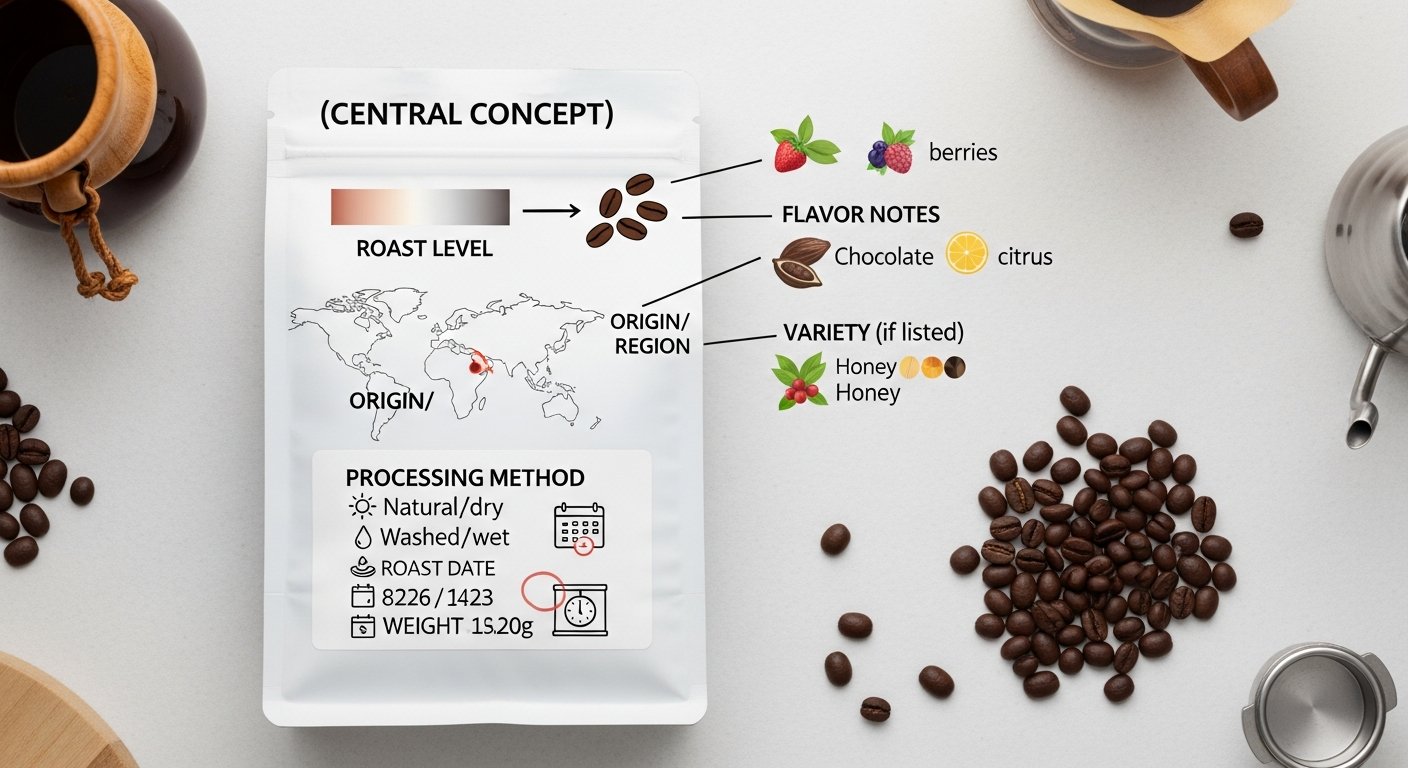
Before diving deep into the nuances, let’s establish a foundational understanding of the common elements found on most specialty coffee bags. These are the immediate identifiers that offer a quick overview of what’s inside and are crucial for proper storage and consumption.
Roaster Name and Branding: Your Guide to Quality and Style
At the forefront of almost every coffee bag is the roaster’s name and logo. This isn’t just marketing; it’s an indicator of the coffee’s provenance and the philosophy behind its creation. Reputable specialty roasters are transparent about their sourcing, roasting practices, and commitment to quality. Over time, you’ll learn which roasters consistently align with your taste preferences and ethical standards. Their branding often reflects their overall approach, from minimalist and modern to traditional and rustic.
Coffee Name/Blend Designation: Single Origin or Harmonious Mix?
The name of the coffee can be a single origin (e.g., “Ethiopia Yirgacheffe”) or a blend (e.g., “Morning Ritual Blend”). A single origin coffee highlights the unique characteristics of beans from a specific geographical area, often a single farm or cooperative. Blends, on the other hand, combine beans from different origins, varietals, or processes to achieve a consistent flavor profile, balance, or specific application (like espresso). Blends are crafted to offer a harmonious and often more complex cup than a single origin might provide alone.
Roast Date vs. Best By Date: The Crucial Distinction for Freshness
This is arguably the single most important piece of information on a coffee bag for freshness and flavor. The **roast date** tells you exactly when the beans were roasted. For optimal flavor and aroma, coffee should typically be consumed within 2-4 weeks of its roast date, though some light roasts can taste great even longer. Freshness is key for proper extraction and to avoid stale, flat flavors. A “best by” date, however, is a much less useful indicator, as it often refers to a period far beyond the coffee’s peak freshness (sometimes 6-12 months after roasting), akin to a grocery store milk expiry date that means very little for actual coffee quality. Always prioritize the roast date.
Whole Bean vs. Ground: Preparing for Your Preferred Brew Method
Most specialty coffee is sold as whole beans, and for good reason: grinding fresh immediately before brewing preserves the volatile aromatic compounds that give coffee its incredible flavor. If the bag indicates “ground,” it means the beans have already been processed to a specific consistency, usually for drip coffee makers. While convenient, pre-ground coffee rapidly loses freshness. Some bags might specify the grind type (e.g., “espresso grind,” “French press grind”), but whole beans offer the ultimate flexibility and quality for home brewers. If you see “whole bean,” you’ll need a grinder at home.
Net Weight: Understanding Quantity and Value
The net weight, typically expressed in grams (g) or ounces (oz), indicates the amount of coffee contained in the bag. Common sizes include 250g/8.8oz, 340g/12oz, or 1kg/2.2lb. This is essential for understanding the value proposition and planning your coffee consumption. A typical serving of coffee uses about 15-20g of beans, so knowing the total weight helps you gauge how many cups you can expect from a single bag.
Decoding Origin: Where Your Coffee Comes From
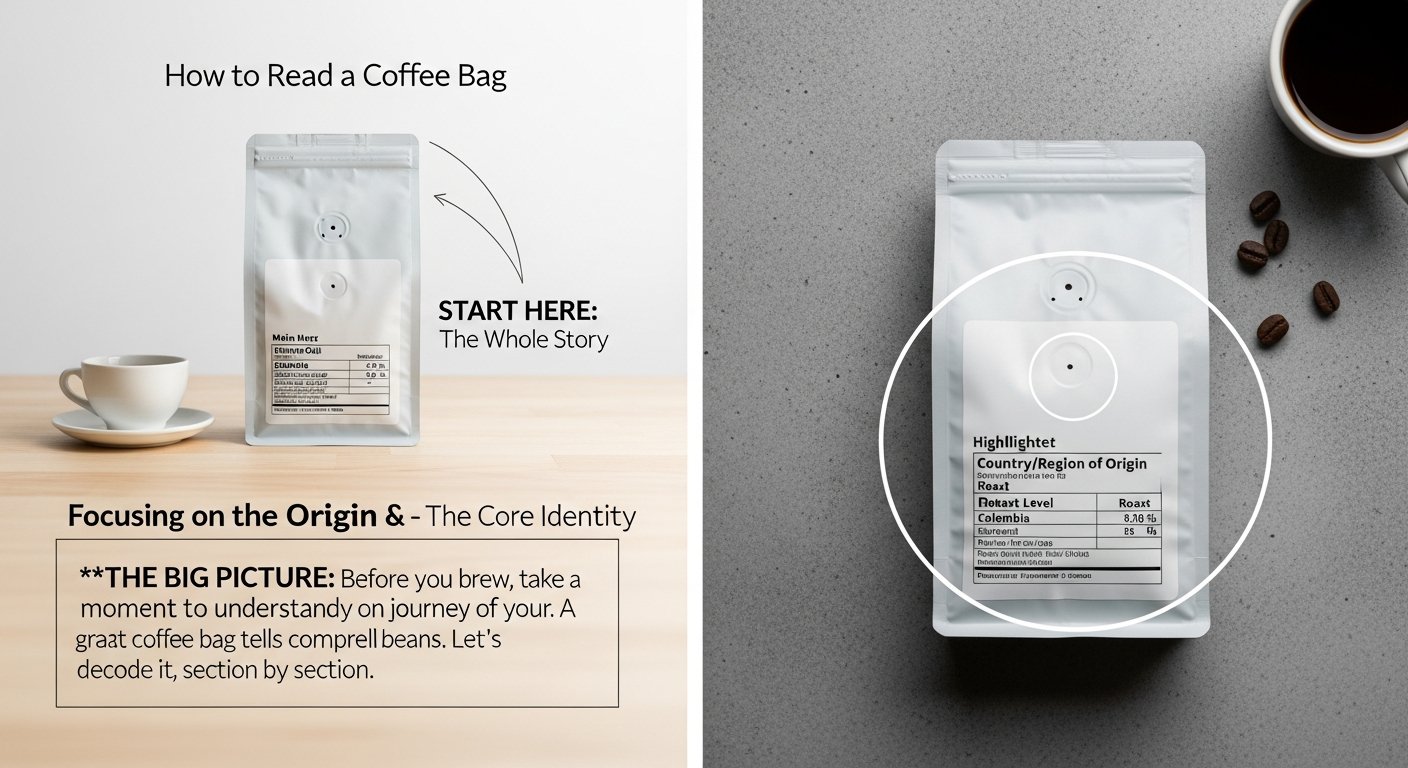
The origin of your coffee bean is perhaps the most foundational piece of information, deeply influencing its intrinsic characteristics. It’s the birthplace of the bean, imbuing it with unique flavors and aromas shaped by climate, soil, and altitude.
[INLINE IMAGE 1: place after second H2 | alt=”how to read a coffee bag concept illustration”]
Single Origin vs. Blend: Understanding the Terroir and Intent
As mentioned, coffee bags often specify whether the coffee is a “Single Origin” or a “Blend.” Single origin coffees are celebrated for showcasing the unique terroir of a specific region, farm, or cooperative. They offer a direct taste of a particular place, often with distinct and pronounced characteristics. Blends, conversely, are curated combinations of beans from various origins. Roasters craft blends to achieve a desired balance, consistency, or flavor profile that might not be found in a single origin, often designed for specific brewing methods like espresso. Understanding this distinction helps you choose between an adventurous journey into a specific terroir or a consistently balanced experience.
Country of Origin: The Big Picture of Flavor Profiles
The country where the coffee was grown provides the first broad strokes of its flavor profile. Different coffee-growing regions of the world are known for general characteristics:
- Africa (e.g., Ethiopia, Kenya, Rwanda): Often bright, fruity, floral, with high acidity. Expect notes of berries, citrus, jasmine.
- Central America (e.g., Costa Rica, Guatemala, Honduras): Typically clean, balanced, medium-bodied, with notes of chocolate, nuts, and caramel, often with crisp apple-like acidity.
- South America (e.g., Colombia, Brazil): Generally smooth, full-bodied, with lower acidity. Brazil is known for nutty, chocolatey notes; Colombia for citrus, caramel, and a balanced profile.
- Asia (e.g., Indonesia, Vietnam): Often earthy, bold, low acidity, with notes of dark chocolate, spice, and sometimes a rustic or smoky quality.
This macro-level information provides a good starting point for expectations.
Region and Micro-Region: Drilling Down to Specificity and Nuance
Beyond the country, many specialty coffee bags will specify a particular region or even a micro-region within that country. This level of detail offers more precise flavor predictions. For example, within Ethiopia, a Yirgacheffe will taste very different from a Sidama or a Guji. Yirgacheffe is renowned for its intense floral and citrus notes, while Sidama often presents with berry and wine-like qualities. Similarly, a coffee from the Tarrazú region of Costa Rica will have different nuances than one from West Valley. The more specific the origin, the more distinct and unique the flavor profile tends to be.
Farm, Estate, or Cooperative: The Producer Story and Direct Connection
At the pinnacle of origin transparency, some bags will name the specific farm, estate, or cooperative that grew the coffee. This level of detail indicates a high degree of traceability and often a direct relationship between the roaster and the producer. It allows you to connect with the human element behind your coffee, understanding who grew it and the specific conditions of its cultivation. This transparency is a hallmark of specialty coffee and often correlates with exceptional quality and ethical sourcing practices. It fosters a connection to the very hands that nurtured the beans.
Altitude: Its Profound Impact on Density and Flavor Development
Altitude is a critical factor often listed on specialty coffee bags, usually measured in meters above sea level (masl). Generally, coffee grown at higher altitudes (above 1,200 masl) develops more slowly, resulting in denser, harder beans. This density contributes to a more complex flavor profile, higher acidity, and increased aromatic compounds. High-altitude coffees are often vibrant, floral, and fruity. Lower-altitude coffees tend to grow faster, producing softer beans with less acidity and a more pronounced body, often exhibiting chocolatey or nutty notes. The altitude directly influences the bean’s cellular structure and the concentration of flavor precursors.
Explore more about the impact of terroir on coffee flavor in our detailed guide.
The Bean’s Pedigree: Varietals and Processing Methods
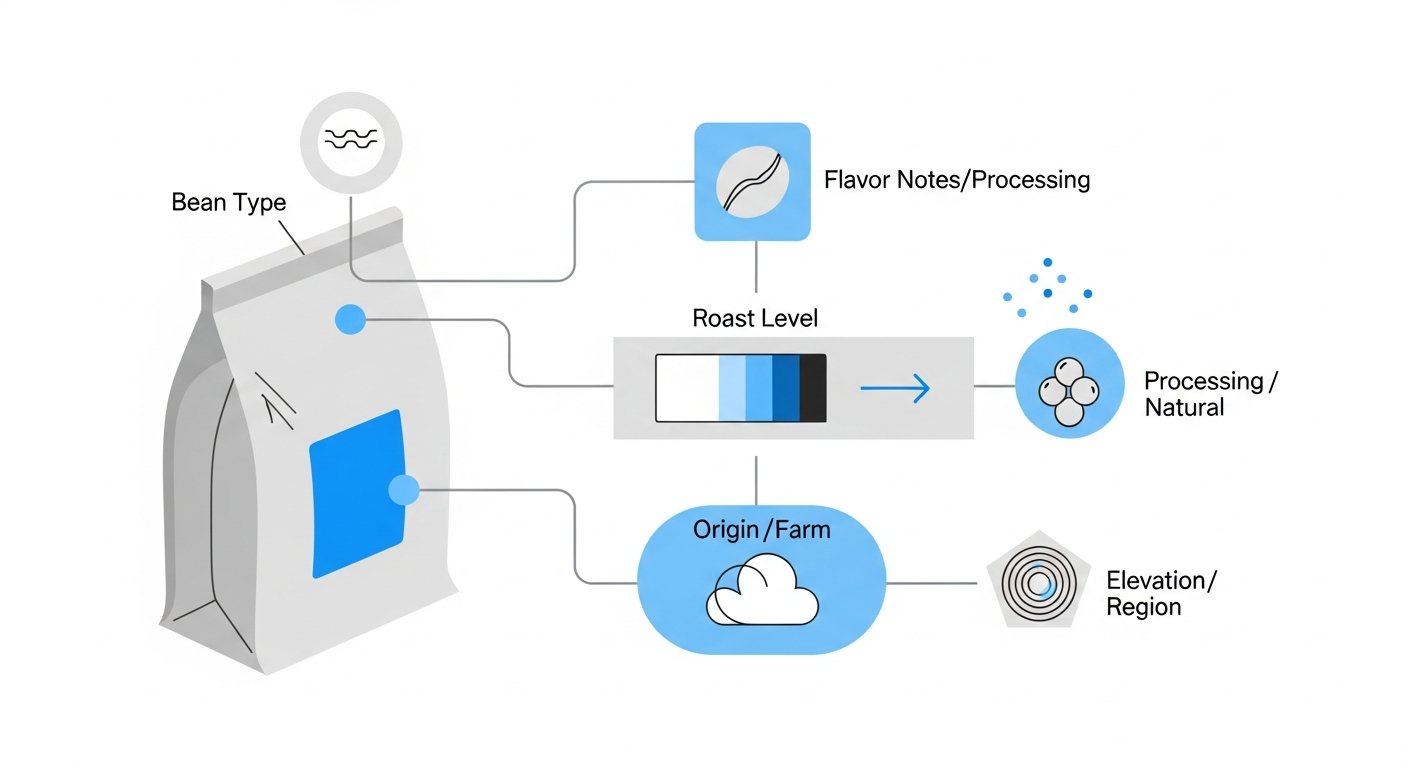
Once you understand where your coffee comes from, the next layer of information on how to read a coffee bag reveals what kind of coffee it is and how it was prepared after harvest. These details are profoundly impactful on the final taste in your cup.
Common Coffee Varietals: Beyond Arabica and Robusta
While the vast majority of specialty coffee is Arabica, there are hundreds of distinct Arabica varietals, each with its own genetic characteristics and flavor potential. Understanding these can unlock a deeper appreciation for the nuances in your cup:
- Typica & Bourbon: Considered the “parents” of many other varietals, known for excellent cup quality, often sweet, clean, and balanced.
- Gesha/Geisha: Highly prized for its exceptionally complex, floral, and tea-like notes, often with bright acidity and tropical fruit flavors.
- SL28 & SL34: Found predominantly in Kenya, these varietals are famous for their bold, complex flavors, often with blackcurrant, tomato, and citrus notes.
- Caturra: A natural mutation of Bourbon, known for high yields and bright acidity, often with citrus and caramel notes.
- Pacamara: A hybrid of Pacas and Maragogipe, producing large beans with complex, often floral, and intensely fruity flavors.
- Heirloom (Ethiopia): Many Ethiopian coffees are simply labeled “heirloom” because of the vast genetic diversity of wild Arabica varieties in the region, contributing to their unique and often intensely floral and fruity profiles.
While Robusta is less common in specialty circles, it’s known for its high caffeine content, strong body, and often rubbery or bitter notes, though high-quality Robustas do exist. Knowing the varietal helps set expectations for the inherent flavor potential.
Understanding Processing Methods: How the Bean is Prepared for Roasting
After harvesting, coffee cherries undergo a crucial processing step to separate the bean from the fruit. This method significantly impacts the final flavor profile:
- Washed (or Wet) Process: This is the most common method, producing clean, bright, and often highly acidic coffees. The fruit is removed from the bean shortly after harvest using water and fermentation, then the beans are dried. This method highlights the inherent characteristics of the bean and its terroir. Flavors are typically crisp, fruity, and floral.
- Natural (or Dry) Process: In this older method, the entire coffee cherry is dried with the bean still inside. As the fruit dries, its sugars and flavors are absorbed into the bean, resulting in coffees with heavier body, lower acidity, and intensely fruity, sweet, and sometimes wine-like or fermented notes. Expect notes of berries, tropical fruits, and chocolate.
- Honey (or Pulped Natural) Process: A hybrid method where the skin of the cherry is removed, but some or all of the sticky mucilage (the “honey”) is left on the bean to dry. This method strikes a balance between washed and natural, often yielding coffees with good body, balanced acidity, and distinct sweetness, often with notes of caramel, honey, and stone fruit.
- Anaerobic Fermentation: A modern and increasingly popular method where coffee cherries or depulped beans are fermented in oxygen-deprived tanks for an extended period. This controlled fermentation can produce incredibly unique and complex flavors, often pushing boundaries with notes of exotic fruits, spices, and sometimes a distinctive “boozy” quality.
The processing method is a powerful flavor predictor, and understanding it is key to anticipating your coffee’s character.
Impact of Processing on Flavor Profile: A Spectrum of Taste
The choice of processing method is not arbitrary; it’s a deliberate decision by producers to cultivate specific flavor characteristics. Washed coffees emphasize clarity and the pure essence of the bean. Natural coffees lean into sweetness and fruitiness, often with a wilder, more expressive profile. Honey process offers a middle ground of balanced sweetness and body. Anaerobic and other experimental processes push the boundaries, creating novel and sometimes polarizing flavor experiences. Paying attention to this detail on the coffee bag can guide you towards coffees that align with your preferred flavor spectrum.
Roast Level: The Spectrum of Flavor Development
The roast level is one of the most immediate indicators of a coffee’s general taste profile. It refers to how long and at what temperature the green coffee beans were roasted. This process transforms the bean’s chemical structure, developing flavors, body, and aroma. Understanding the roast level is crucial for predicting intensity and overall character.
[INLINE IMAGE 2: place after fourth H2 | alt=”how to read a coffee bag comparison illustration”]
Light Roasts: Bright, Aromatic, and Complex
Light roasts are typically stopped shortly after the “first crack” (when the beans start to expand and make a popping sound). The beans are light brown, often retaining some of their original green hue in the crevices, and are dry, without visible oil. These roasts highlight the inherent characteristics of the bean’s origin and varietal. Expect vibrant acidity, delicate body, and complex aromatic notes like floral, fruity, citrus, and sometimes tea-like qualities. They are less bitter and often have a sweeter, cleaner finish. This roast level is favored by specialty coffee enthusiasts for showcasing nuance.
Medium Roasts: Balanced, Sweet, and Developing Body
Medium roasts are developed further, past the first crack but before the “second crack.” The beans are a medium brown color, still dry, and have a more balanced flavor profile. This roast level balances the origin characteristics with the sweetness and body developed during roasting. Expect a rounded acidity, medium body, and notes of chocolate, nuts, caramel, and sometimes a subtle spiciness. They are less bright than light roasts but more complex than dark roasts, offering a harmonious and approachable cup. This is often a crowd-pleasing roast level.
Dark Roasts: Bold, Smoky, and Intense
Dark roasts are roasted until or past the second crack. The beans are very dark brown, often glistening with oils that have been drawn to the surface. These roasts prioritize bold, intense flavors over the nuanced characteristics of the origin. Acidity is significantly muted, and the body is often heavy. Expect strong notes of dark chocolate, smoke, roast bitterness, and sometimes a charcoal or burnt sugar quality. While they offer less origin distinction, dark roasts are popular for those who prefer a robust, powerful cup, often enjoyed with milk and sugar. Terms like “French Roast” or “Italian Roast” typically refer to very dark roasts.
Roast Color Indicators and Terminology: Navigating the Labels
While some roasters explicitly label their coffees as “light,” “medium,” or “dark,” others use more evocative terms. It’s important to understand that there’s no universally standardized terminology, and a “medium” from one roaster might be a “medium-light” from another. However, common indicators include:
- Light Roast: City, City+, Cinnamon
- Medium Roast: Full City, Full City+
- Dark Roast: French, Italian, Espresso Roast (though espresso can be made from any roast level, traditionally darker roasts were used)
When in doubt, looking for visual cues (if possible, through a small window on the bag) or trusting the roaster’s general style based on their branding and other offerings can help. The absence of specific terms often means the roaster focuses on a specific ideal roast for each particular bean, which usually falls in the light to medium spectrum for specialty coffee.
Flavor Notes and Cupping Scores: Aromatic Clues to Your Next Favorite Cup
Beyond the technical details of origin and roast, coffee bags often include a section dedicated to the expected flavor notes and, sometimes, a cupping score. This information is your direct portal into the sensory experience the roaster intends for you to discover.
The Coffee Flavor Wheel: A Sensory Map for Describing Taste
Many flavor notes listed on coffee bags are derived from the Specialty Coffee Association (SCA) Flavor Wheel, a comprehensive tool developed to standardize coffee tasting terminology. This wheel categorizes flavors into broad groups (e.g., Floral, Fruity, Sweet, Nutty, Cocoa, Spice, Green/Vegetative, Roasted) and then drills down into more specific descriptors (e.g., Rose, Jasmine, Berry, Citrus, Honey, Caramel, Almond, Dark Chocolate). Roasters use these terms to communicate the dominant and subtle characteristics of their coffee, helping you anticipate the taste profile before you even brew.
Common Flavor Descriptors: What Do They Really Mean?
When you see “notes of chocolate and caramel” or “bright acidity with hints of berries and jasmine,” these aren’t artificial additives. Instead, they refer to aromatic and gustatory compounds naturally present in the coffee that evoke these familiar sensations. Here’s a quick guide:
- Fruity: Often indicates a coffee with bright, sweet, and sometimes tangy notes reminiscent of berries, stone fruits (peach, apricot), or citrus. Common in African coffees and natural processes.
- Floral: Delicate, aromatic notes like jasmine, rose, bergamot. Frequently found in high-quality Ethiopian coffees.
- Nutty: Flavors resembling almonds, walnuts, hazelnuts, or peanuts. Common in South American and Central American coffees.
- Chocolatey: Can range from milk chocolate sweetness to dark, bittersweet cocoa notes. A ubiquitous descriptor, especially in medium and dark roasts.
- Caramel/Honey: Sweet, rich notes often associated with the Maillard reaction during roasting. Common in medium roasts and honey-processed coffees.
- Spicy: Hints of cinnamon, clove, nutmeg, or even black pepper. Can be found in certain Asian coffees or specific varietals.
- Earthy/Woody: Often refers to deep, sometimes slightly pungent or savory notes reminiscent of forest floor, tobacco, or cedar. More common in Indonesian coffees.
Remember, these are tasting notes, not ingredients. The art is in identifying these nuances yourself!
Acidity, Body, and Finish: Understanding Textural Elements and Lingering Sensations
Beyond flavor, roasters sometimes describe other sensory attributes:
- Acidity: Often misunderstood, acidity in coffee refers to a pleasant, bright, and lively sensation on the tongue, similar to that in a crisp apple or a glass of wine. It adds complexity and vibrancy. Low acidity can feel flat, while very high acidity can be perceived as sour. Descriptions might include “bright,” “citric,” “malic,” or “wine-like.”
- Body: This refers to the weight, thickness, or mouthfeel of the coffee. It can range from “light and tea-like” to “heavy and syrupy.” Factors like varietal, processing, and roast level all influence body.
- Finish (or Aftertaste): The lingering flavors and sensations on your palate after you’ve swallowed the coffee. A good coffee often has a long, pleasant, clean, or sweet finish.
Understanding Cupping Scores: A Numerical Quality Indicator
Some bags, particularly those for high-end or competition-grade coffees, might display a cupping score, typically on a 100-point scale (often above 80 points for specialty coffee). This score is derived from a standardized tasting protocol (cupping) conducted by certified Q Graders (for Arabica) or R Graders (for Robusta) of the Coffee Quality Institute (CQI) and Specialty Coffee Association (SCA). Points are awarded for fragrance/aroma, flavor, aftertaste, acidity, body, balance, sweetness, uniformity, clean cup, and overall impression. A score of 80+ indicates specialty grade, 85+ is excellent, and 90+ is truly exceptional. It’s a reliable indicator of objective quality.
To illustrate how these characteristics interplay, consider this comparison table:
| Coffee Profile | Origin/Varietal | Roast Level | Processing Method | Typical Flavor Notes | Acidity/Body |
|---|---|---|---|---|---|
| Ethiopian Yirgacheffe | Ethiopia (Heirloom) | Light | Washed (often) | Jasmine, Bergamot, Lemon, Blueberry | High/Light |
| Colombian Supremo | Colombia (Caturra/Castillo) | Medium | Washed | Caramel, Milk Chocolate, Orange Zest | Medium/Medium |
| Brazilian Cerrado | Brazil (Mundo Novo/Catuai) | Medium-Dark | Natural (often) | Hazelnut, Dark Chocolate, Brown Sugar | Low/Full |
| Kenyan AA | Kenya (SL28/SL34) | Light-Medium | Washed | Blackcurrant, Tomato, Grapefruit, Wine | High/Medium |
| Sumatra Mandheling | Indonesia (Typica/Catimor) | Dark | Wet-Hulled | Earth, Dark Cocoa, Cedar, Tobacco | Low/Heavy |
Certifications and Sustainability: Ethical and Environmental Considerations
Beyond taste, many coffee consumers prioritize the ethical and environmental impact of their choices. Coffee bags often include various certifications and labels that signal a commitment to social responsibility, environmental stewardship, or both. Understanding these logos helps you align your purchases with your values.
Organic Certification: Ensuring Chemical-Free Cultivation
An “Organic” certification (e.g., USDA Organic, EU Organic) indicates that the coffee was grown and processed without the use of synthetic pesticides, herbicides, fertilizers, or genetically modified organisms (GMOs). Farmers must adhere to strict guidelines for several years before achieving certification. Choosing organic coffee supports ecological balance, biodiversity, and reduces exposure to chemicals for both farmers and consumers.
Fair Trade: Equitable Farmer Compensation and Community Development
Fair Trade certification (e.g., Fairtrade International, Fair Trade USA) ensures that farmers receive a fair and stable minimum price for their coffee, regardless of market fluctuations. It also often includes a premium that goes into community development projects, decided upon democratically by the farmers. Fair Trade aims to empower farmers, improve their livelihoods, and foster sustainable farming practices. It’s a strong indicator of social equity.
Rainforest Alliance: Environmental Conservation and Worker Welfare
The Rainforest Alliance seal signifies that a farm meets comprehensive standards for environmental protection, social equity, and economic viability. This includes preserving biodiversity, protecting waterways, reducing agrochemical use, and ensuring fair treatment and good working conditions for workers. It’s a holistic approach to sustainable agriculture and often results in vibrant ecosystems on and around coffee farms.
Direct Trade: Roaster-Farmer Relationships and Mutual Benefit
While not a third-party certification, “Direct Trade” indicates that the roaster has established a direct relationship with the coffee farm or cooperative, bypassing traditional middlemen. This often means more transparent pricing, higher payments to farmers, and a greater exchange of knowledge and feedback. Direct trade allows roasters to visit farms, ensure quality, and contribute directly to the producers’ well-being. It’s a powerful statement of commitment to both quality and ethical sourcing.
Other Ethical Labels: A Spectrum of Values
Other certifications and labels you might encounter include:
- Bird Friendly® (Smithsonian Migratory Bird Center): This is the gold standard for environmentally friendly coffee, requiring coffee to be grown under a shade canopy that provides habitat for migratory birds, promoting biodiversity.
- UTZ Certified (now part of Rainforest Alliance): Focuses on sustainable farming and better opportunities for farmers.
- C.A.F.E. Practices (Starbucks): A proprietary set of ethical sourcing guidelines developed by Starbucks in partnership with Conservation International.
Each of these labels signifies a different focus and commitment. Understanding them allows you to choose coffee that aligns with your personal ethical compass.
Learn more about sustainable coffee practices and certifications in our comprehensive guide.
Brewing Recommendations and Storage Tips: Maximizing Your Experience
The information on your coffee bag isn’t just about understanding the bean’s history; it’s also about optimizing its future in your cup. Many specialty roasters include brewing parameters and storage advice to help you extract the best possible flavors from their carefully sourced and roasted beans.
Suggested Brewing Methods: Finding the Perfect Extraction Technique
Some bags will offer specific brewing method recommendations, as certain coffees shine brighter with particular techniques. For example:
- Pour Over (e.g., Hario V60, Kalita Wave): Often recommended for light-roasted, single-origin coffees with complex aromatics and bright acidity. It highlights clarity and nuanced flavors.
- Espresso: While any coffee can technically be used for espresso, some blends or single origins are specifically roasted or selected for their ability to create a balanced, creamy shot with good crema. Darker roasts or full-bodied medium roasts are often preferred.
- French Press (or Immersion Brewers like Aeropress): Excellent for coffees where you want to emphasize body and richness. It allows for full saturation and minimal filtration, resulting in a robust, sediment-rich cup. Medium to dark roasts often perform well.
- Automatic Drip Coffee Maker: A versatile method for everyday brewing. Medium-roasted, balanced coffees are typically a good fit.
These recommendations are starting points, not rigid rules, but they often reflect the roaster’s intention for how their coffee is best enjoyed.
Grind Size Guidance: The Foundation of Proper Extraction
The grind size is critical for proper extraction. If the grind is too coarse, water passes through too quickly, resulting in under-extracted, sour, or weak coffee. If it’s too fine, water is restricted, leading to over-extracted, bitter, or astringent coffee. While bags rarely specify exact grind settings, they might give general advice:
- Coarse: French Press, Cold Brew
- Medium-Coarse: Chemex
- Medium: Drip Coffee Makers, Aeropress (longer steep)
- Medium-Fine: Pour Over (V60, Kalita)
- Fine: Espresso, Aeropress (shorter steep)
- Very Fine (Turkish): Specific Turkish coffee preparation
If you purchase whole beans, a quality burr grinder is an invaluable investment for achieving consistent, optimal grind sizes for your chosen brewing method.
Optimal Water Temperature and Ratio: Precision for Peak Flavor
Some detailed bags might even provide guidance on water temperature (typically between 195-205°F / 90-96°C) and coffee-to-water ratio. A common starting ratio is 1:15 to 1:18 (e.g., 1 gram of coffee to 15-18 grams of water). These parameters are crucial for dissolving the desirable flavor compounds from the coffee while leaving undesirable ones behind. Deviating too far can drastically alter the taste, making even the best beans taste subpar.
The Importance of Freshness: Proper Storage Techniques for Longevity
The roast date is only half the battle; how you store your coffee beans determines how long they maintain their peak flavor. The coffee bag itself is often designed for optimal storage, featuring a one-way valve to allow degassing (CO2 release) while preventing oxygen ingress. Key storage tips:
- Keep it Airtight: Once opened, transfer beans to an opaque, airtight container.
- Store at Room Temperature: A cool, dark pantry or cupboard is ideal. Avoid sunlight, heat, and moisture.
- Avoid the Refrigerator/Freezer: Refrigerators harbor odors and moisture that can contaminate coffee. Freezing can be acceptable for very long-term storage (months) but only if done properly in small, airtight portions to prevent freezer burn and condensation, and only once, meaning you freeze it, take it out, use it, don’t refreeze the rest. For daily use, freezing is generally not recommended as it introduces moisture and can mute flavors.
Proper storage ensures that the careful details on the bag translate into a delightful cup throughout the life of the beans.
When to Enjoy Your Coffee: The Peak Window After Roasting
While the roast date tells you when it was roasted, understanding the “peak window” for consumption is equally important. Freshly roasted coffee needs time to degas (release CO2) before it’s ready to brew. Brewing too soon can result in a harsh, sour cup due to excessive CO2 hindering proper extraction. For most coffees, waiting 3-5 days post-roast is ideal, with the peak lasting up to 2-3 weeks for light roasts, and perhaps a bit shorter for darker roasts. This allows the flavors to fully develop and stabilize, providing the best brewing experience. Always let your coffee rest after roasting.
Perfect your brewing technique with our expert guides on various methods.
Beyond the Labels: Trusting Your Palate and Experimenting
While knowing how to read a coffee bag provides an invaluable framework, the ultimate authority on what constitutes a “good” cup of coffee is your own palate. The information on the bag serves as guidance, a starting point for exploration, but personal preference and continuous experimentation are what truly define your coffee journey.
Developing Your Coffee Palate: A Journey of Sensory Discovery
Reading flavor notes and understanding technical terms is one thing; actually identifying them in your cup is another. Developing your coffee palate involves mindful tasting. Pay attention to the aromas (fragrance when dry, aroma when wet), the initial taste, the mouthfeel, the acidity, and the finish. Compare different coffees side-by-side. Try to pinpoint specific fruits, spices, or sweet notes. Over time, you’ll become more adept at identifying these nuances, allowing you to discern subtle differences and develop a more sophisticated appreciation for coffee. Keep a tasting journal to track your experiences and observations.
The Art of Personal Preference: Your Taste is Unique
There’s no single “best” coffee; there’s only the best coffee for you. You might love a vibrant, acidic Ethiopian coffee, while your friend prefers a comforting, chocolatey Brazilian. Both are valid and wonderful choices. The information on the coffee bag helps you discover what you like, not what someone else tells you to like. Don’t be afraid to try coffees that defy your expectations or challenge your existing preferences. Your palate evolves, and so should your coffee choices. Embrace the diversity and find what brings you joy.
Documenting Your Coffee Journey: Learning from Every Cup
A simple notebook or a digital app can become your best friend in your coffee exploration. Jot down details from the coffee bag (origin, varietal, roast date, processing, flavor notes), your brewing parameters (grind size, water temperature, ratio, brew time), and most importantly, your sensory observations. What did you taste? What did you smell? What was the mouthfeel like? Did you enjoy it? Why or why not? Over time, this documentation will reveal patterns, refine your understanding of how different variables affect taste, and help you confidently choose your next bag of beans. It’s a powerful tool for continuous learning and self-discovery.
Supporting Roasters Who Prioritize Transparency: A Shared Vision for Quality
The very existence of detailed, informative coffee bags is a testament to roasters who prioritize transparency. By choosing coffees that provide ample information about their origin, processing, and ethical sourcing, you are supporting roasters who are committed to quality, sustainability, and fair practices throughout the coffee supply chain. This conscious consumerism strengthens the specialty coffee industry as a whole, encouraging
Unlocking the Secrets of Your Brew: A Comprehensive Guide on How to Read a Coffee Bag
Affiliate disclosure: This article may contain affiliate links. Recommendations are independent and editorially driven.
For many, a coffee bag is simply a container for their favorite morning ritual. It’s a wrapper, perhaps adorned with an attractive logo, holding the roasted beans that promise a delicious start to the day. But for the discerning coffee enthusiast, a coffee bag is far more than just packaging; it’s a treasure map, brimming with vital clues about the liquid gold inside. Learning how to read a coffee bag effectively transforms your coffee experience, elevating it from a simple beverage to a rich tapestry of flavors, origins, and stories.
At cafeserre, we believe that every cup tells a story. And that story often begins long before the beans hit your grinder, encapsulated in the intricate details printed on its protective pouch. From the country of origin to the specific varietal, the processing method to the roast date, each piece of information provides a window into the journey of your coffee bean and offers insights into the flavors and aromas awaiting you. This guide will meticulously break down every element you might encounter on a coffee bag, empowering you to make informed choices, appreciate your coffee more deeply, and consistently brew the perfect cup tailored to your preferences.
Whether you’re a seasoned barista or a curious home brewer, understanding these labels is your first step towards coffee mastery. It’s about knowing what you’re buying, appreciating the immense effort behind each bean, and ultimately, making sure your brewing journey is as informed and delightful as possible. Let’s embark on this journey to decode the hidden language of coffee bags together.
Beyond the Brand: Why Reading Your Coffee Bag Matters More Than You Think
In a world saturated with choices, simply picking a coffee based on an appealing brand name or a catchy design is akin to judging a book solely by its cover. While aesthetics play a role, the true value and experience of your coffee lie in the details. Learning how to read a coffee bag is an essential skill for anyone looking to truly appreciate and optimize their coffee drinking experience.
The Hidden Language of Flavor and Terroir
Every coffee bean carries the imprint of its origin – its climate, soil, altitude, and processing. These factors, collectively known as terroir, dictate the inherent flavors and characteristics of the bean. Without understanding the information on the bag, you’re missing out on the crucial data that predicts whether your coffee will be bright and fruity, rich and chocolatey, or bold and earthy. The bag often provides explicit flavor notes, but understanding the underlying factors like varietal and processing method can give you an even deeper insight into what to expect in your cup.
Making Informed Coffee Choices Tailored to Your Palate
Imagine consistently buying coffee that perfectly matches your taste preferences. That’s the power of decoding your coffee bag. Are you a fan of vibrant acidity and floral notes? Look for specific origins, varietals, and light roasts. Do you prefer a comforting, full-bodied cup with chocolate undertones? Certain regions, processing methods, and medium roasts will guide you. By understanding the language of the bag, you move beyond guesswork and start making deliberate, informed choices that guarantee satisfaction. It also helps you avoid coffees you might not enjoy, saving you time and money.
Elevating Your Home Brewing Experience with Precision
The information on a coffee bag isn’t just about taste prediction; it’s also about optimizing your brewing process. Roast date, for instance, is paramount for ensuring freshness, which directly impacts extraction and flavor. Recommendations for brewing methods or grind size, often subtly hinted at or explicitly stated, can guide you towards the ideal preparation. Knowing the origin and processing can even influence your brewing temperature or water chemistry choices, allowing you to fine-tune your technique and extract the absolute best from your beans. This precision transforms home brewing from a routine into an art form.
The Anatomy of a Coffee Bag: Essential Elements at a Glance
Before diving deep into the nuances, let’s establish a foundational understanding of the common elements found on most specialty coffee bags. These are the immediate identifiers that offer a quick overview of what’s inside and are crucial for proper storage and consumption.
Roaster Name and Branding: Your Guide to Quality and Style
At the forefront of almost every coffee bag is the roaster’s name and logo. This isn’t just marketing; it’s an indicator of the coffee’s provenance and the philosophy behind its creation. Reputable specialty roasters are transparent about their sourcing, roasting practices, and commitment to quality. Over time, you’ll learn which roasters consistently align with your taste preferences and ethical standards. Their branding often reflects their overall approach, from minimalist and modern to traditional and rustic.
Coffee Name/Blend Designation: Single Origin or Harmonious Mix?
The name of the coffee can be a single origin (e.g., “Ethiopia Yirgacheffe”) or a blend (e.g., “Morning Ritual Blend”). A single origin coffee highlights the unique characteristics of beans from a specific geographical area, often a single farm or cooperative. Blends, on the other hand, combine beans from different origins, varietals, or processes to achieve a consistent flavor profile, balance, or specific application (like espresso). Blends are crafted to offer a harmonious and often more complex cup than a single origin might provide alone.
Roast Date vs. Best By Date: The Crucial Distinction for Freshness
This is arguably the single most important piece of information on a coffee bag for freshness and flavor. The **roast date** tells you exactly when the beans were roasted. For optimal flavor and aroma, coffee should typically be consumed within 2-4 weeks of its roast date, though some light roasts can taste great even longer. Freshness is key for proper extraction and to avoid stale, flat flavors. A “best by” date, however, is a much less useful indicator, as it often refers to a period far beyond the coffee’s peak freshness (sometimes 6-12 months after roasting), akin to a grocery store milk expiry date that means very little for actual coffee quality. Always prioritize the roast date.
Whole Bean vs. Ground: Preparing for Your Preferred Brew Method
Most specialty coffee is sold as whole beans, and for good reason: grinding fresh immediately before brewing preserves the volatile aromatic compounds that give coffee its incredible flavor. If the bag indicates “ground,” it means the beans have already been processed to a specific consistency, usually for drip coffee makers. While convenient, pre-ground coffee rapidly loses freshness. Some bags might specify the grind type (e.g., “espresso grind,” “French press grind”), but whole beans offer the ultimate flexibility and quality for home brewers. If you see “whole bean,” you’ll need a grinder at home.
Net Weight: Understanding Quantity and Value
The net weight, typically expressed in grams (g) or ounces (oz), indicates the amount of coffee contained in the bag. Common sizes include 250g/8.8oz, 340g/12oz, or 1kg/2.2lb. This is essential for understanding the value proposition and planning your coffee consumption. A typical serving of coffee uses about 15-20g of beans, so knowing the total weight helps you gauge how many cups you can expect from a single bag.
Decoding Origin: Where Your Coffee Comes From
The origin of your coffee bean is perhaps the most foundational piece of information, deeply influencing its intrinsic characteristics. It’s the birthplace of the bean, imbuing it with unique flavors and aromas shaped by climate, soil, and altitude.
[INLINE IMAGE 1: place after second H2 | alt=”how to read a coffee bag concept illustration”]
Single Origin vs. Blend: Understanding the Terroir and Intent
As mentioned, coffee bags often specify whether the coffee is a “Single Origin” or a “Blend.” Single origin coffees are celebrated for showcasing the unique terroir of a specific region, farm, or cooperative. They offer a direct taste of a particular place, often with distinct and pronounced characteristics. Blends, conversely, are curated combinations of beans from various origins. Roasters craft blends to achieve a desired balance, consistency, or flavor profile that might not be found in a single origin, often designed for specific brewing methods like espresso. Understanding this distinction helps you choose between an adventurous journey into a specific terroir or a consistently balanced experience.
Country of Origin: The Big Picture of Flavor Profiles
The country where the coffee was grown provides the first broad strokes of its flavor profile. Different coffee-growing regions of the world are known for general characteristics:
- Africa (e.g., Ethiopia, Kenya, Rwanda): Often bright, fruity, floral, with high acidity. Expect notes of berries, citrus, jasmine.
- Central America (e.g., Costa Rica, Guatemala, Honduras): Typically clean, balanced, medium-bodied, with notes of chocolate, nuts, and caramel, often with crisp apple-like acidity.
- South America (e.g., Colombia, Brazil): Generally smooth, full-bodied, with lower acidity. Brazil is known for nutty, chocolatey notes; Colombia for citrus, caramel, and a balanced profile.
- Asia (e.g., Indonesia, Vietnam): Often earthy, bold, low acidity, with notes of dark chocolate, spice, and sometimes a rustic or smoky quality.
This macro-level information provides a good starting point for expectations.
Region and Micro-Region: Drilling Down to Specificity and Nuance
Beyond the country, many specialty coffee bags will specify a particular region or even a micro-region within that country. This level of detail offers more precise flavor predictions. For example, within Ethiopia, a Yirgacheffe will taste very different from a Sidama or a Guji. Yirgacheffe is renowned for its intense floral and citrus notes, while Sidama often presents with berry and wine-like qualities. Similarly, a coffee from the Tarrazú region of Costa Rica will have different nuances than one from West Valley. The more specific the origin, the more distinct and unique the flavor profile tends to be.
Farm, Estate, or Cooperative: The Producer Story and Direct Connection
At the pinnacle of origin transparency, some bags will name the specific farm, estate, or cooperative that grew the coffee. This level of detail indicates a high degree of traceability and often a direct relationship between the roaster and the producer. It allows you to connect with the human element behind your coffee, understanding who grew it and the specific conditions of its cultivation. This transparency is a hallmark of specialty coffee and often correlates with exceptional quality and ethical sourcing practices. It fosters a connection to the very hands that nurtured the beans.
Altitude: Its Profound Impact on Density and Flavor Development
Altitude is a critical factor often listed on specialty coffee bags, usually measured in meters above sea level (masl). Generally, coffee grown at higher altitudes (above 1,200 masl) develops more slowly, resulting in denser, harder beans. This density contributes to a more complex flavor profile, higher acidity, and increased aromatic compounds. High-altitude coffees are often vibrant, floral, and fruity. Lower-altitude coffees tend to grow faster, producing softer beans with less acidity and a more pronounced body, often exhibiting chocolatey or nutty notes. The altitude directly influences the bean’s cellular structure and the concentration of flavor precursors.
Explore more about the impact of terroir on coffee flavor in our detailed guide.
The Bean’s Pedigree: Varietals and Processing Methods
Once you understand where your coffee comes from, the next layer of information on how to read a coffee bag reveals what kind of coffee it is and how it was prepared after harvest. These details are profoundly impactful on the final taste in your cup.
Common Coffee Varietals: Beyond Arabica and Robusta
While the vast majority of specialty coffee is Arabica, there are hundreds of distinct Arabica varietals, each with its own genetic characteristics and flavor potential. Understanding these can unlock a deeper appreciation for the nuances in your cup:
- Typica & Bourbon: Considered the “parents” of many other varietals, known for excellent cup quality, often sweet, clean, and balanced.
- Gesha/Geisha: Highly prized for its exceptionally complex, floral, and tea-like notes, often with bright acidity and tropical fruit flavors.
- SL28 & SL34: Found predominantly in Kenya, these varietals are famous for their bold, complex flavors, often with blackcurrant, tomato, and citrus notes.
- Caturra: A natural mutation of Bourbon, known for high yields and bright acidity, often with citrus and caramel notes.
- Pacamara: A hybrid of Pacas and Maragogipe, producing large beans with complex, often floral, and intensely fruity flavors.
- Heirloom (Ethiopia): Many Ethiopian coffees are simply labeled “heirloom” because of the vast genetic diversity of wild Arabica varieties in the region, contributing to their unique and often intensely floral and fruity profiles.
While Robusta is less common in specialty circles, it’s known for its high caffeine content, strong body, and often rubbery or bitter notes, though high-quality Robustas do exist. Knowing the varietal helps set expectations for the inherent flavor potential.
Understanding Processing Methods: How the Bean is Prepared for Roasting
After harvesting, coffee cherries undergo a crucial processing step to separate the bean from the fruit. This method significantly impacts the final flavor profile:
- Washed (or Wet) Process: This is the most common method, producing clean, bright, and often highly acidic coffees. The fruit is removed from the bean shortly after harvest using water and fermentation, then the beans are dried. This method highlights the inherent characteristics of the bean and its terroir. Flavors are typically crisp, fruity, and floral.
- Natural (or Dry) Process: In this older method, the entire coffee cherry is dried with the bean still inside. As the fruit dries, its sugars and flavors are absorbed into the bean, resulting in coffees with heavier body, lower acidity, and intensely fruity, sweet, and sometimes wine-like or fermented notes. Expect notes of berries, tropical fruits, and chocolate.
- Honey (or Pulped Natural) Process: A hybrid method where the skin of the cherry is removed, but some or all of the sticky mucilage (the “honey”) is left on the bean to dry. This method strikes a balance between washed and natural, often yielding coffees with good body, balanced acidity, and distinct sweetness, often with notes of caramel, honey, and stone fruit.
- Anaerobic Fermentation: A modern and increasingly popular method where coffee cherries or depulped beans are fermented in oxygen-deprived tanks for an extended period. This controlled fermentation can produce incredibly unique and complex flavors, often pushing boundaries with notes of exotic fruits, spices, and sometimes a distinctive “boozy” quality.
The processing method is a powerful flavor predictor, and understanding it is key to anticipating your coffee’s character.
Impact of Processing on Flavor Profile: A Spectrum of Taste
The choice of processing method is not arbitrary; it’s a deliberate decision by producers to cultivate specific flavor characteristics. Washed coffees emphasize clarity and the pure essence of the bean. Natural coffees lean into sweetness and fruitiness, often with a wilder, more expressive profile. Honey process offers a middle ground of balanced sweetness and body. Anaerobic and other experimental processes push the boundaries, creating novel and sometimes polarizing flavor experiences. Paying attention to this detail on the coffee bag can guide you towards coffees that align with your preferred flavor spectrum.
Roast Level: The Spectrum of Flavor Development
The roast level is one of the most immediate indicators of a coffee’s general taste profile. It refers to how long and at what temperature the green coffee beans were roasted. This process transforms the bean’s chemical structure, developing flavors, body, and aroma. Understanding the roast level is crucial for predicting intensity and overall character.
[INLINE IMAGE 2: place after fourth H2 | alt=”how to read a coffee bag comparison illustration”]
Light Roasts: Bright, Aromatic, and Complex
Light roasts are typically stopped shortly after the “first crack” (when the beans start to expand and make a popping sound). The beans are light brown, often retaining some of their original green hue in the crevices, and are dry, without visible oil. These roasts highlight the inherent characteristics of the bean’s origin and varietal. Expect vibrant acidity, delicate body, and complex aromatic notes like floral, fruity, citrus, and sometimes tea-like qualities. They are less bitter and often have a sweeter, cleaner finish. This roast level is favored by specialty coffee enthusiasts for showcasing nuance.
Medium Roasts: Balanced, Sweet, and Developing Body
Medium roasts are developed further, past the first crack but before the “second crack.” The beans are a medium brown color, still dry, and have a more balanced flavor profile. This roast level balances the origin characteristics with the sweetness and body developed during roasting. Expect a rounded acidity, medium body, and notes of chocolate, nuts, caramel, and sometimes a subtle spiciness. They are less bright than light roasts but more complex than dark roasts, offering a harmonious and approachable cup. This is often a crowd-pleasing roast level.
Dark Roasts: Bold, Smoky, and Intense
Dark roasts are roasted until or past the second crack. The beans are very dark brown, often glistening with oils that have been drawn to the surface. These roasts prioritize bold, intense flavors over the nuanced characteristics of the origin. Acidity is significantly muted, and the body is often heavy. Expect strong notes of dark chocolate, smoke, roast bitterness, and sometimes a charcoal or burnt sugar quality. While they offer less origin distinction, dark roasts are popular for those who prefer a robust, powerful cup, often enjoyed with milk and sugar. Terms like “French Roast” or “Italian Roast” typically refer to very dark roasts.
Roast Color Indicators and Terminology: Navigating the Labels
While some roasters explicitly label their coffees as “light,” “medium,” or “dark,” others use more evocative terms. It’s important to understand that there’s no universally standardized terminology, and a “medium” from one roaster might be a “medium-light” from another. However, common indicators include:
- Light Roast: City, City+, Cinnamon
- Medium Roast: Full City, Full City+
- Dark Roast: French, Italian, Espresso Roast (though espresso can be made from any roast level, traditionally darker roasts were used)
When in doubt, looking for visual cues (if possible, through a small window on the bag) or trusting the roaster’s general style based on their branding and other offerings can help. The absence of specific terms often means the roaster focuses on a specific ideal roast for each particular bean, which usually falls in the light to medium spectrum for specialty coffee.
Flavor Notes and Cupping Scores: Aromatic Clues to Your Next Favorite Cup
Beyond the technical details of origin and roast, coffee bags often include a section dedicated to the expected flavor notes and, sometimes, a cupping score. This information is your direct portal into the sensory experience the roaster intends for you to discover.
The Coffee Flavor Wheel: A Sensory Map for Describing Taste
Many flavor notes listed on coffee bags are derived from the Specialty Coffee Association (SCA) Flavor Wheel, a comprehensive tool developed to standardize coffee tasting terminology. This wheel categorizes flavors into broad groups (e.g., Floral, Fruity, Sweet, Nutty, Cocoa, Spice, Green/Vegetative, Roasted) and then drills down into more specific descriptors (e.g., Rose, Jasmine, Berry, Citrus, Honey, Caramel, Almond, Dark Chocolate). Roasters use these terms to communicate the dominant and subtle characteristics of their coffee, helping you anticipate the taste profile before you even brew.
Common Flavor Descriptors: What Do They Really Mean?
When you see “notes of chocolate and caramel” or “bright acidity with hints of berries and jasmine,” these aren’t artificial additives. Instead, they refer to aromatic and gustatory compounds naturally present in the coffee that evoke these familiar sensations. Here’s a quick guide:
- Fruity: Often indicates a coffee with bright, sweet, and sometimes tangy notes reminiscent of berries, stone fruits (peach, apricot), or citrus. Common in African coffees and natural processes.
- Floral: Delicate, aromatic notes like jasmine, rose, bergamot. Frequently found in high-quality Ethiopian coffees.
- Nutty: Flavors resembling almonds, walnuts, hazelnuts, or peanuts. Common in South American and Central American coffees.
- Chocolatey: Can range from milk chocolate sweetness to dark, bittersweet cocoa notes. A ubiquitous descriptor, especially in medium and dark roasts.
- Caramel/Honey: Sweet, rich notes often associated with the Maillard reaction during roasting. Common in medium roasts and honey-processed coffees.
- Spicy: Hints of cinnamon, clove, nutmeg, or even black pepper. Can be found in certain Asian coffees or specific varietals.
- Earthy/Woody: Often refers to deep, sometimes slightly pungent or savory notes reminiscent of forest floor, tobacco, or cedar. More common in Indonesian coffees.
Remember, these are tasting notes, not ingredients. The art is in identifying these nuances yourself!
Acidity, Body, and Finish: Understanding Textural Elements and Lingering Sensations
Beyond flavor, roasters sometimes describe other sensory attributes:
- Acidity: Often misunderstood, acidity in coffee refers to a pleasant, bright, and lively sensation on the tongue, similar to that in a crisp apple or a glass of wine. It adds complexity and vibrancy. Low acidity can feel flat, while very high acidity can be perceived as sour. Descriptions might include “bright,” “citric,” “malic,” or “wine-like.”
- Body: This refers to the weight, thickness, or mouthfeel of the coffee. It can range from “light and tea-like” to “heavy and syrupy.” Factors like varietal, processing, and roast level all influence body.
- Finish (or Aftertaste): The lingering flavors and sensations on your palate after you’ve swallowed the coffee. A good coffee often has a long, pleasant, clean, or sweet finish.
Understanding Cupping Scores: A Numerical Quality Indicator
Some bags, particularly those for high-end or competition-grade coffees, might display a cupping score, typically on a 100-point scale (often above 80 points for specialty coffee). This score is derived from a standardized tasting protocol (cupping) conducted by certified Q Graders (for Arabica) or R Graders (for Robusta) of the Coffee Quality Institute (CQI) and Specialty Coffee Association (SCA). Points are awarded for fragrance/aroma, flavor, aftertaste, acidity, body, balance, sweetness, uniformity, clean cup, and overall impression. A score of 80+ indicates specialty grade, 85+ is excellent, and 90+ is truly exceptional. It’s a reliable indicator of objective quality.
To illustrate how these characteristics interplay, consider this comparison table:
| Coffee Profile | Origin/Varietal | Roast Level | Processing Method | Typical Flavor Notes | Acidity/Body |
|---|---|---|---|---|---|
| Ethiopian Yirgacheffe | Ethiopia (Heirloom) | Light | Washed (often) | Jasmine, Bergamot, Lemon, Blueberry | High/Light |
| Colombian Supremo | Colombia (Caturra/Castillo) | Medium | Washed | Caramel, Milk Chocolate, Orange Zest | Medium/Medium |
| Brazilian Cerrado | Brazil (Mundo Novo/Catuai) | Medium-Dark | Natural (often) | Hazelnut, Dark Chocolate, Brown Sugar | Low/Full |
| Kenyan AA | Kenya (SL28/SL34) | Light-Medium | Washed | Blackcurrant, Tomato, Grapefruit, Wine | High/Medium |
| Sumatra Mandheling | Indonesia (Typica/Catimor) | Dark | Wet-Hulled | Earth, Dark Cocoa, Cedar, Tobacco | Low/Heavy |
Certifications and Sustainability: Ethical and Environmental Considerations
Beyond taste, many coffee consumers prioritize the ethical and environmental impact of their choices. Coffee bags often include various certifications and labels that signal a commitment to social responsibility, environmental stewardship, or both. Understanding these logos helps you align your purchases with your values.
Organic Certification: Ensuring Chemical-Free Cultivation
An “Organic” certification (e.g., USDA Organic, EU Organic) indicates that the coffee was grown and processed without the use of synthetic pesticides, herbicides, fertilizers, or genetically modified organisms (GMOs). Farmers must adhere to strict guidelines for several years before achieving certification. Choosing organic coffee supports ecological balance, biodiversity, and reduces exposure to chemicals for both farmers and consumers.
Fair Trade: Equitable Farmer Compensation and Community Development
Fair Trade certification (e.g., Fairtrade International, Fair Trade USA) ensures that farmers receive a fair and stable minimum price for their coffee, regardless of market fluctuations. It also often includes a premium that goes into community development projects, decided upon democratically by the farmers. Fair Trade aims to empower farmers, improve their livelihoods, and foster sustainable farming practices. It’s a strong indicator of social equity.
Rainforest Alliance: Environmental Conservation and Worker Welfare
The Rainforest Alliance seal signifies that a farm meets comprehensive standards for environmental protection, social equity, and economic viability. This includes preserving biodiversity, protecting waterways, reducing agrochemical use, and ensuring fair treatment and good working conditions for workers. It’s a holistic approach to sustainable agriculture and often results in vibrant ecosystems on and around coffee farms.
Direct Trade: Roaster-Farmer Relationships and Mutual Benefit
While not a third-party certification, “Direct Trade” indicates that the roaster has established a direct relationship with the coffee farm or cooperative, bypassing traditional middlemen. This often means more transparent pricing, higher payments to farmers, and a greater exchange of knowledge and feedback. Direct trade allows roasters to visit farms, ensure quality, and contribute directly to the producers’ well-being. It’s a powerful statement of commitment to both quality and ethical sourcing.
Other Ethical Labels: A Spectrum of Values
Other certifications and labels you might encounter include:
- Bird Friendly® (Smithsonian Migratory Bird Center): This is the gold standard for environmentally friendly coffee, requiring coffee to be grown under a shade canopy that provides habitat for migratory birds, promoting biodiversity.
- UTZ Certified (now part of Rainforest Alliance): Focuses on sustainable farming and better opportunities for farmers.
- C.A.F.E. Practices (Starbucks): A proprietary set of ethical sourcing guidelines developed by Starbucks in partnership with Conservation International.
Each of these labels signifies a different focus and commitment. Understanding them allows you to choose coffee that aligns with your personal ethical compass.
Learn more about sustainable coffee practices and certifications in our comprehensive guide.
Brewing Recommendations and Storage Tips: Maximizing Your Experience
The information on your coffee bag isn’t just about understanding the bean’s history; it’s also about optimizing its future in your cup. Many specialty roasters include brewing parameters and storage advice to help you extract the best possible flavors from their carefully sourced and roasted beans.
Suggested Brewing Methods: Finding the Perfect Extraction Technique
Some bags will offer specific brewing method recommendations, as certain coffees shine brighter with particular techniques. For example:
- Pour Over (e.g., Hario V60, Kalita Wave): Often recommended for light-roasted, single-origin coffees with complex aromatics and bright acidity. It highlights clarity and nuanced flavors.
- Espresso: While any coffee can technically be used for espresso, some blends or single origins are specifically roasted or selected for their ability to create a balanced, creamy shot with good crema. Darker roasts or full-bodied medium roasts are often preferred.
- French Press (or Immersion Brewers like Aeropress): Excellent for coffees where you want to emphasize body and richness. It allows for full saturation and minimal filtration, resulting in a robust, sediment-rich cup. Medium to dark roasts often perform well.
- Automatic Drip Coffee Maker: A versatile method for everyday brewing. Medium-roasted, balanced coffees are typically a good fit.
These recommendations are starting points, not rigid rules, but they often reflect the roaster’s intention for how their coffee is best enjoyed.
Grind Size Guidance: The Foundation of Proper Extraction
The grind size is critical for proper extraction. If the grind is too coarse, water passes through too quickly, resulting in under-extracted, sour, or weak coffee. If it’s too fine, water is restricted, leading to over-extracted, bitter, or astringent coffee. While bags rarely specify exact grind settings, they might give general advice:
- Coarse: French Press, Cold Brew
- Medium-Coarse: Chemex
- Medium: Drip Coffee Makers, Aeropress (longer steep)
- Medium-Fine: Pour Over (V60, Kalita)
- Fine: Espresso, Aeropress (shorter steep)
- Very Fine (Turkish): Specific Turkish coffee preparation
If you purchase whole beans, a quality burr grinder is an invaluable investment for achieving consistent, optimal grind sizes for your chosen brewing method.
Optimal Water Temperature and Ratio: Precision for Peak Flavor
Some detailed bags might even provide guidance on water temperature (typically between 195-205°F / 90-96°C) and coffee-to-water ratio. A common starting ratio is 1:15 to 1:18 (e.g., 1 gram of coffee to 15-18 grams of water). These parameters are crucial for dissolving the desirable flavor compounds from the coffee while leaving undesirable ones behind. Deviating too far can drastically alter the taste, making even the best beans taste subpar.
The Importance of Freshness: Proper Storage Techniques for Longevity
The roast date is only half the battle; how you store your coffee beans determines how long they maintain their peak flavor. The coffee bag itself is often designed for optimal storage, featuring a one-way valve to allow degassing (CO2 release) while preventing oxygen ingress. Key storage tips:
- Keep it Airtight: Once opened, transfer beans to an opaque, airtight container.
- Store at Room Temperature: A cool, dark pantry or cupboard is ideal. Avoid sunlight, heat, and moisture.
- Avoid the Refrigerator/Freezer: Refrigerators harbor odors and moisture that can contaminate coffee. Freezing can be acceptable for very long-term storage (months) but only if done properly in small, airtight portions to prevent freezer burn and condensation, and only once, meaning you freeze it, take it out, use it, don’t refreeze the rest. For daily use, freezing is generally not recommended as it introduces moisture and can mute flavors.
Proper storage ensures that the careful details on the bag translate into a delightful cup throughout the life of the beans.
When to Enjoy Your Coffee: The Peak Window After Roasting
While the roast date tells you when it was roasted, understanding the “peak window” for consumption is equally important. Freshly roasted coffee needs time to degas (release CO2) before it’s ready to brew. Brewing too soon can result in a harsh, sour cup due to excessive CO2 hindering proper extraction. For most coffees, waiting 3-5 days post-roast is ideal, with the peak lasting up to 2-3 weeks for light roasts, and perhaps a bit shorter for darker roasts. This allows the flavors to fully develop and stabilize, providing the best brewing experience. Always let your coffee rest after roasting.
Perfect your brewing technique with our expert guides on various methods.
Beyond the Labels: Trusting Your Palate and Experimenting
While knowing how to read a coffee bag provides an invaluable framework, the ultimate authority on what constitutes a “good” cup of coffee is your own palate. The information on the bag serves as guidance, a starting point for exploration, but personal preference and continuous experimentation are what truly define your coffee journey.
Developing Your Coffee Palate: A Journey of Sensory Discovery
Reading flavor notes and understanding technical terms is one thing; actually identifying them in your cup is another. Developing your coffee palate involves mindful tasting. Pay attention to the aromas (fragrance when dry, aroma when wet), the initial taste, the mouthfeel, the acidity, and the finish. Compare different coffees side-by-side. Try to pinpoint specific fruits, spices, or sweet notes. Over time, you’ll become more adept at identifying these nuances, allowing you to discern subtle differences and develop a more sophisticated appreciation for coffee. Keep a tasting journal to track your experiences and observations.
The Art of Personal Preference: Your Taste is Unique
There’s no single “best” coffee; there’s only the best coffee for you. You might love a vibrant, acidic Ethiopian coffee, while your friend prefers a comforting, chocolatey Brazilian. Both are valid and wonderful choices. The information on the coffee bag helps you discover what you like, not what someone else tells you to like. Don’t be afraid to try coffees that defy your expectations or challenge your existing preferences. Your palate evolves, and so should your coffee choices. Embrace the diversity and find what brings you joy.
Documenting Your Coffee Journey: Learning from Every Cup
A simple notebook or a digital app can become your best friend in your coffee exploration. Jot down details from the coffee bag (origin, varietal, roast date, processing, flavor notes), your brewing parameters (grind size, water temperature, ratio, brew time), and most importantly, your sensory observations. What did you taste? What did you smell? What was the mouthfeel like? Did you enjoy it? Why or why not? Over time, this documentation will reveal patterns, refine your understanding of how different variables affect taste, and help you confidently choose your next bag of beans. It’s a powerful tool for continuous learning and self-discovery.
Supporting Roasters Who Prioritize Transparency: A Shared Vision for Quality
The very existence of detailed, informative coffee bags is a testament to roasters who prioritize transparency. By choosing coffees that provide ample information about their origin, processing, and ethical sourcing, you are supporting roasters who are committed to quality, sustainability, and fair practices throughout the coffee supply chain. This conscious consumerism strengthens the specialty coffee industry as a whole, encouraging