home barista setup small kitchens
The Ultimate Home Barista Setup for Small Kitchens: 2026 Guide to Micro-Café Mastery
For many coffee enthusiasts, the dream of owning a professional-grade espresso bar often crashes into the reality of urban living: the dreaded “limited counter space.” We envision gleaming dual-boiler machines and massive commercial grinders, but our kitchens offer only a sliver of laminate between the toaster and the sink. However, as we move into 2026, the industry has pivoted toward “compact performance,” proving that you don’t need a sprawling marble island to pull god-shots.
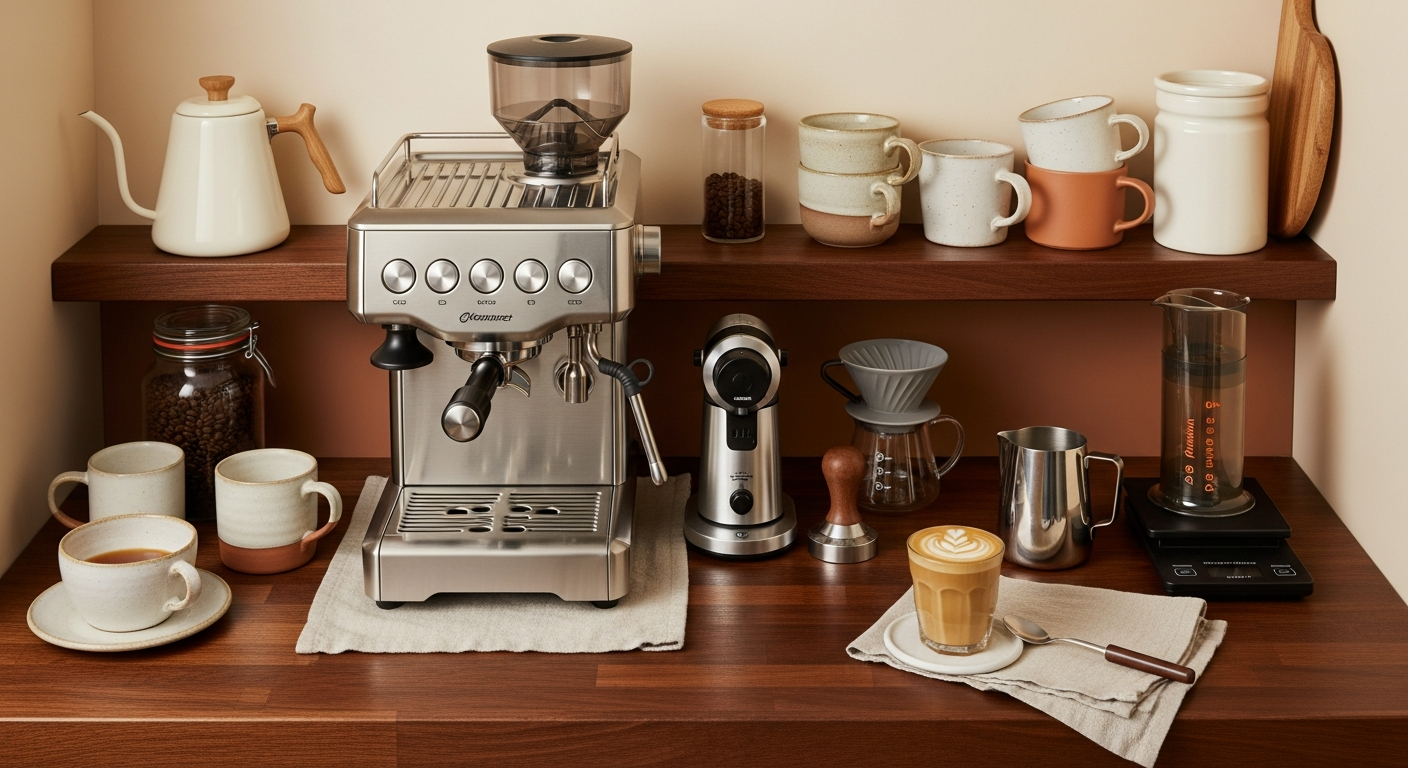
Creating a home barista setup in a small kitchen is an exercise in intentionality. It is about choosing gear that punches above its weight class while occupying the smallest possible footprint. Whether you are living in a studio apartment or simply sharing a crowded kitchen with roommates, the goal is to optimize every square inch for workflow and flavor. In this guide, we will explore how to curate a world-class coffee station that honors your space constraints without sacrificing the texture of your micro-foam or the clarity of your light-roast extractions.
—
1. Defining Your Footprint: The Geometry of a Small Coffee Station
Before purchasing a single chrome-plated accessory, you must perform a “space audit.” In a small kitchen, the most valuable real estate is the depth and width of your primary countertop. Most standard kitchen counters are 24 inches deep, which sounds like plenty until you realize that a standard espresso machine needs room for the portafilter handle to swing and space behind it for water reservoir access.
The “Golden Triangle” of a small-space barista setup involves three components: the machine, the grinder, and the prep area. To maximize efficiency, look for a “linear workflow.” This means arranging your gear so you move in one direction—usually left to right. You start at the grinder, move to the machine for extraction, and finish at the knock-box or steaming station.
If your counters are truly non-existent, think vertically. Use tiered organizers or “floating” shelves designed to hold 10–15 lbs of weight. Another popular 2026 trend is the dedicated coffee cart. A high-quality rolling cart allows you to tuck your entire setup into a pantry or corner when not in use, effectively reclaiming your kitchen for meal prep. When it’s time for your morning ritual, you simply wheel the “micro-café” into position.
2. Choosing the Right Compact Espresso Machine
In the past, “small” usually meant “low quality.” That is no longer the case. The market in 2026 is flooded with slim-profile machines that utilize high-end technology like PID temperature control and 58mm professional group heads.
#
The Ultra-Slim Semi-Automatics
Machines like the Breville Bambino Plus or the newer 2026 iterations of the Gaggia Classic Evo have revolutionized the small-space game. These machines often measure less than 8 inches wide. The key here is the heating system; look for “Thermojet” or “Thermoblock” technology. Unlike traditional heavy brass boilers, these systems heat up in seconds and require very little physical space, allowing the machine to remain narrow.
#
The Manual Revolution
If you want to save the most space possible—and you don’t mind a bit of a workout—manual lever machines are the gold standard for small kitchens. The Flair 58 or the Cafelat Robot have almost no footprint compared to electric machines. They don’t require a power outlet for the extraction itself, and because they lack internal boilers, they are incredibly thin. Plus, they offer a level of pressure profiling that usually costs thousands of dollars in electric counterparts.
#
The Integrated Solution
While “all-in-one” machines (with built-in grinders) were once shunned by purists, recent 2026 models have improved significantly. If you truly have only 12 inches of horizontal space, an integrated machine might be your only choice. Just ensure the grinder is a burr-style system capable of fine adjustments.
3. The Grinder: Why “Single Dosing” is Your Best Friend
In a large café, grinders have massive hoppers filled with pounds of beans. In a small home kitchen, a hopper is just wasted vertical space that prevents your grinder from fitting under your cabinets. This is why “single dosing” is the essential philosophy for the small-space barista.
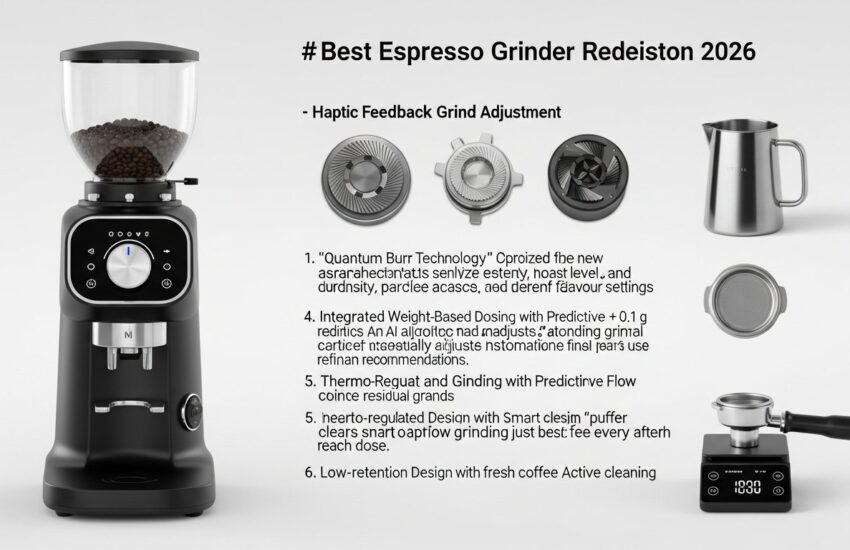
A single-dose grinder is designed to grind only what you need for one shot. These grinders, such as the Niche Zero or the DF64, are significantly shorter than traditional grinders because they lack the plastic “tower” on top.
**Why single dosing works for small kitchens:**
* **Freshness:** You store your beans in airtight canisters (which can live in a drawer) rather than in a bulky hopper.
* **Switching:** You can easily switch between decaf and regular without purging a large chamber.
* **Cleanliness:** Small grinders are easier to wipe down and move if you need to clean the counter beneath them.
If you are a minimalist, don’t overlook high-end hand grinders. Modern manual grinders from brands like 1Zpresso or Commandante can grind for espresso in under 45 seconds with incredible consistency. They can be stored in a drawer, leaving your counter completely clear.
4. Essential Small-Scale Accessories and Workflow Tools
The “clutter” of a coffee station usually comes from the accessories: the tampers, the WDT tools, the scales, and the milk pitchers. In a small kitchen, these items need a home.
#
The Low-Profile Scale
A bulky kitchen scale won’t fit under your portafilter. You need a dedicated “espresso scale” that is thin (less than 15mm) and water-resistant. Many 2026 models are rechargeable via USB-C, eliminating the need for bulky battery compartments.
#
The Knock Box Dilemma
A traditional knock box is a huge space-hog. Consider a “drawer-style” knock box. These are reinforced metal drawers that your grinder or espresso machine can sit directly on top of. By stacking your gear on the knock box, you utilize “dead space” and keep your spent pucks hidden and tidy.
#
Vertical Storage for Portafilters
Wall-mounted magnetic strips or 3D-printed portafilter hangers can move your heavy handles off the counter and onto the backsplash. This not only looks professional but also allows the portafilters to air-dry more effectively.
#
The WDT Tool and Funnel
To prevent coffee grounds from flying all over your small kitchen, a dosing funnel is non-negotiable. It keeps the grounds in the basket during the WDT (Weiss Distribution Technique) process, saving you from a daily routine of vacuuming coffee dust off your counters.
5. Water Management and Maintenance in Tight Quarters
One of the most overlooked challenges of a small kitchen setup is the “water dance.” Most espresso machines have water tanks located at the back. If your machine is tucked under a low-hanging cabinet, you will find it nearly impossible to refill the tank without sliding the heavy machine forward every day.
**2026 Small-Space Solutions:**
* **The Funnel Method:** Keep a long-necked silicone funnel handy. You can often slide it between the cabinet and the machine to pour water into the reservoir without moving the unit.
* **External Reservoirs:** Some hobbyists are now modding their setups to use a side-mounted water bottle or a small external tank that is easier to reach.
* **Water Softening:** Since you likely don’t have room for a plumbed-in filtration system, use a “BWT” or “Brita” pitcher specifically for your coffee water. This prevents scale buildup, which is vital because repairing a machine in a cramped kitchen is a nightmare.
Cleaning is also more critical in small spaces. Steam wand spray and coffee splatter are more noticeable when they hit your nearby toaster or fruit bowl. Keep a microfiber cloth draped over your steam wand at all times; it reminds you to “purge and wipe” immediately, keeping the micro-environment sanitary.
6. Aesthetics: Making the “Coffee Nook” Look Intentional
A small coffee setup can easily look like “clutter” if it isn’t styled correctly. To make your 2026 home barista station a centerpiece rather than an eyesore, stick to a cohesive color palette.
Stainless steel is the classic “pro” look, but in a small, dark kitchen, it can feel cold. Matte black or white machines tend to blend into the cabinetry better. Using a wooden “tamping station” or a bamboo tray can help define the boundaries of your coffee zone, signaling to the eye that this is a dedicated “station” rather than just a pile of appliances.
Lighting also plays a huge role. Adding a small, battery-powered LED strip under the cabinet above your machine can transform the space from a dark corner into a high-end espresso bar. It also helps you see the flow of the espresso as it exits the bottomless portafilter—crucial for diagnosing your shots.
—
FAQ: Mastering the Small Kitchen Barista Life
**Q: Can I really get café-quality espresso from a machine that fits on a 10-inch wide counter?**
**A:** Absolutely. As of 2026, technology has miniaturized significantly. Machines like the Profitec GO or the Lelit Victoria provide full PID control and commercial-grade pressure in a very small frame. The quality of your espresso depends more on your grinder and your technique than the physical size of the machine.
**Q: What is the single best space-saving tip for a new home barista?**
**A:** Go for a single-dose grinder. Getting rid of the bean hopper instantly makes your coffee station look 50% smaller and allows you to fit your grinder under almost any kitchen cabinet.
**Q: Are manual espresso makers (like the Flair) too much work for a daily driver?**
**A:** It depends on your routine. While they require more “hands-on” time, they offer the best flavor-to-size ratio on the market. If you only make 1–2 drinks a day, the ritual is manageable and even enjoyable. If you host large dinner parties, you might find a semi-automatic more practical.
**Q: How do I handle the steam wand if I have low cabinets?**
**A:** Ensure your machine has a “cool touch” steam wand with a 360-degree ball joint. This allows you to angle the wand outward so the steam doesn’t hit the underside of your cabinets, which can cause wood warping or mold over time.
**Q: Should I get a rolling cart or stay on the counter?**
**A:** If you have at least 15 inches of linear counter space, stay on the counter for better stability. However, if your counters are shorter than 12 inches deep, a dedicated heavy-duty rolling cart (like the ones popularized in late 2024 and 2026) is the better ergonomic choice.
—
Conclusion: The Joy of the Micro-Café
Transitioning into a home barista role doesn’t require a commercial-sized kitchen; it requires a shift in perspective. By the time we reached 2026, the “bigger is better” philosophy of the early 2000s had been replaced by a focus on precision, compact engineering, and minimalist aesthetics.
A small kitchen setup forces you to be a better barista. Because you have less room for error and less room for unnecessary gadgets, you focus on the fundamentals: the freshness of your beans, the precision of your grind, and the consistency of your puck preparation. There is a unique satisfaction in pulling a world-class shot of espresso from a setup that occupies less space than a microwave. With the right gear selection and a clever organizational strategy, your small kitchen can become the best coffee shop in the neighborhood.