roasting coffee beans at home
Mastering the Craft: The Ultimate Guide to Roasting Coffee Beans at Home in 2026
For many coffee enthusiasts, the journey begins with a better bean and ends with a perfect pour-over. However, there is a hidden bridge between the raw product and the morning cup that many are only now beginning to cross: home roasting. In 2026, the art of roasting coffee beans at home has evolved from a niche hobby into a mainstream movement for home baristas seeking the ultimate level of freshness and control. When you roast your own beans, you aren’t just making coffee; you are participating in a chemical transformation that unlocks thousands of aromatic compounds. The difference between store-bought “fresh” coffee and beans you roasted 48 hours ago is profound—a clarity of flavor, a vibrant acidity, and a sweetness that simply cannot survive on a supermarket shelf. Whether you are looking to save money, experiment with unique origins, or master the science of heat, this guide will provide everything you need to become a master home roaster.
Why Roasting at Home is a Game Changer for Coffee Lovers
The primary driver behind the home roasting surge in 2026 is the quest for unparalleled freshness. Once coffee is roasted, it begins a rapid process of oxidation and degasification. Even with high-end vacuum sealing, most specialty coffee loses its peak complexity within three to four weeks. By roasting at home, you control the timeline. You can roast in small batches, ensuring that every cup you brew is at its absolute peak of flavor.
Beyond freshness, home roasting offers a level of customization that even the best specialty roasters can’t provide. Do you love a light-roast Ethiopian Yirgacheffe but wish it had just a hint more body? Or perhaps you enjoy a dark-roast Sumatran but want to avoid the charred bitterness often found in commercial “Italian” roasts? When you hold the reins, you decide the exact “drop temperature” and roast duration. You become the architect of your own flavor profile.
Furthermore, there is a significant economic benefit. Green (unroasted) coffee beans are generally 30% to 50% cheaper than their roasted counterparts. They also have a much longer shelf life; while roasted beans stale in weeks, green beans can remain stable for up to a year if stored correctly. This allows home baristas to buy premium, single-origin beans in bulk, exploring the diverse terroirs of the world—from the volcanic soils of Guatemala to the high-altitude farms of Kenya—at a fraction of the retail cost.
Selecting Your Green Coffee Beans: Understanding Terroir and Process
The journey of a great roast begins long before the heat is applied. As a home roaster, your first task is sourcing high-quality green coffee beans. In the modern landscape of 2026, sourcing has become more transparent than ever, with many suppliers providing detailed information about the farm, the altitude, and the processing method.
When selecting beans, consider the **origin**. Coffee is a product of its environment, or *terroir*. Central American beans, like those from Costa Rica or Honduras, are often prized for their balance, notes of chocolate, and bright acidity. African beans, particularly from Ethiopia, are famous for their floral aromas and tea-like qualities. Meanwhile, Indonesian coffees offer earthy, spicy, and heavy-bodied profiles.
You must also pay attention to the **processing method**:
* **Washed (Wet) Process:** This method removes the fruit before drying, resulting in a “clean” cup that highlights the bean’s inherent acidity and floral notes. These are often easier for beginners to roast because they are more uniform.
* **Natural (Dry) Process:** The coffee cherry is dried with the fruit still on the bean. This imparts heavy fruit flavors (like blueberry or strawberry) and a thicker body. However, natural beans can be more challenging to roast as the sugars on the outside of the bean can scorch more easily.
* **Honey Process:** A middle ground where some of the fruit mucilage is left on the bean. This produces a sweet, balanced cup with a creamy mouthfeel.
Understanding these variables allows you to choose a bean that aligns with your preferred flavor profile and your roasting equipment’s capabilities.
Choosing Your Roasting Equipment: From Budget to Prosumer
In 2026, the market for home roasting equipment has exploded, offering options for every budget and skill level. You don’t need a multi-thousand-dollar setup to get started, but choosing the right tool will dictate your level of consistency.
#
The Entry Level: Whirley-Pop or Air Popper
Many legends of the coffee world started with a simple stovetop popcorn popper (the Whirley-Pop) or a repurposed electric air popper. These methods are inexpensive and effective. The air popper uses convection (hot air) to roast the beans quickly and keep them moving, which results in a very even roast. The downside is the lack of control over temperature and the small batch size (usually only enough for 2-3 cups of coffee).
#
The Intermediate Level: Dedicated Air Roasters
Specialized home air roasters, such as the Fresh Roast series, offer more control. These machines allow you to adjust fan speed and heat intensity, which is crucial for “profiling”—the act of changing heat at specific times to highlight certain flavors. They are excellent for beginners because they provide a clear view of the beans as they change color.
#
The Advanced Level: Drum Roasters
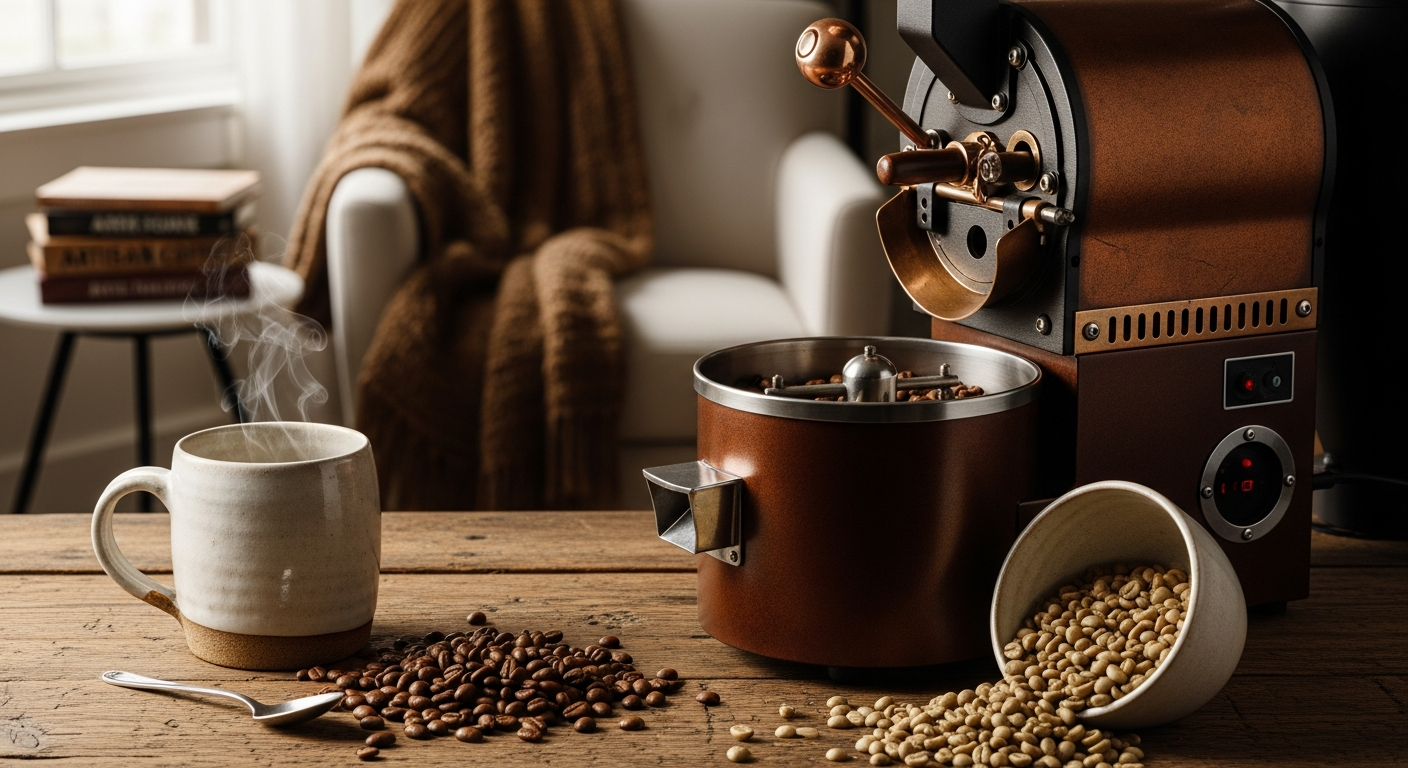
If you are serious about your craft, a drum roaster (like the Behmor or the Aillio Bullet) is the gold standard. These machines mimic commercial roasters by rotating the beans in a drum while applying heat. This method uses a combination of conduction and convection. Drum roasters can typically handle larger batches (up to 1lb) and offer sophisticated software integration so you can track your roast curves on a laptop in real-time.
The Science of the Roast: A Step-by-Step Chronology
Roasting is essentially a controlled application of heat to trigger specific chemical reactions. To roast successfully, you must learn to listen, smell, and watch for the different stages of the roast.
#
1. The Drying Phase
Green beans contain about 10-12% moisture. In the first few minutes of the roast, the beans remain green and then turn a pale yellow. During this phase, the internal temperature is rising, and the water is evaporating. It is vital not to rush this stage, as the beans need to be dried evenly to ensure the core is roasted as well as the surface.
#
2. The Yellowing and Maillard Reaction
As the beans turn from yellow to light brown, the Maillard reaction begins. This is the same chemical reaction that browns steak or toast. Sugars and amino acids react to create hundreds of new flavor and aroma compounds. You will begin to smell toasted grain and baking bread.
#
3. First Crack: The Milestone
This is the most critical moment for any roaster. As the internal pressure of the steam builds up, the bean physically expands and “cracks”—sounding much like popping popcorn. This is “First Crack.” At this point, the coffee is technically drinkable. A light roast (City Roast) is usually pulled shortly after First Crack ends. The flavors will be bright, acidic, and origin-focused.
#
4. Development and Second Crack
If you continue the roast, the beans will darken, and the surface will become smoother. The acidity begins to dissipate, replaced by sweetness and body. If you go far enough, you will hear a “Second Crack”—a faster, snappier sound like Rice Krispies. This indicates the cellular structure of the bean is breaking down and oils are migrating to the surface. This is the realm of Dark Roasts (Full City+ or French Roast).
The Post-Roast Process: Cooling and Degassing
One of the most common mistakes novice roasters make is ignoring what happens *after* the beans leave the heat. Roasting is an exothermic process; once the beans reach a certain temperature, they carry a lot of internal heat. If you don’t cool them quickly, they will continue to “carry-over roast,” potentially turning a perfect medium roast into a burnt dark roast.
Use a dedicated cooling tray or a colander over a vacuum to pull room-temperature air through the beans. You want to bring them to room temperature in under three minutes.
Once cooled, you must resist the urge to brew immediately. During the roast, carbon dioxide (CO2) is trapped inside the bean. If you brew immediately, this gas will escape violently when it hits water, creating “bloom” that prevents proper extraction and leads to a metallic, acidic taste. Most coffees need at least 24 to 48 hours to “degas.” For espresso, many professionals in 2026 recommend waiting 5 to 7 days for the flavors to fully stabilize and the crema to become silky rather than frothy.
Advanced Tips for Roasting Consistency and Success
To move from “hitting the mark occasionally” to “perfecting every batch,” you must become a student of data. Even if you aren’t using high-end software, keeping a roast log is essential. Record the ambient temperature of your room, the weight of the green beans, the time it took to reach First Crack, and the total roast time.
One of the most important metrics to track is the **Rate of Rise (RoR)**. This is the speed at which the bean temperature increases. Ideally, you want a declining RoR—meaning the beans heat up quickly at the start and slow down as they approach the end of the roast. If the RoR “flicks” or increases suddenly at the end, it can lead to “baked” flavors that taste like cardboard or flat bread.
Another tip for 2026 home baristas is to pay attention to airflow. Airflow removes “chaff”—the papery skin of the bean that comes off during roasting. If chaff is left in the roaster, it can smoke and give your coffee a dirty, acrid taste. Ensure your equipment is cleaned thoroughly between every 3-5 roasts to maintain flavor purity.
FAQ: Frequently Asked Questions About Home Roasting
**Q1: Is it cheaper to roast coffee at home?**
Yes, significantly. Green coffee beans generally cost 30-50% less than roasted specialty beans. While there is an upfront cost for equipment, most frequent coffee drinkers find that the machine pays for itself within the first year through savings on bean costs.
**Q2: How much smoke does home roasting produce?**
The amount of smoke depends on the roast level. Light to medium roasts produce very little smoke—mostly just a pleasant, toasted aroma. However, if you prefer dark roasts (Second Crack and beyond), it will produce a significant amount of smoke. It is always recommended to roast under a high-CFM kitchen vent or near an open window.
**Q3: Can I roast coffee in a standard kitchen oven?**
While possible, it is not recommended for those seeking quality. Ovens lack the airflow and agitation needed to roast coffee evenly. You often end up with beans that are burnt on the outside and raw on the inside. A simple air popper is a much better entry-level tool.
**Q4: How long do green coffee beans stay fresh?**
Unlike roasted coffee, which lasts weeks, green coffee beans stay fresh for 6 to 12 months if stored in a cool, dark, and dry place. This makes them ideal for stocking up or buying in bulk.
**Q5: How do I know when the roast is “done”?**
Roast “doneness” is subjective. However, a good rule of thumb for beginners is to wait for the end of First Crack. If the beans look matte brown and have expanded in size, you have a successful medium roast. Use your nose; if it starts to smell like pungent smoke rather than toasted nuts or sugar, it’s time to stop!
Conclusion: Embracing the Roaster’s Journey
Roasting coffee beans at home is perhaps the most rewarding skill a coffee lover can acquire. It transforms a daily caffeine habit into a sensory ritual that connects you directly to the farmers and the land where the coffee was grown. As we move through 2026, the technology available to home baristas has made it easier than ever to achieve professional-grade results in a standard kitchen.
The journey involves a learning curve—you will likely scorch a few batches and pull some roasts too early—but each “mistake” is a lesson in the delicate balance of heat and time. Once you taste a cup of coffee that you have sourced, roasted, ground, and brewed yourself, you will find it difficult to ever go back to store-bought beans. You aren’t just making a beverage; you are mastering a craft. So, grab a bag of green beans, fire up your roaster, and begin your journey into the heart of the bean. The perfect cup is waiting, and this time, you’re the one who defines exactly what “perfect” means.